

Welcome back to The Honest Broker interview series —also available on our YouTube channel. You can also find it on Apple Podcasts and other podcasting platforms.
Today, I’m pleased to share my conversation with Lowry Pressly.
Please support The Honest Broker by taking out a premium subscription (just $6 per month).
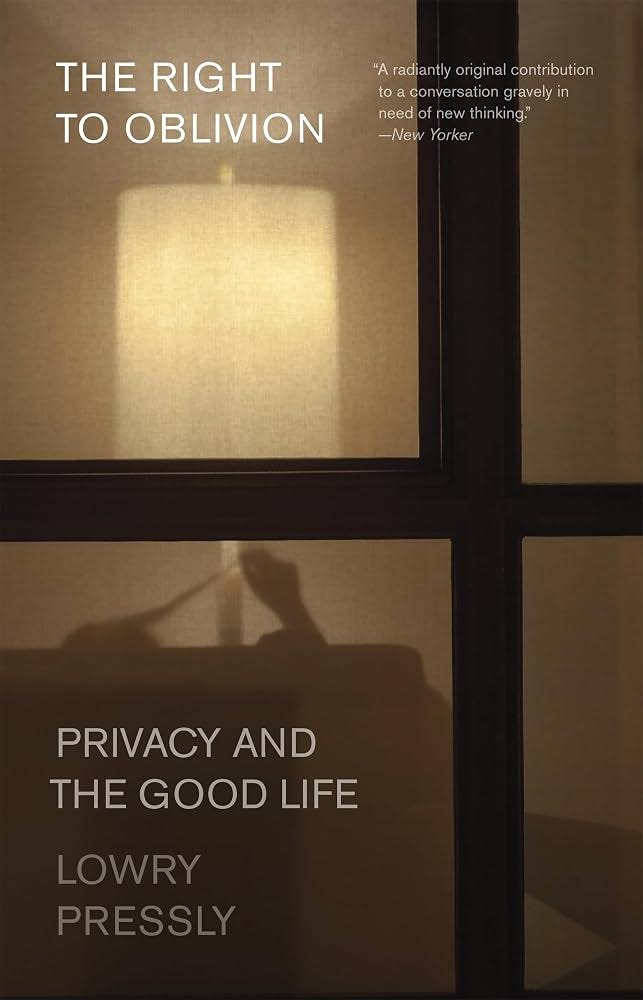
Lowry Pressly is Assistant Professor of Political Science at Stanford University. He holds a PhD from Harvard University and a JD from Yale Law School. He is the author of The Right to Oblivion: Privacy and the Good Life, which was named by The New Yorker as one of the best new books of 2024.
I invited Lowry to join me in Austin, and we sat down to have a conversation about data, surveillance, and the role of privacy in a flourishing human life.
Below are highlights from our conversation. For the full dialogue, check out the video at the top of the page.

A CONVERSATION WITH LOWRY PRESSLY
Jared: When most people think about privacy, it’s purely in terms of apps and websites and tech companies. We even have this nomenclature of privacy settings—how private a person you are is almost measurable by how many of those features you turn on. Is that too narrow an understanding?
Lowry: Without a doubt. The idea of privacy as something important to human beings as such doesn’t emerge in the public consciousness until the middle of the nineteenth century, as a reaction primarily to the photograph camera and the first mass media. The danger today is thinking of privacy through the lens of privacy settings. One, it gives us the wrong idea of what privacy is—deciding the audiences for your information is better described as confidentiality or secrecy. Two, and this is the dangerous one: the camera and the newspaper weren’t part of an economic system whose profit motive was tied to the diminution of privacy.
When we use the technologies of the data economy to think about privacy, we take for granted that what Mark Zuckerberg calls privacy settings track the reality of what privacy is—and not the reality of his business model.
“Not long ago, within my lifetime, it would have been an unbelievable dystopia to portray a world in which video surveillance is more or less everywhere and each person voluntarily carries an individual tracking device.”
Jared: So let’s go back to the camera. Did we invent privacy as a right in response to it, or did it just make salient something we’d ignored?
Lowry: A bit of yes and a bit of no. The word goes back to the 1500s—the privy council, private correspondence. But it isn’t used to describe an interest human beings have just by virtue of being human until the mid-nineteenth century. The big moral panic has to do with cameras: 1888 was George Eastman’s Kodak, which made candid shots possible for the first time. And note the language of candid—it normally means freely expressing oneself, and now we naturally use it for photographs.
One of the first legal cases to try to vindicate a right to privacy was a woman whose picture was taken on stage by a paying member of the audience. The judge said this was a moral violation of privacy—sadly, we have no law to cover it. That’s later taken up in the famous 1890 Warren and Brandeis article. What worried people weren’t illicit exposures but candid ones—taking a moment out of the flux and flow of life as it’s lived and fixing it in a permanent form. There’s a continuum—being looked at, the person taking notes about you, the photograph. The question is, what moves us along it?
Jared: Here’s a case I don’t have strong feelings about. Imagine I’m eating lunch in a park and discover someone at the next bench has been making a charcoal drawing of me. I don’t have as strong an aversion to that. The person sketching is providing an interpretation of your presence rather than just grabbing the moment. Whereas the more factual it becomes—12:01, took a bite; 12:02, picked his nose—the worse it feels.
Lowry: The charcoal drawing says at least as much about the artist as about you. The list isn’t interpretive. And that goes to what really bothered people about the camera. It creates an image that seems to bypass human interpretation—people called it the mirror of nature, nature’s pencil. It makes a claim to objectivity. And there was a belief, which we still have, that a person’s image—particularly the face—expresses what this person is really like. What the camera seemed to do was to speak from your heart for you. The thing that’s harmed, in the Warren and Brandeis article, is inviolate personality—and inviolate doesn’t mean inviolable. It means sacred. This is a line past which people shouldn’t cross.
Jared: Now you should pretty much always assume you’re being recorded. And it goes well past images. There are settings in Google where you can find out what Google thinks all of your interests are. The first time I saw that, a lot of it was so wrong—Google thinks I like snowboarding, and I’ve maybe looked it up once in my life. But I had this sense of disturbance.
Lowry: There’s an error in their dossier.
Jared: But why is there a dossier? My interests change. Who I am changes. But this is a perfect record of everything I’ve ever been briefly interested in. I felt like a line in a bookkeeper’s balance sheet. I feel like I’m being compressed—and compression almost inevitably loses resolution. You know all this about me, but you don’t know me.
Some people would say privacy is an outdated right, that we should embrace the post-privacy world. Are you fighting a losing battle?
Lowry: You do hear people say privacy is dead, but it’s almost always someone who stands to profit from the death of privacy—famously, Mark Zuckerberg. This is a hopeful pitch. I teach a class of first-year Stanford students on privacy, and if any students are going to be post-privacy, it’s these. Invariably, they all value privacy. But the world has changed so radically.
Not long ago, within my lifetime, it would have been an unbelievable dystopia to portray a world in which video surveillance is more or less everywhere and each person voluntarily carries an individual tracking device. Within living memory, people pointed to the GDR—or today, China’s surveillance state—as one of the most dehumanizing violations of human dignity imaginable. We’ve gone so quickly from seeing this as anathema to a free society to just the normal way of doing business. But these kids aren’t as credulous as we were. The problem is structural—you can opt out as an individual, but that leads to a feeling of impotence.
Jared: And even if you opt out, other people keep documenting you. I don’t put my kids’ pictures on the internet, and it’s like a part-time job—a relative posts their picture and says, oh, it’s just for my Facebook friends. No, it’s on the internet now. Delete it. A good historical analogy is East Germany: it was the willingness of people to surveil each other that made the surveillance state possible. So opting out always feels a little futile.
Lowry: This comes from Bentham’s Panopticon, later taken up by Foucault and the GDR authorities: the best way to control people is constant surveillance. That’s impossible. The close second best is having people never be able to be certain that they’re not under surveillance. You will discipline yourself to fit your imagined idea of what the authority wants. One way to do that is an authoritarian state with informants. Another is just to have recording devices—not just video, but metadata—integrated into the fabric of social life.
Jared: There are these new Meta glasses with a red light that’s supposed to show when they’re recording. I saw just this week that for sixty dollars a company will disable the red light but keep the recording on. So you could always be recorded and have no way of knowing.
I bought one of those AI friend pendants as an experiment, to write about why they’re bad. I couldn’t last a day with it. I didn’t realize it always listens. I went to the farmer’s market with my son—we go every weekend, he likes to get a popsicle from one of the stands—and I got this message on my phone: “Oh, popsicle time?” I smashed it with a hammer when I got home. I had invited this presence into my life, and it was observing this intimate moment with my son. I felt almost soiled by the experience.
Lowry: We’ve been talking about being objects of surveillance, but we have just as much to lose when we become the surveillers. Overnight, without realizing it, we all became private detectives.
Jared: We even say stalking as if it’s a joke.
Lowry: In five or ten years it’s gone from one of the creepiest things you can do to a completely normal activity. Here’s an example from having little kids: baby monitors. At first we had the old-style audio monitor. If she woke up crying, we’d go in. Fine. Then we got a video monitor, and I started checking it in idle moments, the way we check our phones. My wife’s cousin had the next step up—an anklet that monitors vitals—and that one you check constantly, and when it falls off, you think maybe your baby’s dying.
Each step that gives me more information about the child, the more information I think I need, and the more anxious I am. One thing we get from privacy, from limits to knowing more, is that those limits are part of the way we produce trust.
Jared: My wife and I don’t share our locations with each other, and I’ve met people who are horrified by this—they think we have something to hide. By enabling the possibility of dishonesty, it gives us an opportunity to be honest with each other. If we were always disclosing our location, there’s no dishonesty—but there’s no honesty either, because there’s no chance to voluntarily reveal.
Lowry: And therefore no trust. Trust isn’t a thing we have or don’t have. It’s something we do. As a kid, you have the experience of being trusted by being able to close your door. That seems very important for the development of a self who thinks of herself as worthy of trust—and therefore as worthy of leading her life in her own way.
In the most forthcoming relationship imaginable—cohabitating spouses, co-parents—there are lots of privacies. The bathroom door, what she’s thinking in a pensive moment, what she’s texting. Imagine seeing those things as secret or hidden instead of private. Trust turns to suspicion, and what had been a sustaining thing falls apart.
Jared: My wife and I never sat down and made these rules, but if I saw a letter from someone I didn’t recognize in the mail, I wouldn’t open it. I might ask about it later, and she’d tell me basically everything in it. And yet I would never ask, can I read it? I see that as a way of showing respect for her.
In a long-term relationship the boundaries between the two persons get blurrier—you start doing life together. But you don’t want to obliterate the distinction and act like I have the right to know everything, because that reduces her as a person. I want to be in a long-term marriage with a fully realized human being, and her privacy is part of her full realization of her life.
Lowry: Say the letter turns out to be totally innocuous, and you’d insisted: show it to me. If I were her, I would feel disrespected, but also invaded. Because you didn’t respect the boundary—that there was a part of my life beyond what you can get at.
Jared: The problem isn’t that it was revealed. It’s that it was hers to reveal. To be human is in part to live together and strive for some kind of unity, but we’re also individuals. Privacy sits at one of those core tensions between social reality and individual reality. And I don’t think all tensions have to be resolved. Sometimes living with them is part of what it means to be human.
Lowry: Tension can be good. Tension is what makes narrative exciting, what makes music move us. We shouldn’t want to get rid of all friction in human life, or we’d end up with a dull, flat, inhuman world.
And the people outside the home get something from privacy too. There’s a door here—I don’t know what’s behind it. I’m surrounded by privacies all day, every day. It’s a human realm of the beyond in my life. That’s a public good that privacy radiates: a sense of depth, of possibility, a sense that the human world will always exceed what is known and quantifiable about it.
Jared: You carried a backpack when you got in my car, and I didn’t even think to ask what’s in it. There could be a weapon in there. There could be a present. There could just be your notes.
Lowry: Great example. Our default about limits to our knowledge is not a set feature of human biology—it’s a cultural product. Our default in the backpack case is privacy. It doesn’t call attention to itself. But it’s not hard to imagine a society in which we treat concealment as hiding: your eyes go to my backpack, and suddenly your mind is thinking, what’s in there? That’s a very different way of going through the world.
Jared: It’s a much more paranoid world. It’s a small act of trust, and we get to do these little acts of trust.
Lowry: And these small acts are productive. I have the experience of being trusted—it habituates me to a sense that I’m trustworthy, I belong in this society. Privacy—understood as privacy, not hiding—is a linchpin of that trust.
Jared: Explain the title of your book: The Right to Oblivion: Privacy and the Good Life. What is this right to oblivion?
Lowry: I wanted a word for the kind of unknowing that privacy produces. Compare secrecy: the thing behind secrecy is secrets, and a secret is a piece of information. It can be shared—I come to know the information you were keeping. That, not coincidentally, is how we think of privacy in the age of privacy settings. By oblivion I mean a kind of unknowing that is fundamentally opposed to the existence of information—a limit that describes what is knowable, not just what’s known. A secret has to be information to exist. Oblivion cannot be.
And privacy isn’t the only thing that produces this kind of unknowing. The two well-known kinds have both been described historically in terms of oblivion: death and forgetting. Something that’s actually forgotten is beyond your power to recall. The oblivion of death is a barrier beyond which knowledge and perception can’t pass. Because there’s a barrier, we know that there’s a beyond—but we can’t say anything about that realm.
The corresponding kind of unknowing is obliviousness. We use it pejoratively, but think of the backpack—you’re oblivious to what’s in there. We don’t want people staring at our drapes, wondering what’s going on inside. We want them to walk by in blithe ignorance. That’s what we want from privacy: for people to be oblivious to our lives.
One last thing. Oblivion comes from the Latin for forgetting—ob, toward or against, and livio, which the philologists aren’t completely sure about, but the general consensus is it means something smooth. Against or toward a smoothness. I like that because oblivion is an absence of knowledge, a kind of void—but a void we can integrate into our daily lives in myriad unnoticeable ways. And by doing so, we add depth and a sense of potentiality to the human person, and to the social, material world that we build.
Jared: I was thinking about my own children as they get older. The phrase I wanted to use was, they’re going to start hiding things from me. But before they hide things because they’re ashamed, there are just going to be times where they start doing things in private. My impulse as a parent is to not let them do that. And I’m now thinking about what it would be like to rob my kids of their privacy. My son’s two and a half, and already he wants to do things for himself—and it’s a very small step from wanting to do things for yourself to wanting to do things in private.
Lowry: I feel the same anxiety. And that anxiety isn’t a steady-state constant of human psychology—ironically, it’s directly correlated with how empowered we are to know more about them. These magical little rectangles are like cursed gifts from a fairy tale. They give us unbelievable powers, and yet they end up limiting us. In the same way that it would be damaging to a child to never have any sense of privacy—infantilizing — it’s infantilizing of adults to be surveilled that way. It’s a moral insult to treat an adult as if they were a child.
Jared: That’s a great place for us to end. But before we go, we always ask for a book recommendation—something nobody’s reading, but you think everybody should.
Lowry: Other than mine, obviously: Parallel Lives by Phyllis Rose. This is the most dark-horse book I’ve ever read. The cover is schmaltzy, and it says it’s the story of five Victorian marriages—Carlyle, Mill, Dickens. And her analysis of how these couples led parallel lives, entwined, but living different versions of the same marriage, is one of the most beautifully written, insightful, and profound books on what it means to be a human being with others that I’ve ever read. I think it’s a masterpiece, and it deserves to be much more widely read.
Jared: Well, that sounds great. Lowry Pressly, thanks for joining us.
Lowry: Thank you so much for having me, Jared. It’s been fun.


