

Welcome back to The Honest Broker interview series—also available on our new YouTube channel. You can also find it on Apple Podcasts and other podcasting platforms.
Today, I’m pleased to share my conversation with Naomi Kanakia.
Please support The Honest Broker by taking out a premium subscription (just $6 per month).
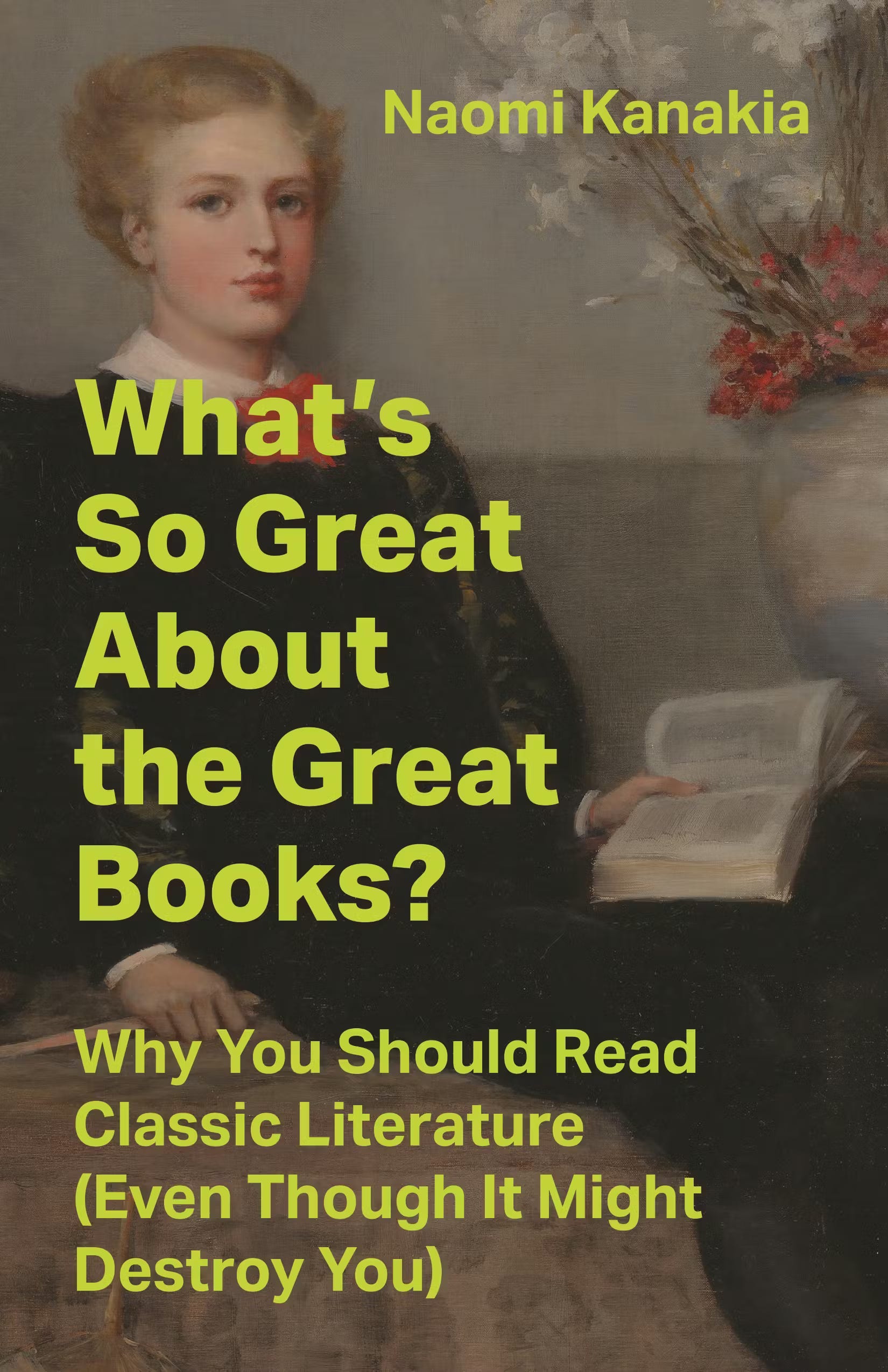
Naomi is a writer. She’s published four novels, and her next book, What’s So Great About the Great Books?, will be released in May by Princeton University Press. She also writes the wonderful Woman of Letters newsletter here on Substack, and she is working on a short story collection to be published by Random House.
I had the pleasure of reading What’s So Great About the Great Books? last year, and here’s what I wrote for the blurb:
If you've ever wanted to read the Great Books, or ever wondered why you should, this is the book for you. Personal, humorous, and intimate, What’s So Great About the Great Books? gives us a great gift: a grounded guide to the classics, and a new standard for introducing these books to modern readers.
In our conversation, we covered a range of topics, including why she wanted to write about the Great Books, why she decided to read them in the first place, and her struggles (and occasional triumphs) in the publishing industry.
Below are some highlights from our dialogue. For the full conversation, check out the video at the top of the page.
Highlights from the Naomi Kanakia Interview
Jared: Naomi Kanakia, thank you for joining me.
Naomi: Thanks for having me.
Jared: You’re writing a book about the classics, which will be published by Princeton University Press. Tell me a little bit about what made you want to dedicate a year or two of your life to writing a book about the classics?
Naomi: When I first started wanting to seriously be a writer, I decided that I should read all these great books that people always talk about. I bought a book called The New Lifetime Reading Program, I typed out the list of books recommended by this volume, and I have now spent 15 years reading through many of these books.
Then, four or five years ago, I started writing some essays online, and an editor from Princeton reached out to me and asked if I wanted to do a book. At the time, I was between agents and my career prospects seemed pretty dire, and I wanted to work.
I really love books about reading classics. I really like the angry polemical books, like Alan Bloom’s Closing of the American Mind, but I do feel that there’s a lot of angry polemic in this space. I felt there was room for more measured opinions, because I do think there are serious critiques to be made of the concept of reading old books. I wanted to write a book that took those concerns seriously and also had a more conversational tone.
Jared: What are some of those critiques that you have in mind that you want to respond to?
Naomi: A lot of books about reading classics are defenses of the humanities, or the idea that you should think deeply and love nuance. And it’s like, nobody’s against those things. The real question is: why do you have to read Milton instead of reading a modern author? Are we really saying that these old books are the best books and no modern books are good?
Really, it’s a defense of a specific canon of books, and I believe that list is good and that people should read those books. Generally, it’s easier to gravitate towards the contemporary, and you have to try a little bit harder to look at these older books.
But there are two major concerns. One is that older books are more difficult and more inaccessible. The other major concern is that if you’re reading older books, there will be less diversity.
Jared: And despite those criticisms, you’re making an argument that it’s worth reading these old books.
Naomi: Yes.
Jared: I assume for part of that project, you had to go back and reread a lot of books. Was that part of the research, or was it just drawing on what you’ve been doing for the last fifteen years?
Naomi: This was mostly an excuse to mentally return to a lot of my touchstones. These older books have a sense of integrity. This project was just an opportunity for me to go back to some of my favorite books and look at the ways that’s true. And I haven’t read every Great Book, but I believe in the wisdom that created this list.
Jared: One of the striking things about reading books that make it onto the canon or the list of classic books is that oftentimes they’re really weird. Moby-Dick is famous for being dry and boring if you try to read it in high school, but I don’t see how anyone gets that impression, though, because Moby-Dick is just a really odd book.
Naomi: Almost always when I open these books, I see how strange they are. At one point, I went back and was like, ‘How did contemporaries view Moby-Dick?’ Because Melville had written travel narratives, a lot of readers came to Moby-Dick to learn about whales and the whaling industry. They wondered why it was wedded to this weird, Shakespearean plot.
Jared: Did any books on your list disappoint you?
Naomi: Moby-Dick, the first time I read it. I found myself bored. I reread it earlier this year and had a lot more appreciation for it. I would say Don Quixote is tough.
Jared: Something I find so interesting about your writing is that you write about the classics, but you’re very keyed into the weird parts of online writing: things like Kindle Direct romances or even fanfic. There’s a type of person who styles themselves as readers of the classics, and another type of person who styles themselves as lovers of fanfic. You seem to be comfortable in both worlds. Or are you always a little uncomfortable?
Naomi: As a kid, I only read science fiction and fantasy books, and I wanted to be a writer of science fiction and fantasy. Science fiction and fantasy is a world in itself, and it has its own critical apparatus. Reading the classics was a way to see what else is out there. And it is odd, because the classics exist because they are, you know, ‘above’ popular culture. You have to say that reading Moby-Dick is a better use of your time than reading a self-published orc romance.
Jared: Do you think there are going to be orc romances on the list of classics?
Naomi: That sort of writing reminds me of the early days of science fiction. You had these sci-fi fanzines by people who just felt compelled to explain why this stuff was so good and better than contemporary published writing. Those zines preserved the early classics of the genre because pulp magazines were disposable. Without that effort, we wouldn’t have science fiction today.
Jared: You’re weird, right? I mean this as a compliment. You write self-published fiction, and it gets critical attention in The New Yorker. Did that happen with your previous books?
Naomi: No. I’m the author of three young adult novels and a novel for adults. None of these were discussed in The New Yorker. But last October, I published a novella on Substack, and Peter C. Baker, who writes for The New Yorker, really liked it, and he pitched a story.
Jared: You have a very distinctive style. Tell me about that.
Naomi: I call it the ‘tale,’ A few years ago, I got really into Icelandic sagas. I was really struck by how they’re recognizably novel-like, but they don’t have any of the conventions of fiction. They don’t have a lot of description. They don’t have a close point of view. Reading those, along with ancient Greek fiction, inspired me. The style is very stripped down, has a strong point of view, goes in and out of different heads. It has very little description of setting, scenery. I have very strong opinions about the stories, too, so I’ll interject my opinions about what’s going on. And so I started self-publishing those on Substack.
Jared: You write these tales on Substack now. They’re really stripped down. You tell a lot of story with very few words. And one of the reasons you’re able to do that is because you’re not giving into these long descriptions, these sensory details. And you’re definitely okay with telling rather than showing. But that’s not how you used to write. I was looking at some of your older books, especially The Default World. The opening scene is the main character going to a coffee shop. We’re deep in her head. She is trying to suss something out about another character, but you’re seeing visual descriptions of them. You give us some backstory, but it’s all very, really strictly in her point of view as well. Did you feel comfortable writing that style, or do you feel like you were trying to do something because it was the expectation?
Naomi: When you start off writing fiction, you are really imitating the models that you know and trying to produce things that look like recognizable stories. When I started writing The Default World—which was my serious, important novel to be taken seriously—I wrote it in a more distant, omniscient perspective. But as I tried to interest agents, they felt too distanced from the narrative. So I rewrote it to be more immediate and embodied. I didn’t like it, and it did not feel natural.
Over the last 200 years, we’ve built up a set of conventions that are designed to put you right in the action and make you feel like you’re living out the dream of the story. I do feel like we might have hit the end of that style. I definitely think it is a tradition that has produced a lot of good work, but it doesn’t feel like the life is there anymore.
Writing these tales was a way for me to feel like I was getting back to why I had started wanting to write, which is just to tell a story.
Jared: Okay, this is an interesting tension then, because you are not opposed to writing to market. You’ve tried to write to market, but you did better when you stopped writing to market. People actually wanted to read it. I think that’s a good lesson for people. When I read The Default World, I thought that you felt very self-conscious. You were less confident than the Naomi Kanakia I’ve read online.
Naomi: When I started writing these tales, it was like a bow shot from an arrow. It hit the target. I really prioritize preserving that feeling of inspiration.
Jared: Tell me about anyone else you find exciting on Substack.
Naomi: Alexander Sorondo. He’s great.
Jared: I sent him a text last night and just said, ‘Every time I bring a writer into town from Substack, they bring you up.’
Naomi: He writes two sorts of things. He writes these long, deeply reported, maximalist literary criticism pieces on people like William Volmann. And then he writes these short, punchy lyric essays that are just kind of unlike what anybody else is writing. I love him. I love Henry Begler, who is another literary critic on Substack. I’ve actually learned a lot from Henry. I copy Henry. I steal from what he does.
Jared: We always end these episodes by asking for book recommendations. Do you have something for us?
Naomi: I really think people should read Uncle Tom’s Cabin. It’s hard to overstate. It’s about this guy, Tom, who is in slavery in Kentucky in a border state. He’s treated relatively well by his family and has his own house and has a wife and a family. But then they fall on hard times, and so they have to sell him off to a creditor. And then he goes through deepening circles of hell as he is sold further and further south to different owners.
It’s just like an incredibly powerful book. This was written at a time when slavery was legal, and there were many people who defended slavery and thought that it was a moral system in various ways. And it was written to show that there is no goodness under slavery.
Jared: Naomi Kanakia, thank you for joining us.
Naomi: Thank you.


