
The Real Story Behind 'Zen and the Art of Motorcycle Maintenance'
How this book was written is as strange as the novel itself


This is the latest installment in my ongoing survey of the 20th century counterculture. I will probably publish all of these in a book some day. In the meantime, you can check out my previous essays here at The Honest Broker:
Please support my work—by taking out a premium subscription (just $6 per month).
The Real Story Behind ‘Zen and the Art of Motorcycle Maintenance’
By Ted Gioia
A Korean War veteran is floundering. His career is an endless bumpy road, and includes work as a teacher, a technical writer for Honeywell, and even a Nevada casino employee. But our ambitious vet also studies philosophy at the Banaras Hindu University in India—and starts to develop his own philosophy of life, an unconventional merging of Eastern and Western currents.
Then comes a mental breakdown that sends him to a psychiatric hospital. Here he undergoes repeated electroshock therapy. He finally emerges a changed person.
But maybe he changed too much—he can hardly remember the person he once was. It’s almost as if his life got cleaved in two at this juncture. His wife leaves him. He holds on to his relationship with his son—but that ends tragically with the son’s murder in San Francisco at age 22.
While working for Honeywell, our aspiring philosopher stays awake from 2 AM to 6 AM in a small apartment above a shoe store in Minneapolis. Here he writes a novel destined to become one of the defining books of the era. But he has to pitch it to 121 editors before he gets a contract and a $3,000 advance.

-2007.jpg)
The editor, J.D. Landis, admitted that he only accepted the novel because this “book forced him to decide what he was in publishing for.” But the author, he insisted, shouldn’t expect to make more than his tiny advance. Then Landis added: “Money isn’t the point with a book like this.”
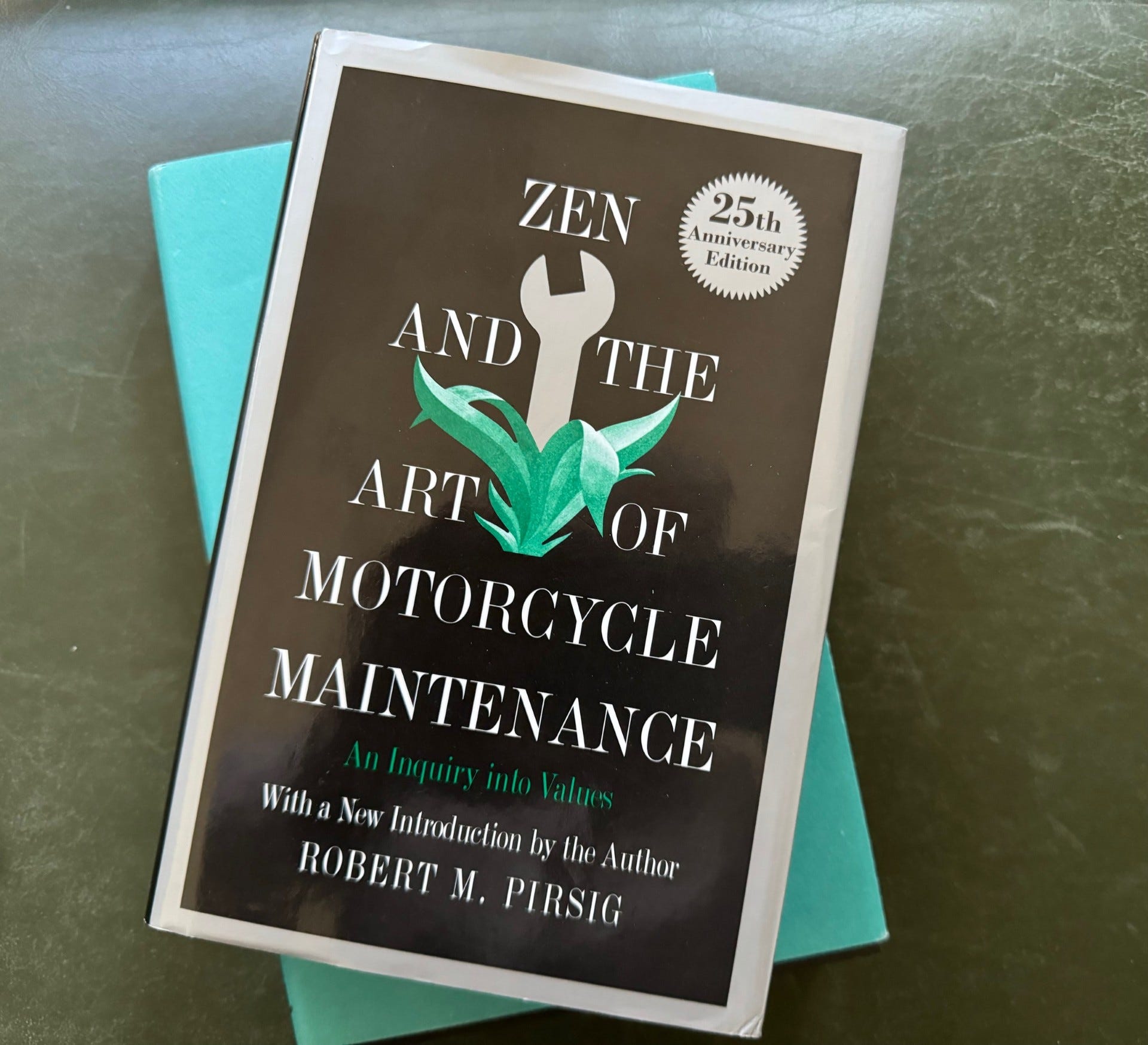
That’s the story of how Robert Pirsig published of Zen and the Art of Motorcycle Maintenance. But the editor was wrong. The book sold 5 million copies, and for a spell in the 1970s you would see copies everywhere, even in the hands of people who didn’t read novels.
And that was just the start. Robert Redford tried to buy movie rights, but the author said no. Highbrow literary critic George Steiner compared Pirsig to Dostoevsky—which is especially meaningful when you know that Steiner wrote a book on Dostoevsky. The Smithsonian acquired the titular motorcycle for its permanent collection.
The book is simple enough to describe. It tells the story of a 17-day motorcycle trip from Minnesota to California. Along the way, the narrator tries to figure out many things—but especially his own past before his life split in two.
At one point in the novel, Pirsig writes:
“Before the electrodes were attached to his head he’d lost everything tangible: money, property, children; even his rights as a citizen had been taken away from him by order of the court….I will never know all that was in his head at that time, nor will anyone else. What’s left now is just fragments: debris, scattered notes, which can be pieced together but which leave huge areas unexplained.”
The electroshock treatment was done without Pirsig’s consent. That would be illegal nowadays.
In the aftermath, Pirsig felt so disconnected from his past that he included his pre-treatment self as a separate character in the novel. He calls that abandoned part of himself Phaedrus, a name drawn from Plato’s dialogues.
So you can read Zen and the Art of Motorcycle Maintenance as a dialogue between a man and his past self. Or you can treat it as a travel story or as a philosophical discussion (what Pirsig describes as a chautauqua, a name drawn from a populist adult education movement of the late 1800s). And, yes, it’s also a guide to motorcycle maintenance.
The text actually moves back and forth between all of these. Few novels pay less attention to the rules of fiction than Zen and the Art of Motorcycle Maintenance. For that reason, it just might be the strangest travel book ever written—because most of the journey happens inside the narrator’s head.
But maybe that’s part of the story too. Pirsig worked as a college writing teacher, and was frustrated by the rules he was expected to impart to his students. He felt that good writing was indefinable. It violated accepted rules, and created its own. The whole process was mysterious.
Solving that mystery of Quality—also called goodness, excellence, or worth—is the main theme of the novel. Indeed, it’s the overarching theme of Pirsig’s entire life’s work. He wrote one more novel after Zen and the Art of Motorcycle Maintenance, the seldom read Lila, and it continues the discussion on quality. And the same topic takes center stage in the posthumous collection of writings published under the title On Quality: An Inquiry into Excellence.
At first glance, this inquiry feels like it’s full of holes. Pirsig has stumbled upon the Naturalistic Fallacy, and thinks he has discovered it anew. He might benefit from learning what G.E. Moore wrote about the subject back in 1903. Or Frankena’s response to Moore from 1939 or Moore’s 1942 rebuttal. But Pirsig is clearly unaware of this ongoing debate.
In general, his philosophical education is spotty. He knows some Hegel and more Kant, but he would probably have found more sympathetic voices in Heidegger, Bergson, and Nietzsche. But in the great spirit of American homespun thinking, he isn’t going to let those gaps limit his ambitions.
This ambition reached its highest intensity when Pirsig showed up at the University of Chicago, and developed a fierce antagonism against Aristotle in general, and the famous Aristotelian Richard McKeon—founder of Chicago’s esteemed Committee on the Analysis of Ideas and Study of Methods—in particular.
Pirsig was a little out of his depth here, but this is the most engaging part of the Zen and the Art of Motorcycle Maintenance for me. He arrives at the epicenter of Great Books education, but “he had no time or interest in other people’s Great Books,” Pirsig writes. “He was there solely to write a Great Book of his own.”
I daresay that Aristotle survived his attacks, as did McKeon (who also counts Susan Sontag, Richard Rorty, and Paul Goodman among his students). But Pirsig did get a famous book of his own out of this encounter—although no degree from U of C. That’s hardly a negligible achievement. And it adds more evidence to support my view that dropouts are often more successful than the people who earn degrees.
But let’s be honest: Pirsig was a better mystic than philosopher, and the deeper Pirsig digs into his personal notion of Quality, the more interesting—and metaphysical—his thinking becomes. Quality, he insists, can never be defined. He eventually embraces it as a kind of Tao, a force underlying all our experiences—hence resisting empirical analysis. He is now leaving philosophy behind, and perhaps for the better.
So he eventually aligns himself with a profound idea drawn from the ancient Greeks—but not the philosophers. Instead he goes back to the Homeric mythos, five hundred years older than rational philosophy, and discoveres the source of his Quality in the Greek concept of aretḗ, or excellence (sometimes translated as virtue). Aretḗ, Pirsig believes, is more powerful than Aristotelian logic, and closer in spirit to the Hindu dharma.
He quotes a passage from classicist H.D.F. Kitto, which I want to share in its entirety—not only because it is essential to Pirsig’s worldview, but because it’s invaluable to us today. Many are struggling to understand a place for humans in a world of AI and super-smart machines. From a purely rational perspective, the robots can beat us in terms of data generation and analysis. But in a world of aretḗ (or Quality), they fall far short.
This is where Pirsig earns my admiration and loyalty. Some things really are more powerful than logic.
Back in 1952 Kitto anticipated Zen and the Art of Motorcycle Maintenance—and provided the missing piece to Pirsig’s worldview—when he wrote:
[If aretḗ refers to a person] it will connote excellence in the ways in which a man can be excellent—morally, intellectually, physically, practically. Thus the hero of the Odyssey is a great fighter, a wily schemer, a ready speaker, a man of stout heart and broad wisdom who knows that he must endure without too much complaining what the gods send; and he can both build and sail a boat, drive a furrow as straight as anyone, beat a young braggart at throwing the discus, challenge the Phaeacian youth at boxing, wrestling or running; flay, skin, cut up and cook an ox, and be moved to tears by a song. He is in fact an excellent all-rounder; he has surpassing arête.
Aretḗ implies a respect for the wholeness or oneness of life, and a consequent dislike of specialization. It implies a contempt for efficiency...or rather a much higher idea of efficiency, an efficiency which exists not in one department of life but in life itself.
We are now at the heart of Zen and the Art of Motorcycle Maintenance. If you read Kitto, you are already prepared for Pirsig—maybe you can even skip the novel. But, much better, you have a game plan for living a human life in the face of encroaching machines.
Pirsig understood this more than fifty years ago. He saw that we made a Faustian bargain when we put rationality ahead of the Good, and data ahead of human excellence. He grasped that science should be subservient to human needs, not the other way around. And the price we’re paying now is much higher than it was back then.
In an extraordinary passage, the narrator of Pirsig’s novel picks up a copy the Tao Te Ching, and recites it aloud—but substituting the word Quality for Tao. This is strange and unprecedented, but hits at the heart of this mystic work from the fourth century BC:
The quality that can be defined is not the Absolute Quality….
The names that can be given it are not Absolute names.
It is the origin of heaven and earth.
When named it is the mother of all things….
He declares: “Quality is the Buddha. Quality is scientific reality. Quality is the goal of Art.”
I worked with many quality control engineers in the business world and often walked with them on the factory floor. I’m sure they would be shocked by Pirsig’s statement that “Quality is the Buddha.” But that’s exactly the kind of journey we’re on in this book.
Pirsig, in defense of this unexpected proclamation, tells us that the words god and good have a shared etymology in English—and that’s why, he believes, Quality is a concept that can unify science, art, and religion.
Now this is something different from Philosophy 101. We’ve reached a level where G.E. Moore and other Anglo-American philosophers can no longer follow us, or even Aristotle and his progeny. And, after all, what did those ivory tower thinkers know about motorcycle maintenance?
Even fifty years after its publication, this is still a unique novel. And at its core there’s a powerful idea—more inspiring than logic because it draws on the defining mythos of our culture, and maybe all cultures. That’s more than enough to keep drawing readers to Zen and the Art of Motorcycle Maintenance so many years after its debut.
But for my money, the story behind this book is just as interesting as the novel itself. Pirsig is a kind of Gatsby-like character of the spiritual realm, and inspires me just through his ambition and persistence—and especially his dogged pursuit of Quality (or aretḗ or dharma or the Tao) in his own life. They should make that tale into a movie.
The detail that stays with me is the shoe store apartment and the 2-to-6 AM writing hours while holding a day job at Honeywell. That’s the part of the story that never gets romanticised — the book didn’t come from retreat or freedom, it came from the hours stolen from sleep by someone who had no reason to believe anyone would ever read it. 121 rejections and he kept going. There’s something in that stubbornness that connects to the book’s own argument about Quality — you can’t define it, you can’t prove it exists, but you know when you’re in the presence of it, and that knowing is enough to keep you at the desk at 2 AM.
damn Ted. I read this before I went to college. I loved it. But if I’d really understood it, I wouldn’t have gone to college - or better, i would have gone and then left before graduating. I may have to read Pirsig again. thanks so much for this…