
A Reading List for the End of Civilization
I'm making this previously paywalled article available to everyone

I’m releasing this essay from behind the paywall. So enjoy—and if you value analysis of this sort, consider becoming a premium subscriber.
By the way, all of my non-paywalled are available for cross-posting on Substack. You don’t even need to ask my permission. Just click on “Cross Post” under the Share button or the three dots at the top of the article (although to find these you may need to go my home page on a desktop, and click on the desired article). You can get more info on cross-posting at this link.
(For licensing and republishing outside of a Substack crosspost, you do need to get my okay.)
Please support my work by taking out a premium subscription—for just $6 per month (even less if you sign up for a year).
A READING LIST FOR THE END OF CIVILIZATION
By Ted Gioia
Not long ago, I got touted in The Atlantic as the ultimate source on the death of civilization. I responded with denials, and even offered to take a polygraph test.
I’m innocent. I’m just a patsy. They’re trying to pin this on me—don’t believe them.
Then I pulled out the ultimate alibi: The death scene was a set-up. Civilization isn’t dying—it’s coming back. Just give it time. (I spelled out the reasons in this article.)
Ah, but I still had some things to explain. That’s because The Atlantic published evidence of my complicity—all because of 41 mysterious books.
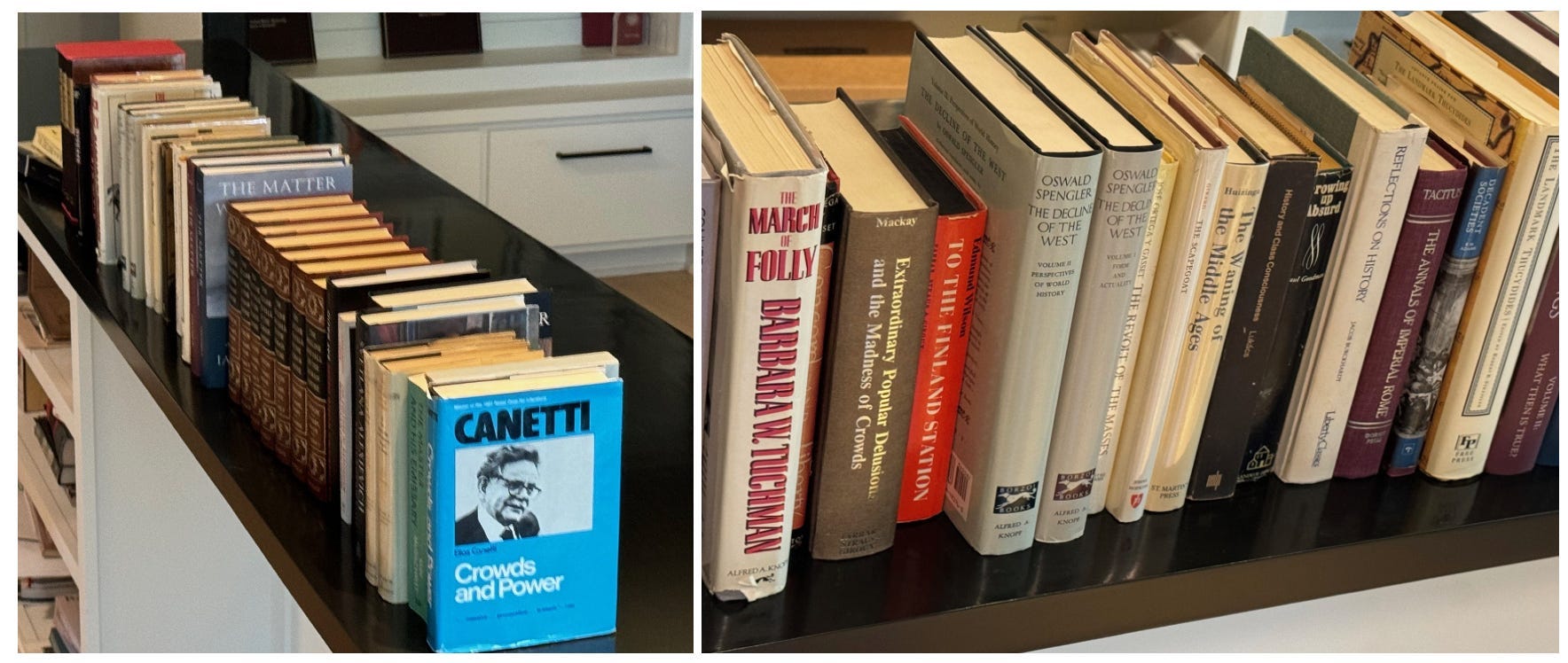
Here’s what they pinned on me:
Last year, I visited the music historian Ted Gioia to talk about the death of civilization.
He welcomed me into his suburban-Texas home and showed me to a sunlit library. At the center of the room, arranged neatly on a countertop, stood 41 books. These, he said, were the books I needed to read.
The display included all seven volumes of Edward Gibbon’s 18th-century opus, The Decline and Fall of the Roman Empire ; both volumes of Oswald Spengler’s World War I–era tract, The Decline of the West ; and a 2,500-year-old account of the Peloponnesian War by Thucydides, who “was the first historian to look at his own culture, Greece, and say, I’m going to tell you the story of how stupid we were,” Gioia explained.
Gioia’s contributions to this lineage of doomsaying have made him into something of an internet celebrity….
In the aftermath, everybody was asking about those 41 books. Did I really have a reading list for the end of civilization?
With some reluctance, I agreed to share it. I’m doing that today. But don’t hold it against me. Books are just circumstantial evidence. I didn’t actually kill civilization—I just read about it. I never left my comfy chair.
It’s true that I earned a living, some years back, as a kind of futurist. This is a valuable skill in turbulent times. I probably handled this vocation with a more holistic approach than others. That meant that I took old books and primary sources very seriously, and used them to interpret current day statistical, anecdotal, and theoretical information.
In my world, game theory and data analysis co-exist with history, philosophy, and literature—some of it two thousand years old. If you can bring those together, you may gain insights that others might miss.
That’s what I try to do here at The Honest Broker.
With that proviso, I’ll recommend the following books on societal collapse. It’s not the full 41 volumes mentioned above—but below I will discuss 22 of those titles.
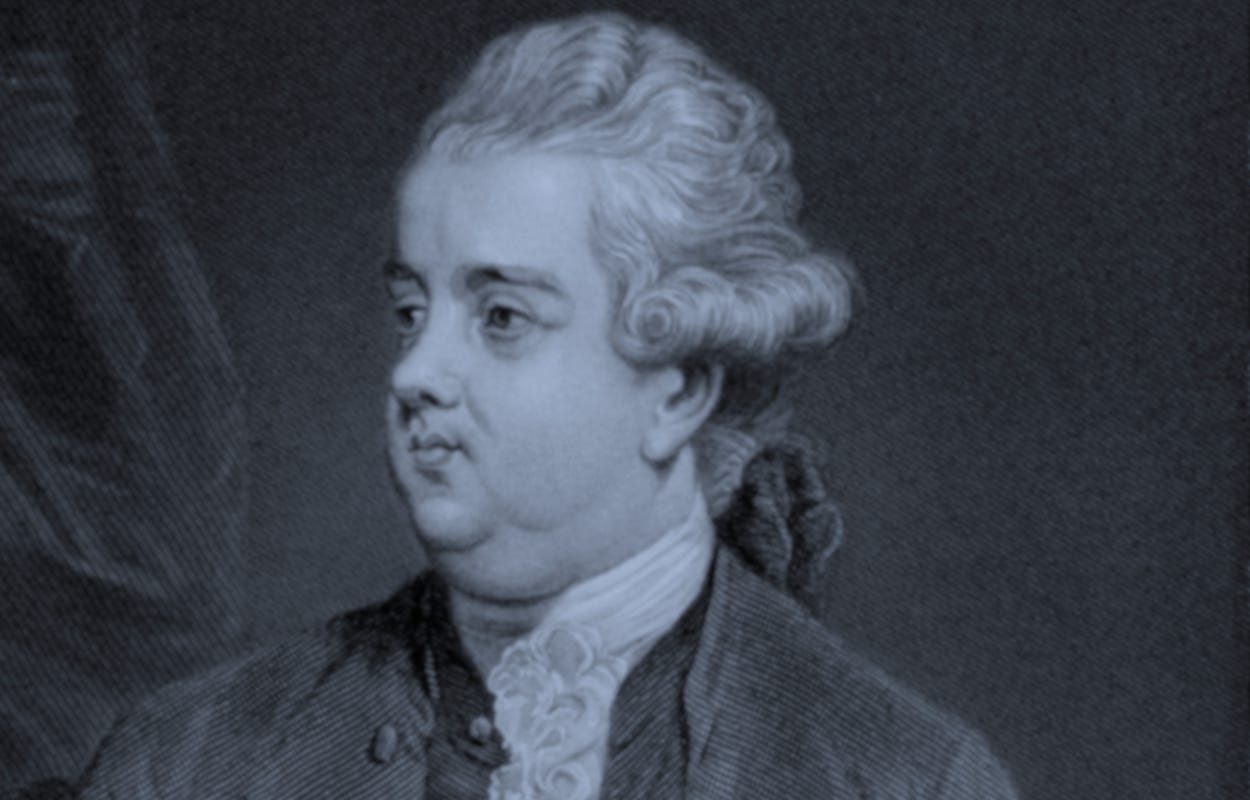
Edward Gibbon: The History of the Decline and Fall of the Roman Empire
I’ve spent a lot of time with Edward Gibbon—this massive work fills up seven volumes in my Bury edition. I won’t try to summarize a work that covers 1,500 years and took almost two decades to write. Instead I’ll cut to the chase.
Gibbon is one of the greatest writers in my native tongue. I rank him among the top five prose stylists in the history of the English language. He’s worth reading if only to admire the beauty of his sentences.
But I have less patience for Gibbon as a thinker. He was a true child of the Enlightenment, and approached everything with an extreme rationalist bias that has aged poorly. He doesn’t seem to grasp human fallibility and moral cowardice—key factors in Roman decline. Instead he so desperately believes in the glories of progress that he accepts the worst abuses of power—abhorring what he should praise, and praising what he should abhor.
That’s happening nowadays too in progress studies (as they call it), in case you haven’t noticed.
In How Rome Fell, one of the best recent works on the same subject, historian Adrian Goldsworthy insists that the lessons of the Empire’s decline have “more to do with human nature than specific policies.” But Gibbon—who was also a professional soldier for another Empire—has a hard time grasping this, or drawing out the requisite conclusions.
It’s especially ironic that Gibbon’s great work was published in 1776—shortly before the signing of the Declaration of Independence. Gibbon as a member of parliament had recently voted to send more troops to America to suppress the freedom fighters.
You can’t rely on a person of this sort to critique tyranny. But Gibbon pushes his respect for authoritarianism to extremes. In a book on the decline of Rome, he doesn’t even include the collapse of the Roman republic. He starts his history after that event.
For him, Caligula and Nero (and dictatorship in general) are part of the glory years.
Simone Weil, building on this same insight, would tell you that the Romans became enslaved to their emperor because they had already accepted the legitimacy of slavery. They became subject to violence and domination because they had built their own empire on these values.
What goes around comes around.
Gibbon can’t grasp that. Maybe I shouldn’t expect repudiations of slavery, colonization, and wars of conquest from someone living in an age when these were taken for granted. But there’ a lesson there: If you’re seeking critiques of imperialism, you might not trust the opinions of an imperialist.
But Gibbon is provocative, influential, erudite, and as eloquent as they come. If you disagree with him (as I do) you still need to wrestle with him. So enjoy Gibbon for all the right reasons, especially literary ones, but if you want to understand the fall of Rome, you would do better reading five other sources I’ve selected below.
Let’s start with modern commentators.
Adrian Goldsworthy: How Rome Fell
Bryan Ward-Perkins: The Fall of Rome
Adrian Goldsworthy is your single best starting point on this subject. He sifts through the evidence fairly, and with a moral compass—which is necessary when studying the fault lines in ancient Rome. But Ward-Perkins also offers essential insights, drawing from recent archeological evidence that Gibbon didn’t know about.
Now let’s move on to the primary sources. These three books are, I believe, essential readings in Roman decline and decadence.
Suetonius: The Twelve Caesars
Tacitus: The Annals of Imperial Rome
Procopius: The Secret History
Years ago, I got interrogated in a courtroom as a potential juror in a high profile case. The lawyer asked me: “Why do you think somebody would commit a terrible crime like this?”
I responded with erudite sociological and psychological explanations, but I summed it all up with the simplest reason of them all: “Sometimes,” I said, “it’s just a matter of bad people doing bad things.”
That got me bumped from the jury. I was deemed too soft on crime.
But I will stick up for what I said that day. There are plenty of fancy explanations—for things like the collapse of Rome. But sometimes it’s just bad emperors doing bad things.
There’s plenty of that in Suetonius, who is our ultimate source on decadent rulers and failed leadership. Gibbon ignores all this—as noted above, he doesn’t even include this period in his massive study. But anyone who has worked under an incompetent or immoral leader will know immediately how much destruction a single bad actor at the top can cause.
Tacitus takes a more institutional approach, and will make you weep for the victims of failed republics and cowardly senators. The problem isn’t just bad rulers, as he sees it, but weak elites who don’t want to make waves. For that reason alone, his annals are sadly relevant today.
Finally Procopius gives you the inside scoop on the moral degradation of the Byzantine phase of the Roman Empire. He saw Justinian and Theodora up close and personal, and risked his life by putting it down on paper—although he wisely kept his Secret History a well-kept secret during his lifetime. Here, too, Gibbon ignores most of these tawdry details, and even takes the side of the abusers.
These books are better than any theoretical accounts, and will make you feel viscerally what dysfunctional political structures are all about.
Now lets leave Rome behind (finally!).
Oswald Spengler: The Decline of the West
This is another massive work, like Gibbon’s. But you can’t ignore either of these sources—because these are the two most frequently mentioned titles when cultural collapse is discussed. It’s unfortunate that people who cite these authorities have rarely read them.
Like Gibbon, Spengler is a poor theorist. His cyclical theory of history gets more tendentious the more he struggles to support it. So I advise you to ignore his endless categorizations and comparisons between civilizations (which he divides into three types: the Apollonian, the Magian, and the Faustian), and instead focus on the insights and observations he delivers along the way.
On a micro level, Spengler can be absolutely stunning. For example, read my account of Spengler’s predictions for the future of big cities. He got that right, no? He is also prescient in his analysis of technology and the degradation of modern culture. So enjoy his shrewd perceptions on the micro level, but remain skeptical when he tries to squeeze everything into his system.
By the way, if you find The Decline of the West too daunting—because it is 400,000 words in a tiny font—you should consider reading Spengler’s short book Man and Technics from 1931. Or, even better, make time for both.
Here, again, I suggest that you balance his theorizing with case studies of actual institutional and social collapse. For a start, I’d recommend these five books.
Svetlana Alexievich: Secondhand Time
Thomas Carlyle: The French Revolution
Thucydides: History of the Peloponnesian War
Barbara Tuchman: The March of Folly
Johan Huizinga: The Waning of the Middle Ages
These books look at specific examples of decline, but with a narrative sweep and granular details that will sometimes remind you of epic works of fiction. I believe that this attention to the human and circumstantial elements is necessary if we hope to understand how decisive events play out in the real world.
Svetlana Alexeivich won a Nobel Prize for her oral history of the collapse of the Soviet Union. This was a rare instance in which the literary award went to a work of non-fiction. But the honor was well deserved.
Thomas Carlyle wasn’t an actual participant in the French Revolution, but you might think that he was, given the vivid immediacy of his account. I’ve returned to books about this period over the years, and for good reason—between 1789 and 1804, almost every possible social conflict played out on French soil, with monarchy, democracy, anarchy, military dictatorship, and various forms of tyranny all battling for control of a nation. So you may want to check out other key works on this war (Burke, Tocqueville, Madame de Staël, etc.).
Thucydides invented this genre of historical narrative. His account of the Peloponnesian War remains an essential source for anyone who wants to know how nation states pay a price for overreaching. Barbara Tuchman is a modern equivalent of Thucydides, and applies a similar approach to other conflicts, especially the Vietnam War.
Finally, I recommend Huizinga’s account of the decline of the Middle Ages for a case study in a different kind of social shift. In this instance, the final blossoming of a doomed society is presented as something to savor, almost as if it were a work of art.
Now I want to turn to books with a more theoretical approach. These particular authors have been invaluable guides to me over the years—and have enabled me to make accurate predictions in turbulent situations.
José Ortega y Gasset: The Revolt of the Masses
René Girard: The Scapegoat
Simone Weil: The Need for Roots
Elias Canetti: Crowds and Power
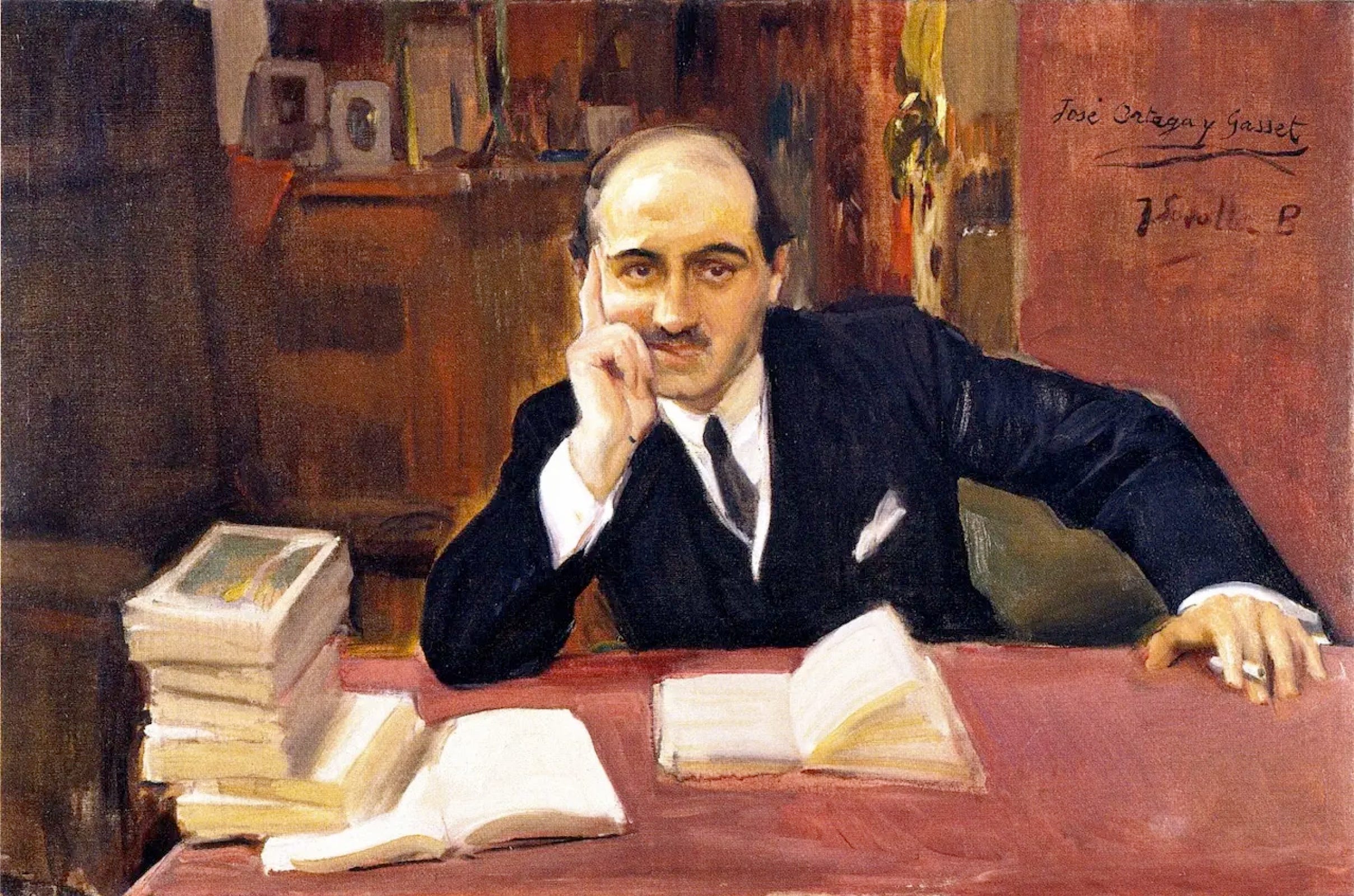
I’ve frequently cited Ortega, whose description of populist revolt is a touchstone for my own analysis of current social trends. While everyone else focuses on the conflict between Left and Right, Ortega reminds us that the more decisive battle is sometimes between Up and Down.
I believe that is true in the current moment
I’ve also written several times about René Girard, whose concepts of scapegoating and mimetic desire help me understand surprising social phenomena that might otherwise be inexplicable. Check out my article on twelve things I’ve learned from Girard for some examples.
Simone Weil was a brilliant commentator on the challenges of rebuilding Europe after World War II. She offers interesting opinions and concepts on almost every page—and a few of them are rather odd. But they’re so many valuable insights here on matters of relevance today, that she is required reading for those trying to survive in our turbulent times.
Canetti is another wise guide. He spent decades on his study of crowd psychology, and he is just as erudite as Gibbon or Spengler, and far more reliable as a prognosticator.
Canetti won a Nobel Prize for his work—so you might assume that his ideas are well known. But that’s simply not the case. Crowds and Power is a neglected book, especially among the people who might benefit most from reading it.
Now I want to recommend works of science fiction. This may seem out of keeping with the sober nature of the preceding titles. But sci-fi is a useful tool in teaching us how societies can go bad.
George Orwell: Nineteen Eighty-Four
Aldous Huxley: Brave New World
Mary Shelley: Frankenstein
Ray Bradbury: Fahrenheit 451
Philip K. Dick: Do Androids Dream of Electric Sheep
These books offer different takes on dystopia, but each one captures a relevant aspect of our current troubles.
Orwell correctly anticipated the rise of mass surveillance and the degradation of both thinking and language.
Shelley grasped the danger of tech overreach—her Dr. Frankenstein will remind you of today’s vainglorious billionaire entrepreneurs.
Bradbury saw a coming age of censorship and shrinking literary culture.
Dick foresaw the collapse of reality and rise of bogus replicas of human culture.
And, finally, Huxley capture the scariest idea of them all—namely that pleasure-seeking individuals will simply stop caring about anything except themselves, and thus (like the ancient Romans) sit back and let the collapse happen.
Let me conclude by recommending one last literary work….
Johann Wolfgang von Goethe: Faust
The Faust legend tells of a man so obsessed with personal aggrandizement and scientific control that he sells his soul for more progress. This may be the defining story of our own time, and Goethe understood its dangers more than two hundred years ago.
By the way, that’s one thing Spengler got right in The Decline of the West. He grasped that our society today is essentially Faustian in its orientation. If you understand this, many things start to make sense. (I hope to write more about this in the future.)
I won’t give away plot spoilers, but you ought to know that this kind of deal-with-the-devil story always has an unhappy ending.
That’s a good start for your reading in societal collapse. It doesn’t include all of the books on my list—but I’ve discussed more than half of them above. Perhaps we will revisit this matter again in the future.
I think a more pertinent Philip K. Dick novel is The Three Stigmata of Palmer Eldritch, with its characters seeking happiness by retreating into dream worlds that wind up being designed and controlled by others who only want to exploit and manipulate for their own ends. Sound familiar?
I'd add Zamyatin's We to the sci-fi selection. I read it about the same time I read 1984 & BNW, when I was maybe 16 or 17,and it was the one I enjoyed most.