
The Return of the Weirdo
Will this be the cool new thing of 2026?


“People are less weird than they used to be,” claims psychologist Adam Mastroianni. He describes this as “an epidemic of the mundane.”
The strangest thing, he believes, is absence of strangeness. Nobody wants to make waves—or even trickles. Conformity is the flavor of the month, and it tastes the same every month.
We live in a “smoothness society,” explains philosopher Byung-Chul Han. He points to the smooth, rounded contours of the iPhone as a symbol of society’s desire to remove friction. Our phone apps demonstrate the exact same thing. We scroll and swipe with such ease, and anything with complexity, nuance, or resistance is eliminated from consideration.
“The smooth is the signature of the present time,” he claims. Everything from the Brazilian wax job applied to human bodies to the wax coating put on fruits and vegetables aims at the same ideal.
Resistance is futile. Everything must be smooth. Paradise now really is that paved parking lot.
Please support my work—by taking out a premium subscription (just $6 per month).
In a world without complexity or resistance, nothing ever changes. Most movies, music, books feel like stagnant rehashes of the same formulas. And that’s intentional.
For the first time in history, fashions don’t change. We don’t change.

Others have noticed this avoidance of anything new or different. Things are designed to blend in, not stand out. Jessica Stillman, writing in Inc., complains about a “blandness epidemic.” Brian Klaas calls it the “surefire mediocre.”
Everywhere you look, the system is serving up more of the same.

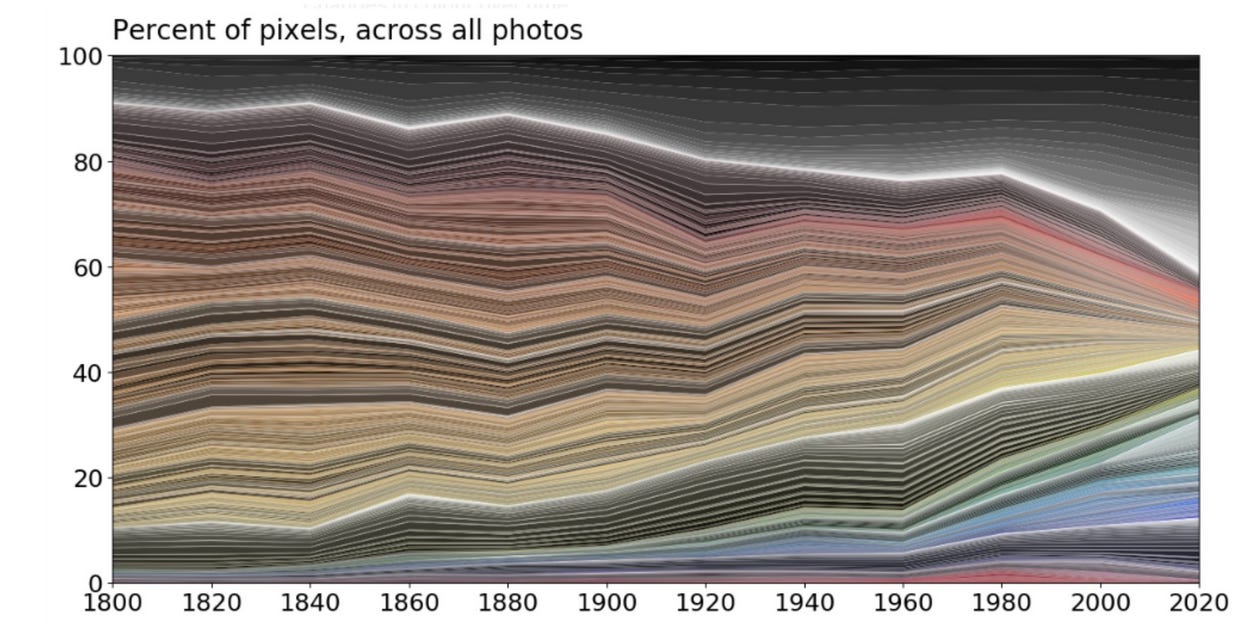
It’s not just in our imagination—the “world really is getting grayer.” A researcher recently studied photos of household items going back two centuries. An analysis of the pixels showed a scary collapse in color.
Even the Victorians—often considered as conformists—lived a more color-filled life. We have almost completely abandoned red and yellow and other bright hues in favor a boring black-and-white spectrum.
But what’s most striking is how this descent into grayness has accelerated during the last few years. The most popular color is now charcoal—and at the current rate it will soon account for half of the marketplace.
This runs counter to the mantra of marketing experts, who claim that products need to make a statement and capture the public’s attention.. They say that, but then turn around and launch another gray product into the look-alike marketplace.
In an attempt to counter this, Pantone announced recently that the color of the year in 2026 should be white. Some people complained. Others merely yawned. The shift from gray to white is one more measure of the tedium imposed by today’s tastemakers.
Not long ago, popular colors were striking and changed with regularity. There was a time when avocado was the preferred shade for kitchen appliances. Orange and red had their day. When Monsanto designed a house of the future for Disneyland back in 1957, the kitchen looked like this.

But the real problem isn’t our home decor—it’s the avoidance of risk-taking and the embrace of conformity in our behavior. And even in our inner lives.
People do this for a good reason. It doesn’t take much to stir up the crowd against you.
Just look at recent events. Sydney Sweeney wears jeans in a TV commercial, and people have a meltdown. Cracker Barrel changes its logo, and the anger spreads like a wildfire.
Never before in history have more people blown a gasket over so little. Is there any room for weirdness in this conformist world?
Even as the word diversity is said over and over, the opposite is apparent in almost every sphere of social life. I don’t think it’s coincidence that diversity is proclaimed most often by some of the most conformist corporations on the planet.
That’s the nature of newspeak in our time. Words come to take on an opposite meaning from what they apparently say. I call this the gentleman’s club phenomena—it’s the last place you would go in order to find a gentleman. The name is designed to hide the obvious.
That’s why the same corporations extolling creativity, diversity, and innovation work so hard to kill them. The words are, at best substitutes for reality, and at worst a smokescreen for hiding what’s actually going down.
It’s hardly surprising that the biggest investments right now are all targeted at swallowing and regurgitating the past. This is happening everywhere in the creative culture—with record labels focused on buying the rights to old songs and film studios regurgitating brand franchises from the last century. But even forward-looking tech is doing the same.
A trillion dollars is spent training AI on all the digital data of the past—forcing the bots to digest every book, every song, every image. Even in Silicon Valley, the future will be built on an endless rehash of yesteryear.
“Corporations didn’t intend to make the culture stagnant and boring,” I recently explained. “All they really want is to impose standardization and predictability—because it’s more profitable.”
But the end result is the same: repetition, conformity, and stagnation. Weirdness has been banished from the realm.
So even search engines no longer search. They just serve up an official AI answer—monolithic and smugly confident even when totally wrong—drawing on all this swallowed data from the past.
End of story.
That’s the reality of algorithmic society. it creates an endless information loop—like the snake swallowing its own tail. And a fog of sameness descends upon the land.
But this can’t last forever. Human history teaches us that societies resisting change eventually collapse from sheer inertia. And insurgents show up on the scene to accelerate the process—and bring on something new.
Maybe that will happen in 2026.
Gift subscriptions to The Honest Broker are now available.
We should welcome the triumph of the weird. History books will later call them innovators, but they always start out as weirdos—enemies of normality and promoters of change.
That’s because the weight of a stagnant past eventually stirs up revulsion and rebellion. So the dominance of conformity is only short term. Vitality and change always triumph, sooner or later.
I believe we are approaching a moment of that sort right now. When everything feels too smooth and predictable, change is just around the corner. So be on the lookout for the weird resistance—it just might be our first glimpse of the future.
This is probably a more important article than we think. Thanks for publishing it.
I have found myself listening to Captain Beefheart a lot in the last couple years… just sayin’…