
Socrates vs. the Venture Capitalist
Which side do you pick?

At his trial in 399 BC, Socrates faced the death penalty on charges of impiety and corrupting the youth. But in reality, philosophy and free inquiry were put on trial. Socrates had spent his life asking too damn many questions. And now the authorities wanted him to shut up.
Socrates was given a chance for a rebuttal. He had gotten himself into this mess by talking too much—and now he had one last chance to talk himself out of it.
His response ranks among the greatest moments in the history of Western culture. In a famous phrase, Socrates told the jury that “the unexamined life is not worth living.”
That was why he asked so many questions. “Examining myself and others” is the “greatest good” of which we are capable, he insisted. If we abandon introspection and critical thinking, we descend to an animal life—and that is unworthy of us as human beings.
The jury was unconvinced. And a short while later, Socrates was put to death with a dose of poison. His days of asking questions were now over.
It’s now up to us ask questions in his place. In many ways, that is the story of Western culture.
Please support my work by taking out a premium subscription (just $6 per month—or less).
I’ve been thinking a lot about Socrates and the examined life lately. That’s because Silicon Valley thought leaders have launched an unlikely war against introspection. They are advocating the un-examined life as the ultimate productivity hack.
A prominent venture capitalist recently boasted that he aspires to “zero” introspection—“as little as possible.” This mindset, he claims, is a huge productivity boost. The less time wasted on thinking, the more time you can spend on doing.
“If you go back 400 years ago,” he adds, “it never would've occurred to anybody to be introspective.”
That’s an odd statement, and reveals a total ignorance of Socrates’s plea for an examined life—which is, to be blunt about it, the origin story of Western rationalism, philosophy and science.
Without Socrates and his legacy, there is no Silicon Valley. There is no venture capital. There is no IPO on the NASDAQ.
What does a life without introspection even look like?
A good example might be Forrest Gump, who flourishes in the military by never thinking, just obeying orders.
SERGEANT: “Gump, what is your sole purpose in this army?”
GUMP: “To do what ever you tell me, drill sergeant.”
SERGEANT: “Godammit Gump, you’re a goddamn genius. That’s the most outstanding answer I’ve ever heard.”
We’re all a little weary of productivity hacks from tech elites. What happens on LinkedIn should stay on LinkedIn. But many clear-headed people were especially horrified by this new assault on introspection.
We don’t want to follow orders from Silicon Valley drill sergeants. We prefer to think for ourselves.
But a few days later, our pundit doubled down.
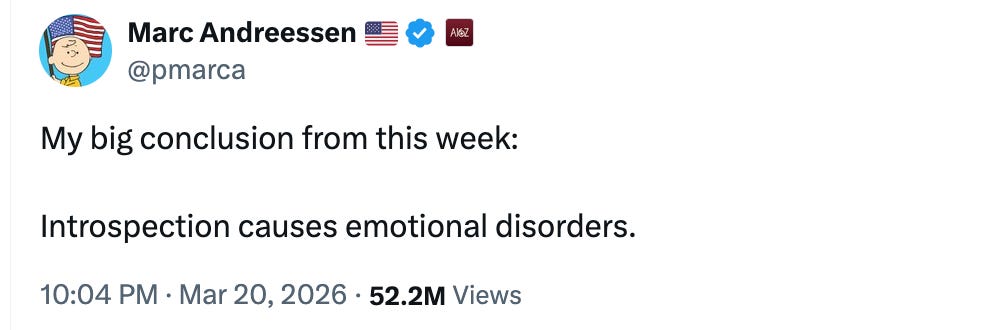
Other tech leaders joined in the attack on introspection—including the richest of them all.
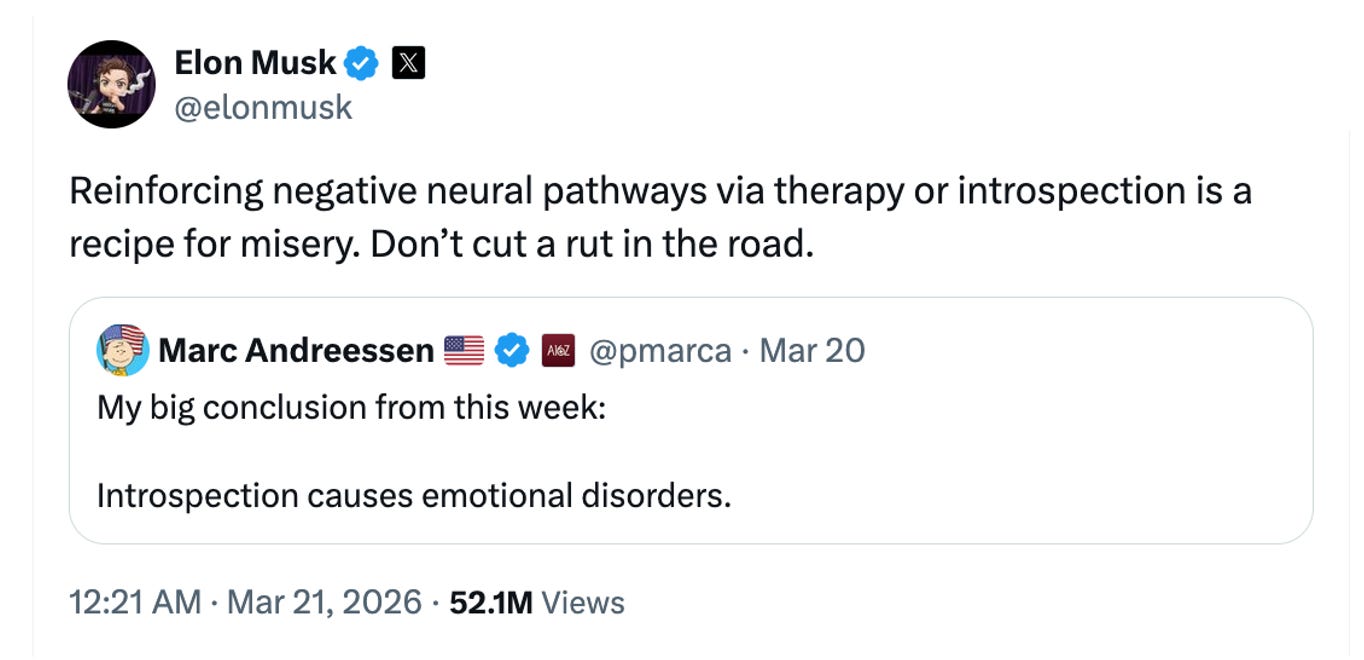
On a surface level, I can’t disagree with this.
If you could live the life of amoeba or newt, you could avoid both introspection and all emotional baggage—but you’re also abandoning consciousness.
For humans, consciousness is the ultimate source code or operating system (I’m trying to talk in language that the technocracy might understand). These things all go hand in hand. A zero level of introspection would actually demand zero consciousness: The life of an automaton.
Related Articles:
How to Read Plato
The New Cool Thing: Being a Human
25 Propositions About the New Romanticism
Maybe it’s no coincidence that this attack on introspection comes at the very moment when Silicon Valley is trying to promote automatons in every sphere of life, public or private.
You might assume that a war against consciousness is a losing battle. But history shows that millions of people have always sought an escape from awareness. Just spend some time in bars and watch the regulars drink themselves into oblivion.
“We’re all a little weary of productivity hacks from tech elites. What happens on LinkedIn should stay on LinkedIn.”
For many, oblivion is actually the goal—not some unintended side effect. Consciousness is a heavy burden and they want to shut it off. Today’s high tech version of a life without introspection is just the latest variant on an ancient quest.
Those folks getting shitfaced at the bar teach us another lesson. As they stumble home, they refute the claim that introspection causes disorder. It’s the avoidance of self-awareness that is a far more dangerous path.
Meanwhile, our pundit was on a roll. And his claims kept getting more and more interesting.

Ah, where is Socrates when we need him?
All this leads to the obvious question: How do we spend our time after we give up introspection. We’re fortunate that tech bro influencers are already offering solutions.
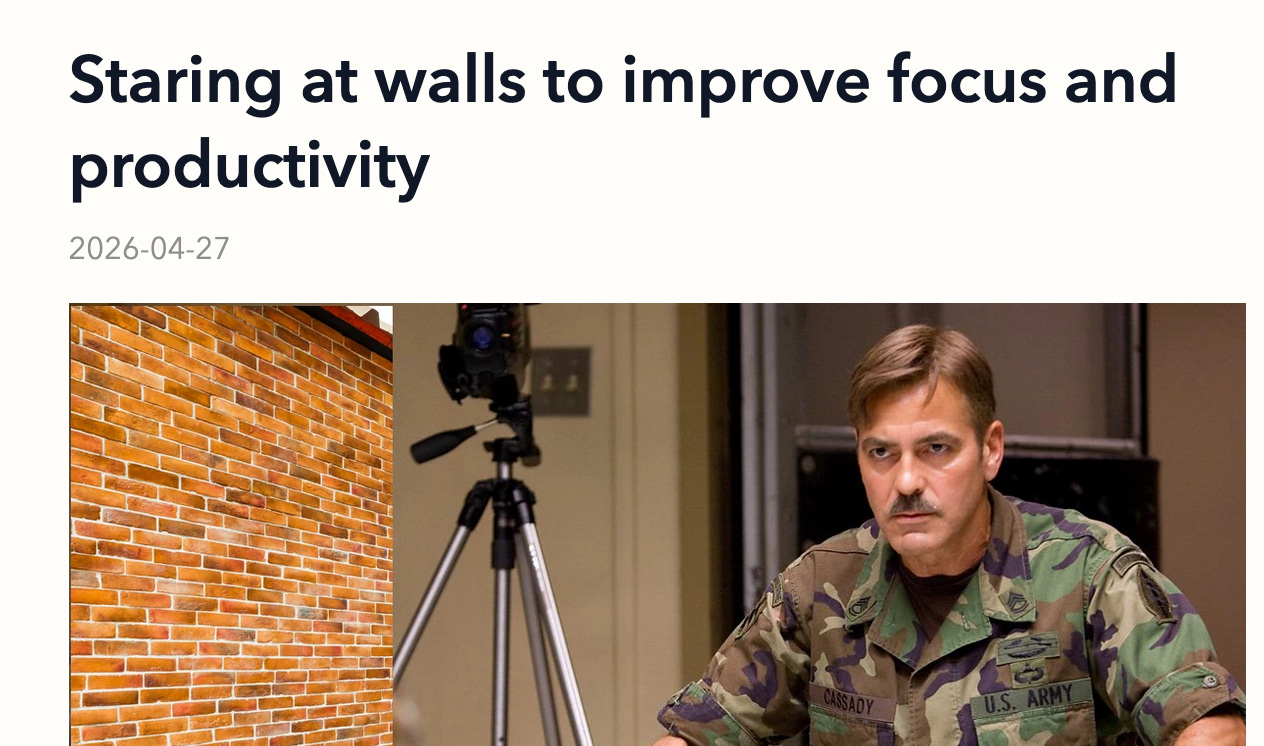
This viral video—with more than one million views!—recommends staring at walls for extended periods. “Believe it or not,” explains Luke McCarthy, “this helped me have one of the most productive weeks of my life.”
This is a variant of the hot new trend of raw dogging. You practice this during air travel when you spend the entire duration of the trip staring in front of you. No, you’re not looking at a movie screen or even a book or in-flight magazine—you’re just staring at the back of the seat in front of you.
Is this really a productivity hack, or just incipient mental illness?
Escaping consciousness often comes at a price—frequently a steep one. The next step is more likely to be rehab, not a promotion to the CEO’s office. I’ll admit that staring at a wall is better than getting blitzed at a frat party, but it’s still a poor substitute for a well-ordered, thoughtful life.
“Escaping consciousness often comes at a price—frequently a steep one. The next step is more likely to be rehab, not a promotion to the CEO’s office.”
So I’m taking Socrates’s side in this dispute—not the venture capitalist’s. I’m opting for mindfulness, not mindlessness.
The unexamined life is an empty one, or even a dangerous one. The fact that our wealthy powerful elites don’t grasp this danger, tells us many things. For a start, we need to look outside of Silicon Valley for wisdom.
The better alternative should be obvious—it’s called the humanities. And it’s the ultimate productivity hack.
A humanistic education teaches us to embrace our agency, not assign it to an automaton. It encourages us to live with purpose, not passivity. It sets us on a pathway to self-awareness, not oblivion.
If you give it chance, you can also avoid the pain of staring at the back of the seat in front of you during your next flight. Trust me, you will get much, much more out of a good book while in transit. In its own way, it will take you to a better destination.
“If you go back 400 years ago,” he adds, “it never would've occurred to anybody to be introspective.” From that sentence alone, I know I need not take any other claim he makes seriously, because of the staggering ignorance he's already revealed.
If you go back 400 years, you arrive at ... Hamlet.
Thanks--from a retired Philosophy Prof. Teaching Socrates is the best intro to Philosophy.