

It’s painful to admit, but the comments emails from readers are sometimes better than my articles. So let me put aside my pride, and share some recent responses.
Please support my work—by taking out a premium subscription (just $6 per month).
Reader Jennifer Keishin Armstrong discovered that an AI bot wrote a biography of her life. Even worse, it made up stuff.
She provides more details in a scary article:
It states my birth year as 1975, which is close but three days off: I was born on Dec. 29, 1974. Then things get truly crazy. It names my mother as Michiko Armstrong, who taught Japanese language and culture at DePaul University, and my father as David Armstrong, a professor of English literature at Loyola University. It says I’m married to a man I met at Northwestern University and have two teenage sons. We move a lot for my job, it says, though it doesn’t say where we’ve lived. We did, however, apparently go to India so that I could research my book When Women Invented Television, which is about pioneers of American television who never go to India. In perhaps the standout moment of this narrative, one of my sons watched Sex and the City with me and shared his insight that Carrie is actually a hoarder, which I apparently put into my book Sex and the City and Us.
There is literally nothing correct in this entire previous paragraph. I cannot emphasize enough just how wrong all of this information is. And now it’s out in the world in a “meticulously researched” biography, stated with great confidence.
In response to my article on the disappearance of midlist books from major publishers, reader Stephen S. Power shared some inside information. He shows how a simple accounting change (borrowed from the Mafia!) destroyed opportunities for thousands of authors.
When I was a senior editor at Avon Books, we were bought by HarperCollins in 1999. The first change they made was to give us a new P&L to use. It was exactly like our old P&L with one thing added: a $20,000 skim for Harper from every book, regardless of sales projections.
It was pointed out to Harper that we were primarily a mass market publisher (they wanted us for our romances), and mass market worked because each month our list was set up like a baseball organization. You’d have 1-2 super lead titles and 3 general leads (the major league team), then genre leads (AAA), then increasingly smaller books in each genre (for example, Mystery 1, Mystery 2 and Mystery 3, your low minors). Ideally, you’d build an author from a genre title to a genre lead to an overall lead.
The best part of the system was that a book could save your month from any position; the leads might tank, but some book from Columbus would come up and sell 100K+ copies (looking at you, TV tie-in edition of Christy).
Charging each book $20K, like a mobster taking his cut out of a pot in an illegal poker game, would make it financially impossible to publish most of these books, most of which we didn’t pay anywhere near $20K for. I don’t think Harper cared.
Soon I didn’t either. Their second act was to lay me off. And now mass market publishing is basically dead.
Here’s an email I received from Brady Purcell, nephew of audio guru Denny Purcell, who did the mastering on 500 gold records:
I am writing to you from Richmond, Indiana, the birthplace of recorded jazz, and I hold the archive of my uncle, the mastering titan Denny Purcell. I am currently fighting to protect the integrity of the original 1989 Elvis digital masters, which are being systematically scrubbed from history by corporate algorithms.
The industry has spent over a decade pushing a “cleaned-up” 2015 narrative that is a complete fabrication. This isn’t a remastering choice; it is a technical fraud designed to sanitize the record and bury the original source.
I am in possession of the original 1989 Sony PCM-1630 working master. This tape holds the raw, physical reality of the sessions, including two distinct intros to “When Your Heartaches Begin”—a detail that has been erased in the current algorithmic version.
I have the evidence to prove the 2015 version is a lie:
The Extraction: After the tape was baked for 5 hours on April 2nd and April 3rd, I successfully extracted a bit-perfect clone of the original 1989 data.
The Verification: The data has independent mainstream verification with zero interpolations and exceptionally low CRCs. It is the raw, unadulterated source code of the Elvis sessions.
The Smoking Gun: The 1630 header data on the original master acts as an immutable technical fingerprint. When compared to the “official” 2015 digital release, the data discrepancy is absolute. The 2015 version is a scrubbed, hollowed-out substitute.
The Provenance: This is supported by the Shelby Singleton-verified materials. This is a direct, documented line of custody from the Purcell archive.
I have a detailed technical dossier available upon request.
I am being stonewalled by the institutions that should be safeguarding this history because they know this 1989 evidence exposes their 2015 narrative as a fraud. I am not looking for a payout; I am looking for the truth to be documented before the industry succeeds in permanently scrubbing the record.
I lack the technology acumen to judge this, but Brady says he has evidence to back up his claims.
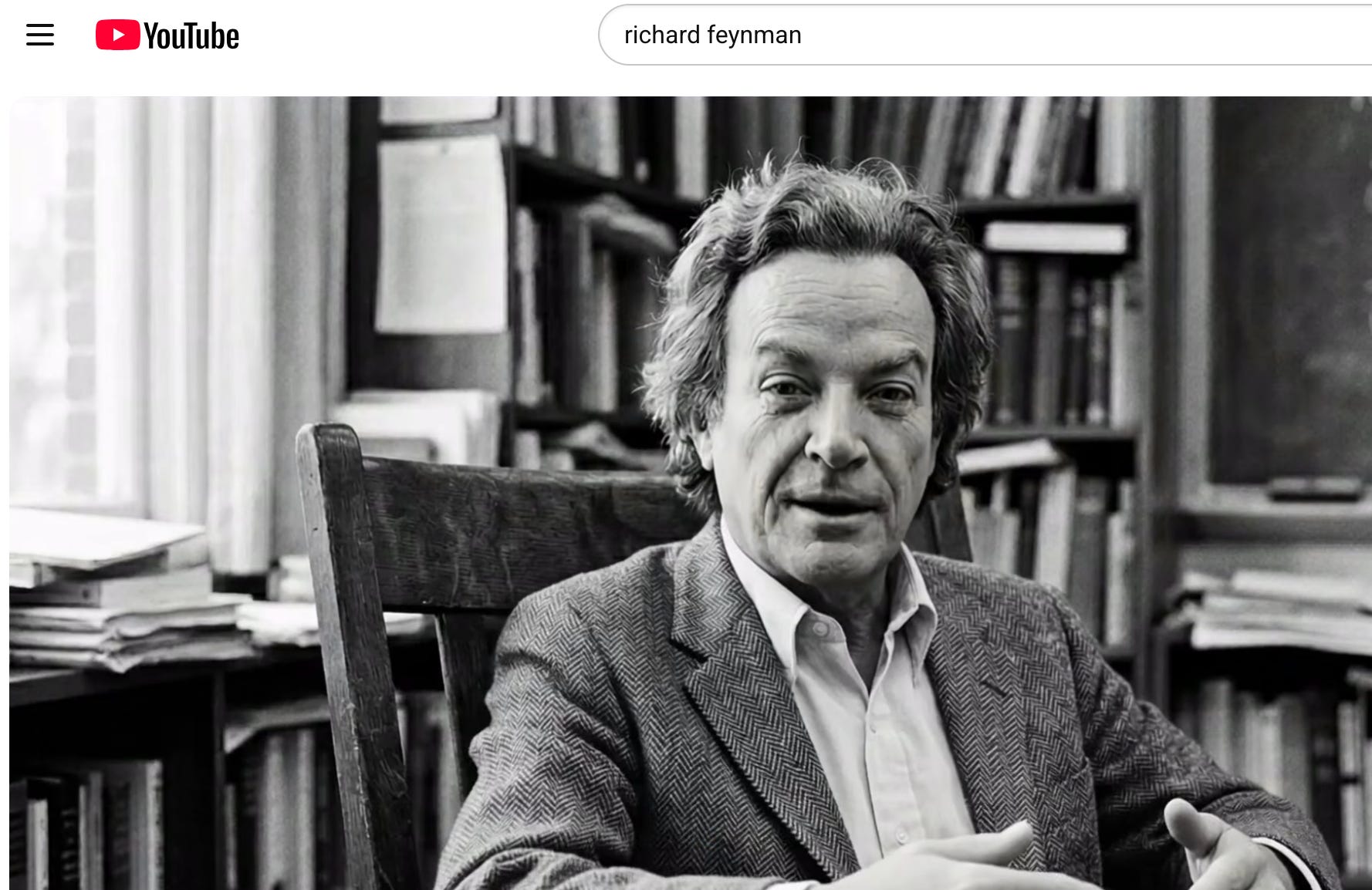
A subscriber who wishes to remain anonymous alerted me to widespread impersonation of famous dead people on YouTube. This started when he found “more than 700 fake Richard Feynman videos uploaded within the last few month.”
He adds:
Thumbnails for these videos consistently show Feynman’s face and name while the small print says things like “Visual lip-syncing, narration, and edited footage are used solely to enhance clarity and engagement. There is no intent to impersonate, mislead, or imply direct involvement”.
I have no doubt there are many more. And now I have discovered the same thing happening with talks by the philosopher Alan Watts.
This is alarming. And the big web platforms don’t seem to care.
Here’s an observation about the spread of AI music into public life from reader TekTok:
I heard my first AI jazz the other day. I was in a small Italian restaurant in NYC—no TVs. They usually have Frank Sinatra or Tony Bennett on as background music. When I walked in, the soundtrack was a jazz piano trio. Perfectly recorded. I couldn’t recognize the pianist. Not a note out of place, wonderful touch. Perhaps a previously unreleased Keith Jarrett recording? But even Keith Jarrett hits bad notes occasionally. Then I noticed that there was no change in dynamics. After about 2 minutes, I realized there was no cyclical chord structure—in other words, no song. The chords were quite hip and the bass player dutifully outlined them but there was no coherence.
Then it switched to a guitar trio, same deal. Impossibly perfect solo, no dynamics, chords going nowhere. At this point I started to feel anxious and told the bartender to change the channel or I would walk out. I don’t think anyone else in the room noticed or cared....
Reader Roland Ramanan pushes back on my opposition to AI, and asks me to specify the contexts in which I’d support it. I offered this brief answer (which I may expand in a future article):
I’ve been very clear about my support of AI if it meets three very reasonable demands: (1) TRANSPARENCY—let us know when it’s used; (2) LEGALITY—don’t train it on copyrighted work without the author’s approval; and (3) PERMISSION—don’t force people to use it unless they specifically opt in.
These are very modest requests, but it’s revealing that most of AI would disappear tomorrow if they were mandated. So the AI companies are stonewalling at every turn.
It’s pointless having more detailed discussions on AI use cases until we have these simple guardrails. Otherwise AI will be used to deceive, rob, and manipulate the general public—those are, in fact, the key use cases at present. I’ve described it elsewhere as “spamming, scamming, and shamming.”
Tech companies that promote these abuses should face consequences. What reasonable person could think otherwise?
Feel free to add your own words of wisdom in the comments.
I was "laid off" this week so they could replace me with a zero-experience "generative AI coach" who never checks its correctness and has fallen far behind me in every A/B test we've done. I saw it coming with how they treated me leading up to it but also... How do I keep a job if I'm demonstrably better and get let go anyway? The absolute disregard for quality or truth is the most disturbing part of the AI wave, even beyond the moral, environmental, and human aspects.
I sure resonated with the one that started, "I heard my first AI jazz the other day," and have posted almost the exact same in two different posts:
April 9, 2026
What the hell? I’m in a restaurant last night and they’re playing jazz in the background on the sound system. “Desafinado” starts playing and though it seems to be the original Verve recording I’ve been hearing my whole life, something’s off. It’s the saxophone — it’s all the right notes, but the sound isn’t Stan Getz’ sound.  As the song goes on it changes - the solo is completely different. But when the melody comes back it’s note for note. I Shazam it and this is what I get (I posted a picture of the Shazam results: "Desafinado: New York Jazz Lounge").
And as I mentioned in a comment, as we were leaving, “Take the A Train” started. But it didn’t repeat the intro enough times, and the swing feel was ever so slightly off - just a fraction of a second, but I felt it in my body.
Februay 10, 2025
In other news...I had a dentist appointment this morning. I settled into the chair and heard faint gentle piano jazz coming from somewhere in the ceiling and thought, oh, that's nice. But soon enough I realized what I was hearing was a lot of right hand noodling punctuated by the occasional left hand chord—the SAME chord over and over and over again—with no melodic logic or harmonic development, no color, nothing unpredictable, and no end: just a whole lot of nothin' on and on and on and on. (And so, I realized, no actual right or left hands.) I asked the hygienist the source of the music and she pointed to a screen on the wall. I said, "That's not real music. It's not made by humans." She said she had thought it was AI and asked me how I knew. I explained what I described above, and added, "And look, how long have I been here, half an hour? Nothing has changed this whole time." When I went out to pay the bill I heard some actual music. The people in the front area had a little radio (or, I guess, a little speaker that looked like a radio) playing music by actual people, and with an actual radio DJ. I said, "I'm so glad to hear real music, unlike the AI shit in the room." They smiled and nodded and seconded my emotion.