
The Shock of the Old
What happens when everything is a reboot?

During the 15th century, the leading critics all agreed that the greatest works of art came from an unusual place. No, not a museum or church or palace—they were found, instead, underground and amid ruins, literally covered in dirt.
Before you could see them, you first had to dig them up.
Can we even imagine this attitude today? Our whole hierarchy of aesthetics would need to be reversed. Just consider the shame of admitting that our most cherished cultural legacy had been buried and forgotten by our ancestors. Art appreciation gets turned into some kind of exhumation.
But the reaction to this rediscovered art was just as interesting as the sculptures themselves. How do you feel when you look at these works?
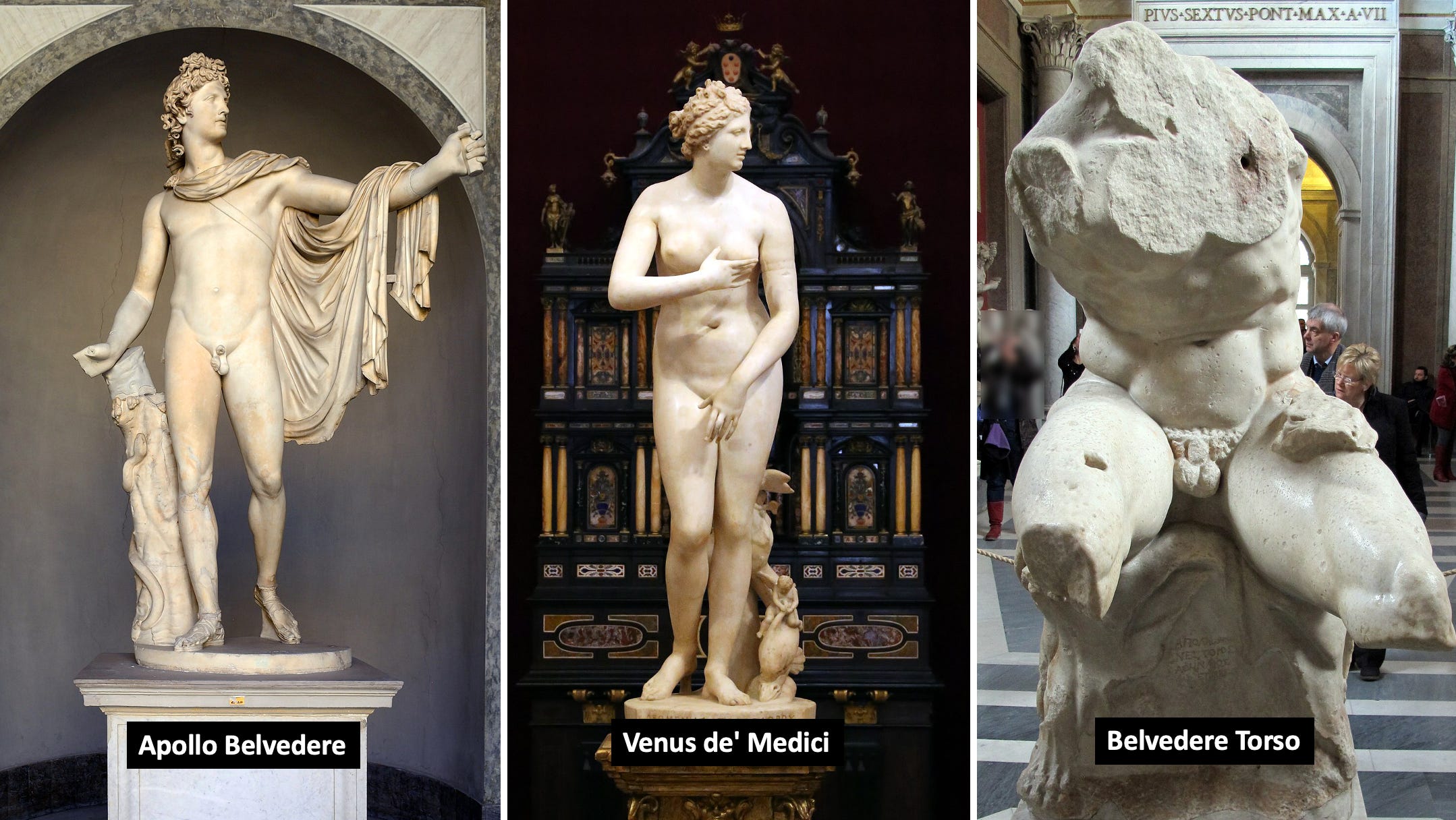
You probably aren’t shocked by the nudity. You’ve seen more salacious stuff on Netflix. In fact, you probably aren’t shocked by anything here—these statues feel very old fashioned and antiquated.
That’s an interesting word, antiquated. It means “old, and no longer useful.” If the plumbing in your house is antiquated, you’re in big trouble. And it’s even worse if you are antiquated.
If you want to support my work, please take out a premium subscription (just $6 per month).
The word comes from the same root as antiquities—a term applied to arts and artifacts from the past. And most observers today would put the two ideas together, and say that these old statues might be charming to see in a museum, but have little or no relevance to us today.
But that’s not how Michelangelo, Raphael, and other Renaissance artists saw them.
These works were more than a thousand years old, but the leading 16th century artists believed they were worthy of study and imitation. Even more shocking, the great minds of the Renaissance believed that such works represented timeless standards of artistic excellence that could not be erased by the passing centuries.
In other words, evaluating art was like pursuing the good life. After you discovered the pathway to do that, you kept to the course. It didn’t go stale like a loaf of bread. It wasn’t a fad or a trend, but something enduring. The same thing is true of good health or a good marriage—you want them to endure, not get replaced by the next new thing.
Five hundred years later, leading critics believed the exact opposite. Standards were not timeless, but constantly in flux. During the 20th century, art was supposed to disrupt the standards from the past. If a work made you uncomfortable, all the better—you needed a kick in the ass. If the Venus de Milo hadn’t already lost her arms, some witty critic would probably suggest that we cut them off. That would give you a jolt, huh?
This notion of disruption was already prevalent a hundred years ago. And the kicks aimed at your posterior came from all directions. Critic Robert Hughes called this the “Shock of the New.”
The individual asskicks were the -isms.
There’s surrealism, dadaism, cubism, futurism, brutalism, fauvism, abstract expressionism, deconstructionism, postmodernism, serialism, minimalism, and so forth and so on. You could make a patter song from all of them.
Critics placed wagers on them, as if they were horses at the track. If they made a smart bet, they could reap a windfall. Their reputation was enhanced, and also their wallet. I’m reminded of the elite art critic who launched the careers of painters, and sent the market price of their works skyrocketing—but only after he had accumulated some choice specimens for his own collection. In the finance world, this is called insider trading.
The suffix -ism originally denoted a doctrine, theory, or worldview. Or even a religion, such as Judaism or Buddhism. These aesthetic -isms were also a bit like religions, inspiring fervent loyalty.
But there was a big difference. Religions like Judaism or Buddhism last for thousands of years. But aesthetic theories come and go. None of the artistic -isms lasted very long. Today’s -ism soon becomes yesterday’s was-ism.
That’s a little strange, because the advocates of the -isms all promised that they were delivering the blueprint for the future. And then we finally get to the future—and what do we see?
In the year 2026, the dominant aesthetic theory is the Shock of the Old. Of course nobody describes it that way. But they should. Because it’s scandalous how much we rely on old formulas for current day artistic work. We’ve returned to digging into the dirt of the past for artistic inspiration.
Some of it is positively antiquated. Consider the most popular blueprint for Hollywood movies today—it’s called the Hero’s Journey. And it’s based on ancient myths and epics even older than the Apollo Belvedere.

Who would have guessed it? The bosses in Hollywood now clearly believe in timeless universal standards—much like Michelangelo back in the Renaissance. They are literally embracing a role model that is more than two thousand years old!
The same archaeological mindset is evident in the music business. Major labels not only prefer older styles of music, but even imitation is not good enough for them. They actually want to own the old songs, and invest their free cash flow in acquiring old publishing catalogs.
Every other field of aesthetic judgment is equally obsessed with old formulas. You see it in TV shows, comic books, video games, etc. Back in the day, this was called classicism. Nowadays it’s called the reboot. The audience now gets a reboot in the posterior, whether they want it or not.
The idea is the same as in movies. You imitate the dead. The only thing missing is the -ism. And that’s for a good reason.
The -ism implies a coherent theory or artistic purpose. And those simply don’t exist in the world of the reboot. There is no theory of rebootism, or manifesto of brand franchise-ism, or movie-sequel-ism.
Of course, there is a purpose to these creative works, but it’s a financial purpose not an aesthetic one. The reboot is expected to make money—end of story.
And that’s the true Shock of the Old. Old styles have taken over the entire creative landscape—but without any conceptual underpinnings, larger meaning, or creative mission. If you doubt this, just look at the words used to describe these reboots. They are called brands or content or franchises. That’s the language of marketing, not aesthetics.
You might think that the businesses foisting these antiquities would at least pretend otherwise. But they don’t even bother to hide their motives, using MBA terminology and techniques to describe what previous generations viewed with reverence as art.
That doesn’t have to be the case. We still have Michelangelo’s option available to us. He could find universal wisdom in the past because of the timeless qualities of the human form and the human condition. We could do the same. We could seek out the timeless—if we cared enough to make an effort.
But that’s not happening in reboot culture. These brand extensions have nothing to do with seeking the eternal elements of the human condition. They’re just a way to generate cash flow and boost the share price.
That’s what makes the current cultural situation feel so flat and stagnant. If your purpose is just to make a buck, you can serve up a superhero movie or reboot an old TV show. But you might as well share prank videos on TikTok or AI slop on YouTube.
That’s actually happening. In the absence of actual artistic values, this culture of repetition and regurgitation inevitably results in a race to the bottom. And, as always happens in a downward journey, the speed of your fall increases rapidly. We’re just three years, more or less, into the AI revolution and it already feels like a freefall into the abyss.
Slop is everywhere, polluting all the creative fields. And it provides a frightening extension of Gresham’s law of economics. Gresham, as you may know, famously announced that bad money drives out good—so that a rise of counterfeit bills inevitably leads to the disappearance of real cash. That’s what is happening to our current culture: slop overwhelms the system and marginalizes the real creative works of human artists.
I’m now seeing this firsthand as a music critic, and its scary. The platforms I rely on for access to new recordings are all contaminated. They are filled with frauds, impersonations, and scams—most of them driven by AI. Just in the last month, the number of bogus recordings on Spotify has reached such an extreme level that anything promoted by the company’s algorithm feels potentially tainted.
Here’s where I make a prediction.
This limp, empty approach to culture is a dead-end. People will soon demand something more from the creative economy—something riskier, something more inspiring, something more disruptive. Above all, they will insist on something more human.
Or maybe they will even seek out something more timeless on a larger scale. This would be a kind of art-making that contributes to human flourishing and a deeper understanding of who we are and what we can do.
They are unlikely to get it from the large entertainment platforms. And I’m even more certain that they won’t get it from an AI chatbot. But sooner or later, people will find it somewhere.
I know that because I can feel the hunger for it everywhere. You tell me this in your comments and emails. I feel it myself.
And when it arrives, it will shake things up on a massive scale—akin to what happened with Romanticism, circa 1800 or Modernism, circa 1900. We will have something more than a culture built on scams and a constantly ringing cash register.
I’m confident in predicting this because the only other alternative is living in the past. Organisms that try to do that get killed off. If you bet on them, it’s a losing wager. And, above all, don’t be one yourself—because there’s no reboot yet for people, despite all the promises made by the transhumanists.
Each of us needs to be fresh and vital to survive. All we want is a culture that does the same. Is that too much to ask?
When an artist does deliver a new take on a classic, often the response is confusion or dismay. People get way too comfortable with the familiar.
This is just a guess, but maybe it will come from live community theatre. Look at the way people are going nuts over Daniel Radcliffe on “Every Brilliant Thing” on Broadway, and WHY. Perhaps people will get fed up with mediocre corporate celebrities and the PR machine, and local celebrities will become the trend—ones you can actually come across at the grocery store. There’s no AI at the local community theater and limited special effects—just honest performances from real people. And the bad, unprofessional acting? Maybe it will come to be valued as “theatre grunge” and loved for its edgy authenticity!