
Rick Beato Versus the NY Times
The backlash over the best songwriter list intensifies

Fifteen days ago, the New York Times published its list of the 30 greatest living American songwriters. Since then, all hell has broken loose in the music world. And in the last 48 hours, that Hades just got a lot hotter.
I’d been one of the 250 “music insiders” surveyed by the Times for the article—so the day after the list was published I shared my ballot here.
I was unhappy with the results, as were many other music fans. But that might have been the end of the story. Surveys are always a bit dodgy—but what can you do about it?
Then I took time to learn about the Times methodology and was even more dismayed. In fact, I was miffed.
If you want to support my work, please take out a premium subscription (just $6 per month).
I assumed that I was voting for the songwriters who would be included in the list. But I now see that the experts consulted by the Times only got to make nominations. The final 30 names were chosen by six New York Times music critics.
There never was a real vote. The Times got the results it wanted internally—the insiders made the final call. But the way they explained it to their readers was intentionally vague.
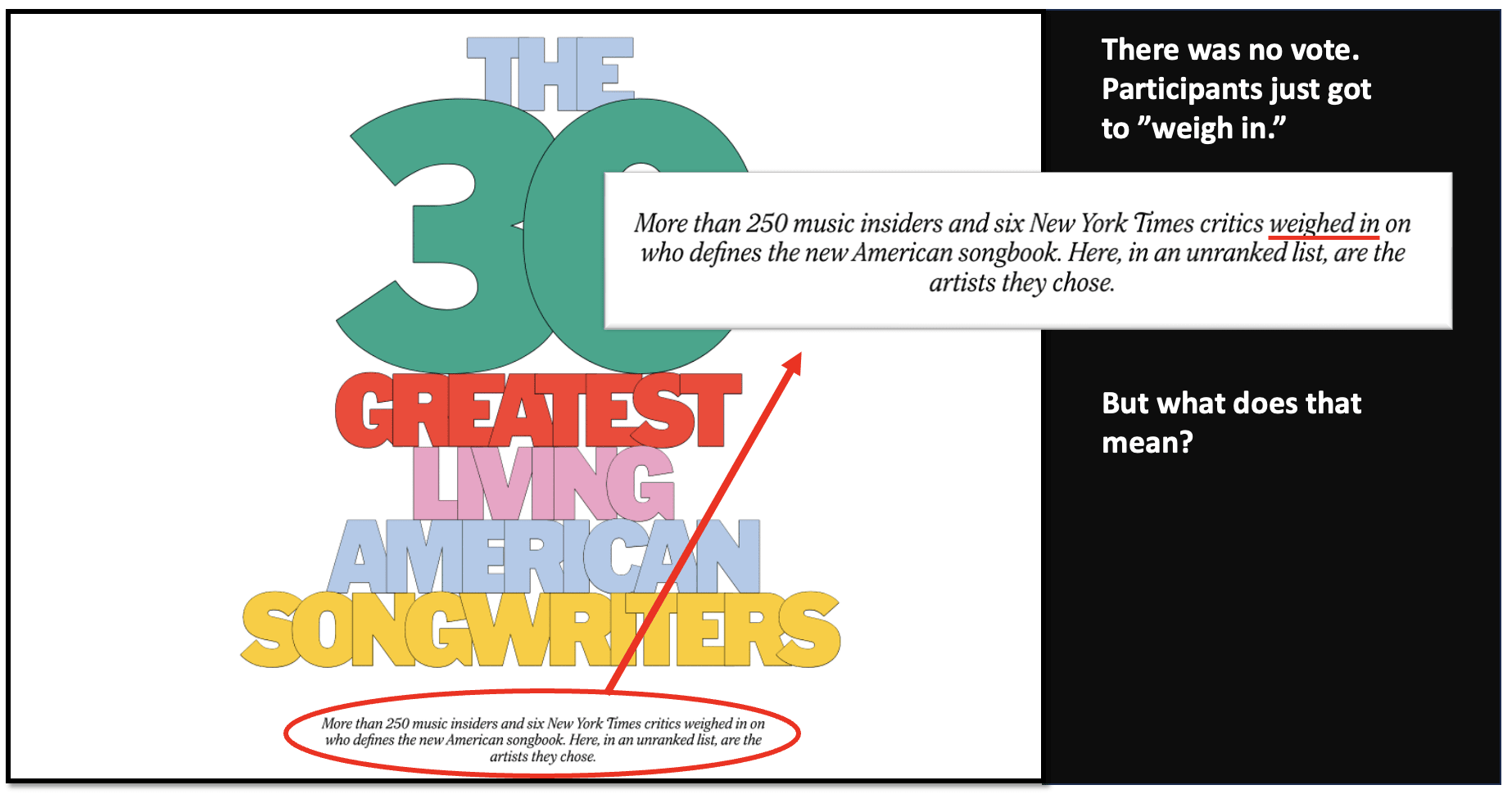
In small print, readers were told that industry experts “weighed in”—whatever that means.
Readers were invited to click on a link to learn “how we made the list.” But even here, the Times served up fuzzy language.
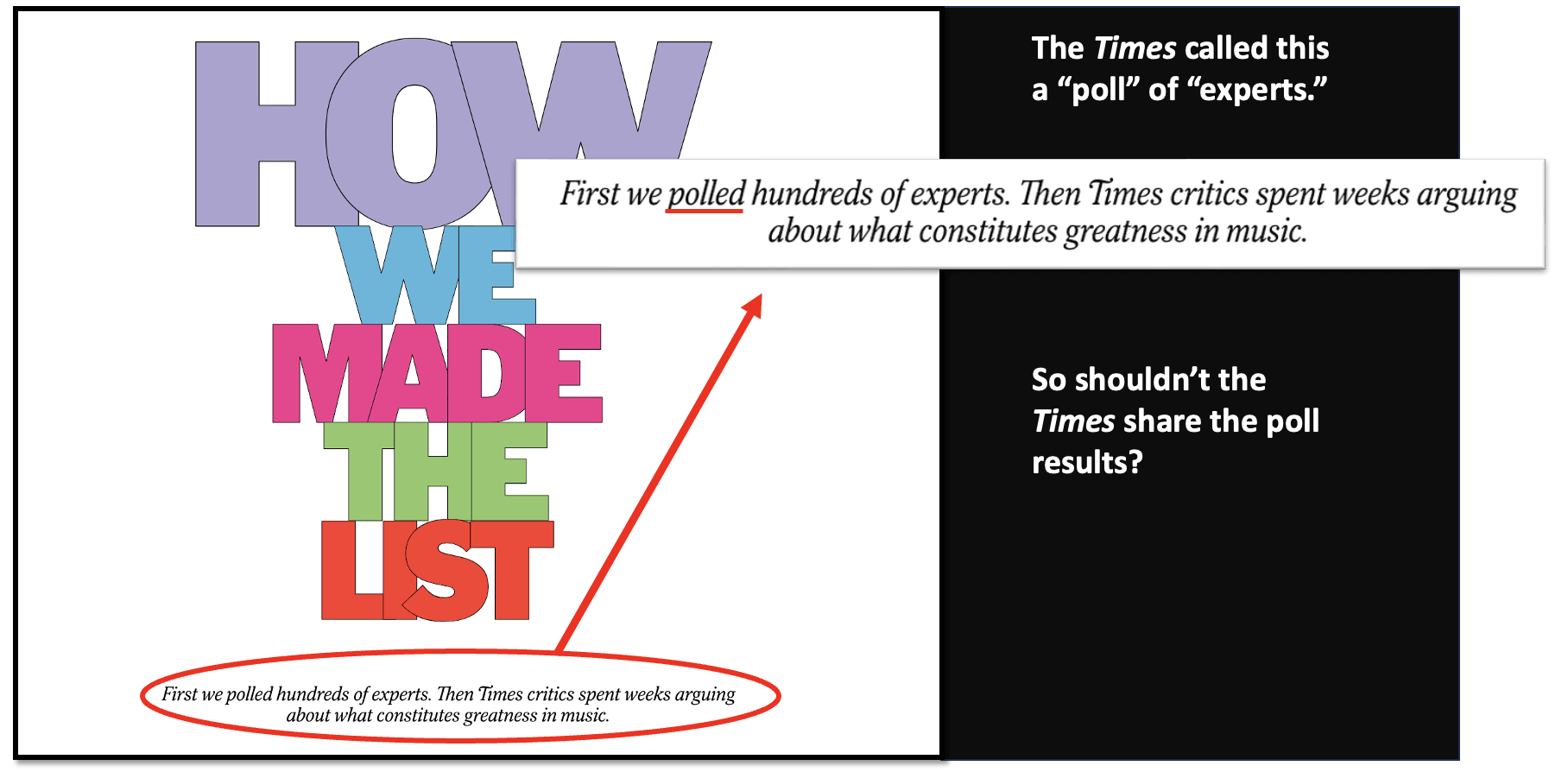
If you kept on reading, you eventually learned the truth. The Times took the verdict of the “experts” and then “ran it through a filter.” The survey was just a “starting point.” The actual top thirty was decided via a “conversation” among its internal team.
Huh?
The Times did share a few ballots, and even this small sample made clear how different the final list was from the survey of experts. That would be embarrassing for the Times under the best of circumstances, but especially so in the current environment—when that same newspaper has repeatedly expressed outrage about voter suppression and attempts to subvert democracy.
If the Times really believes in the importance of voting and standing by results, why doesn’t it just share the actual ballot count?
Even so, this all might have been forgotten. But last Friday, the Times made the mistake of releasing a video entitled “In Defense of the NYT ‘Greatest Songwriters’ List.”
Here members of the inside team came across as smug, maybe even contemptuous, in responding to music fans who reached out to them. At one juncture, a Times critic laughs at a comment from a reader—simply for saying that he went to the Berklee College of Music. Then he continues to chuckle and smirk as he reads the rest of the reader’s comment, before finally throwing it on the floor.
This music lover had made the mistake of defending Billy Joel. For a serious critic at the Times, that is apparently very funny.
In a curious coincidence, I had just published an article on music criticism the day before the Times released this video. In this article—entitled “Nine Rules of Music Criticism”—I made this claim:
Trust your emotional response to creative work, and be wary of critical stances that run counter to how it actually makes you feel….
Be wary of any critic who doesn’t seem to care about your enjoyment of music or other art forms. I’m not saying that the critic needs to agree with your responses, but a clear hostility to enjoyment and doctrinaire disregard of our emotional response to a work is a huge warning sign.
Little did I know that I would see this “warning sign” on display the very next day at America’s newspaper of record.
During the subsequent 72 hours, the backlash intensified. A fiery response from esteemed jazz pianist Brad Mehldau was ostensibly a defense of Billy Joel, but focused mostly on the problems with music criticism of this sort. He describes a music critic character type very similar to the one I warned against in my article:
He is a snob who wants to be hip, so he becomes a critic. He listens to music not because he loves music, but because of how it defines his understanding of himself, narcissistically.
But even this response was mild compared to Rick Beato’s take, which went live yesterday. Rick is a very smart guy with big ears and a deep understanding of music—much deeper than those Times insiders. And his words carry weight. By my measure, Beato has more influence than any music critic in the world right now, and when he says something, it gets attention.
Rick had already released a video about the Times songwriter list, and he rarely deals with the same issue a second time. “I don’t usually make videos back-to-back on the same topic,” he explains. But he was also irritated by the tone of the Times video and felt compelled to respond to it.
His rebuttal is going viral with a vengeance. It’s been up for less than a day, and already has ten times as many views as the original Times video.
For the most part, he just shares clips from the Times podcast—which are damaging enough—before asking in frustration: “You hear these guys competing for the worst take?” In his words, they come across as “the most pretentious, cork-sniffing smug people”—whose condescension is all the worse because they have “no background in music.”
Rick, I should add, is not just a pundit, but is also a very skilled guitarist, record producer, music educator, etc. He possesses real credentials—the same ones the Times critics lack—and not just opinions.
But did he go too far?
The people watching his video clearly don’t think so. It already has 10,000+ comments—that’s more responses than the original Times article received. And they are brutal.
That first comment has almost 8,000 likes. As I said above, Hades is getting hotter—especially that level of Dante’s Inferno reserved for music critics.
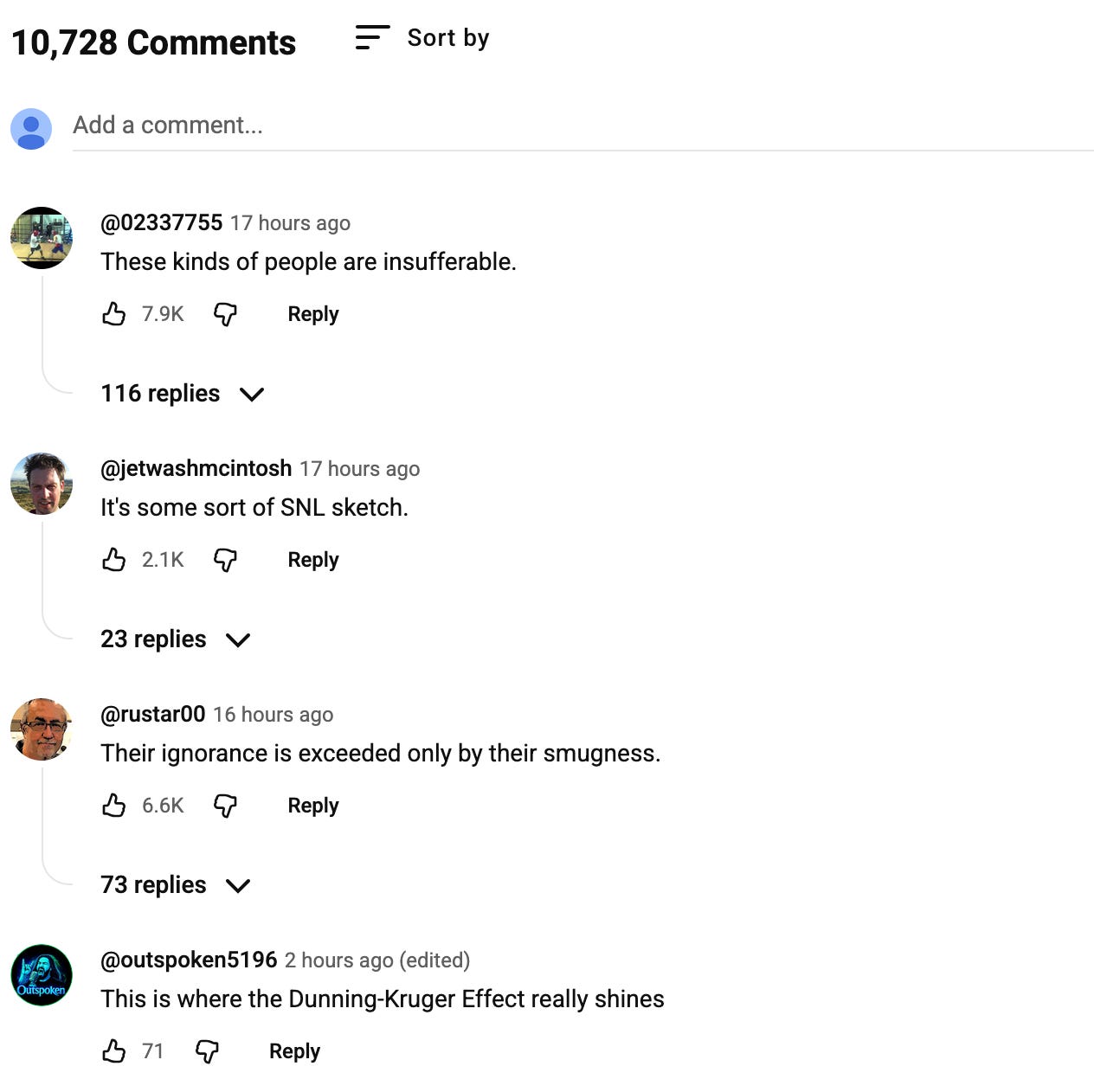
By my measure, around 99% of the responses are in agreement with Beato. All this adds up to a bad look for the New York Times. A very bad look.
It also tells you about the shift underway in media power. A few years ago, I couldn’t imagine a single person taking on the Times in this way and having such an impact. But the world has changed.
I’ve said it over and over, but I need to repeat it now: Trust is the most scarce thing in the media landscape right now.
Many journalists have fooled themselves into thinking that the institutional power of their employer is more important than this personal authority held by the trustworthy individual—but they’re wrong.
We’re now seeing how that plays out in the world of music criticism. On one side, we have a trusted individual, and on the other a team of institutional insiders. The response of the audience has already made clear which side wins in this kind of disagreement.
I’m not sure if the Times can muster an adequate response at this late stage. But if it wants a bit of that trustworthiness for itself, it ought to start by publishing an actual count of the 250 ballots it solicited for its songwriter list.
I suspect that it would be very revealing.
Beato’s beat down was way more interesting then the NY Times video
When you realize that the NYT article was all about generating clicks, then the positions of the critics make sense. The best thing to do is not give these idiots oxygen.