
Objective Standards Really Do Exist in Music
And the New York Times is caught in the middle of the argument

A few weeks ago, I got pushback because of a passing comment I made in the article “My Nine Rules of Criticism.”
“Music has far more objective standards than most people realize,” I wrote. For some readers, these were fighting words. Naysayers came back at me in full Big Lebowski mode—declaring: That’s just, like, your opinion, man.
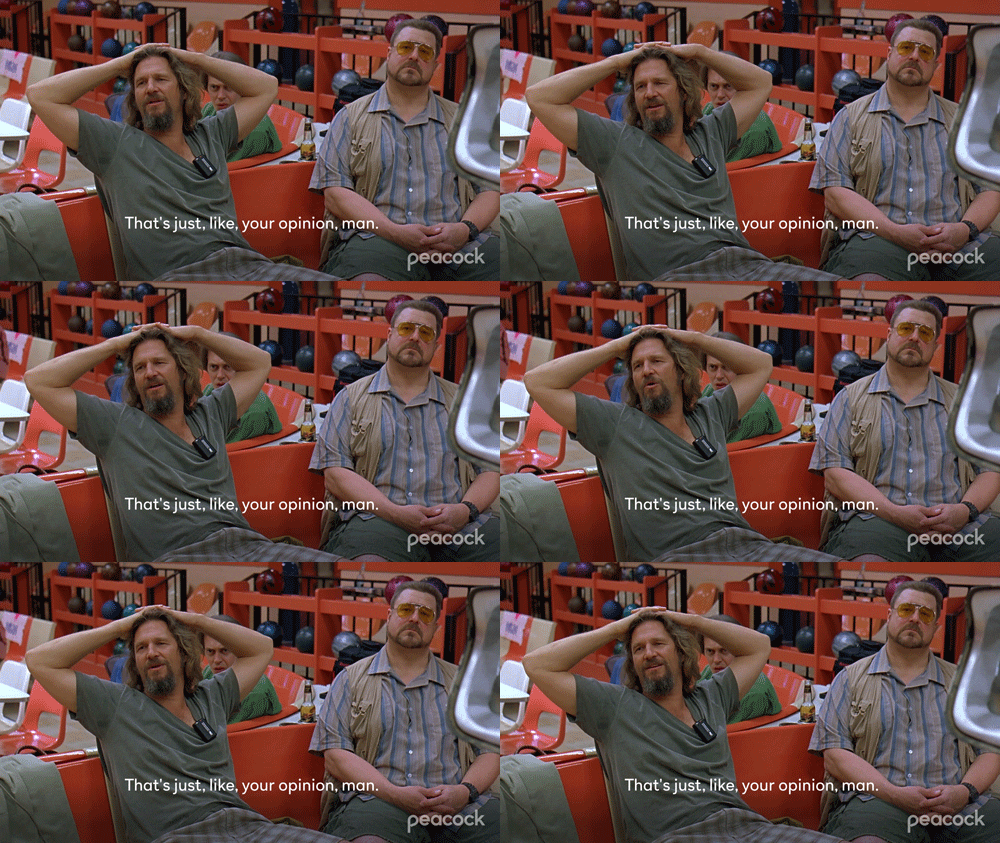
That’s how they see all evaluations of music—and of other art forms, too. Everybody has an opinion, they tell me, and they’re all equally subjective.
I can see why this is a popular view. It’s a very democratic notion, and a great equalizer. A music critic gets a vote, but so does the butcher, the baker, and the candlestick maker.
Everybody picks their favorite song, their favorite musician. Whether it’s Beethoven and Bach, or just “Disco Duck,” it’s all good, man.
If you want to support my work, please take out a premium subscription (just $6 per month).
I wish I could agree with this.
It would burnish my populist (and poptimist) credentials. But I’ve spent too far too many years in music, and in almost every kind of capacity. What I’ve learned from these cumulative experiences permanently banishes me from the ranks of populists and poptimists.
I’ve performed and recorded. I’ve written songs and have my own music publishing company. I’ve raised money from investors and launched various music businesses. I’ve produced albums. I’ve licensed music. I’ve taught music in classrooms and practice rooms. I’ve written thick books of music history, and more than a thousand shorter reviews and articles.
Put simply, I devote hours every day to music—and have been doing this for dog’s years. So I can tell you with total confidence: All musicians are not created equal.
I know this with certainty because there are at least some objective tests and standards.
I was planning to write about this at a future point. But when I saw Rick Beato’s latest upload to YouTube, it spurred me into action—because he conveys the essence of this reality in just a few seconds.
Here Beato revisits his breakout video from ten years ago. It went viral with a vengeance—and for a good reason.
But it’s a very simple video. All he does is test the musical aptitude of his eight-year-old son Dylan.
The test starts by asking his son to identify individual notes, but it soon gets harder—much harder. Rick eventually presents the child with thick, dissonant polychords, and asks him not only to identify the notes, but also describe the sounds in terms of music theory.
Dylan handles it like it’s nothing. And he is just eight years old. It’s really quite stunning.
Go to the 2 minute 30 second mark here, and watch. You will see why this caused a sensation when it was first released—and generated more than four million views on YouTube.
After watching this, do you still think all musicians are created equal—and that there are no objective differences? Is everything just opinion and personal preference?
This debate is more relevant than ever now, given the controversy over the recent ranking of songwriters in the New York Times. Some observers felt that the internal criteria applied in the construction of this list had little to do with musical standards.
In other words, it was a Lebowski kind of list.
And now the Times seems to be nervous about its own list, publishing an alternative one (more on that below).