
How to Read the Great Books in 52 Weeks
A conversation on my humanities reading program

A few weeks ago, reader Cheryl Drury reached out to me. She had been inspired by my 52-week humanities program. Not only had she completed the course, but documented her progress on a podcast.
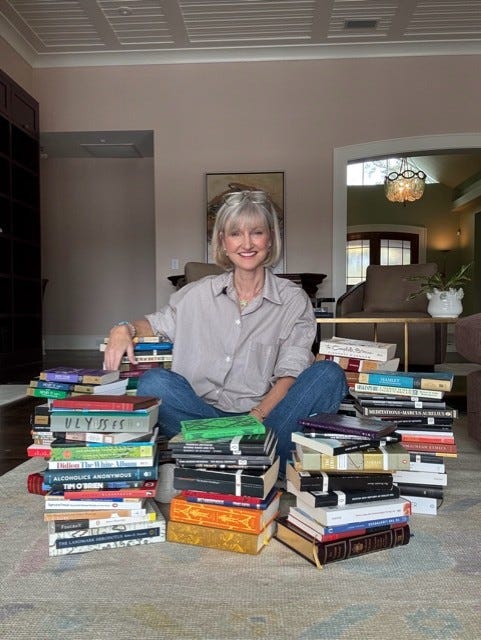
She now had questions for me. And I agreed to do this Q&A—which we are both publishing on our respective Substacks. You can find her at Crack the Book.
Below is our conversation.
Please support my work by taking out a premium subscription—for just $6 per month (even less if you sign up for a year).
Q&A with Ted Gioia (conducted by Cheryl Drury)
What led you to create your 52-week humanities reading program?
Many people want this kind of immersive education in the humanities—maybe even more so nowadays given the mind-numbing impact of apps and social media on our lives. People feel victimized by tech and mass media. They want to learn how to think more deeply, not just via soundbites and scrolling videos.
You probably feel it too—I know I do. Our attention span is degraded by the dominant digital culture. Our brains feel under attack. So it’s not surprising that a growing number of people are asking if these books, so rich in tradition and influence, might hold the key.
They’re on the right track. But they don’t know where to start. And even if they find some entry point, the task feels overwhelming. There are so many books, so many agendas.
So I set myself a challenge. I would design a complete survey of arts and culture in just 52 weeks. And I wouldn’t limit myself to Western culture—I’d try to cover the entire world.

That’s a tall order.
It sounded crazy. Was it even possible? I’d find out.
But, first, I added to the challenge. I would limit the required reading to 250 pages per week—that’s a demanding workload, but not impossible. And I would also add music recommendations, with the same global approach—there would be a playlist for each week. I’d also suggest online art galleries, so that the program would encompass visual arts too.
If I could pull it off, the upside would be enormous. By the end of the year, the student would have a powerful grasp of all the major ideas and worldviews that have shaped the history of human culture. They will have also gained an appreciation of the great works of literature, music, and art that have inspired generations.
What a fantastic way to spend a year. This just might be the most mind-expanding project you could possibly undertake.
Just thinking about this got me excited. But then I sat down and started to design a week-by-week plan. That was hard work.
I was lucky that I had some relevant experiences, not just in my own education, but also in teaching. As an undergraduate at Stanford, I had tutored freshmen in the university’s great books program—which tries to encompass 3,000 years of culture in one year of intense reading.
Back then, I helped these teens as they grappled with the assigned texts, and I’d seen firsthand how life-changing it could be. Now I would do something similar, but bring it to a larger group of readers.
What’s been the feedback on this list in particular? I know you’ve created a few different reading lists—you first got my attention when you shared the list about living with technology. But this was the biggest reading list of them all.
I didn’t know what to expect when I published the first installment of my humanities reading list. Sure, I knew how much I care about this kind of deep education. But would others feel the same?
As it turned out, the response was overwhelmingly enthusiastic. So many people reached out to me. They wanted to be part of this. They have a hunger for this kind of learning and feel starved by mainstream culture.
I guess I knew that already from my own education. But I also knew how many obstacles there are to this kind of learning. When I was a teen, I encountered smug responses to my own efforts to read the great books. I was told that this kind of education was not relevant for someone like me—a working class kid from an Italian-Mexican household with parents who had never gone to college.
I thought that was patronizing in the extreme. For me, reading Plato, Shakespeare, Dante, etc. was tremendously liberating. The people who tried to prevent me from getting this education were, in my opinion, the narrow-minded ones.
When you were paring your list down to 52 weeks, what titles were the hardest to cut?
It was painful to limit myself to just 250 pages of reading per week. That meant I often had to pick part of a book—because it was too long to be read in its entirety.
For example, I would love to have students read all of The Brothers Karamazov. Instead I focused on the most famous part of the novel—the section known as “The Grand Inquisitor.” It’s just 30 pages—but it’s a mind-blowing 30 pages. I made similar decisions about Proust, Joyce, and other authors.
What was the biggest challenge in doing this? Looking at the entire course now, what are the one or two things you’d change, if any?
I wish I could offer more support to readers—in terms of video lectures, discussion groups, etc. I’m just one person, and can lay out a week-by-week plan. But I can’t replicate a total educational experience.
But I do point readers to online resources—for example, the Catherine Project. I also encouraged readers to get together and create their own discussion groups.
That said, it is possible to learn on your own without institutional support. Most of my education happened that way. The key thing is to devote time to reading and thinking. As I recently said in an article, reading shouldn’t be a goal, it should be a habit.
One of the biggest surprises for me was in the very last week—I loved David Foster Wallace.
If I taught high school or college students, I would assign that specific book by David Foster Wallace—it’s called Something to Do with Paying Attention. I’ve given copies as gifts to young people because it grapples with the core issues they must face if they want to become responsible adults. It tells you the things they don’t teach in school.
It helps that it’s just 150 pages, and is an easy read. That’s not always true with Wallace’s work.
If you had created a Week 53 set in the early 21st century, who would you have included? Do you have your eye on anyone writing now who might eventually qualify for inclusion?
If I had an extra week to the course, I wouldn’t add any books. Instead I’d focus on cinema.
This is the biggest gap in the program. I talk to young people who haven’t seen even the obvious films—The Godfather, Casablanca, Citizen Kane, etc. The whole notion of black-and-white movies is strange to them, and they view silent films as equivalent to cave paintings from prehistoric times.
Maybe the best solution would be to add one movie per week to the assignments—that would give us 52 films over the course of the year. We could cover a lot of territory that way, and the films would be a fun break from reading.
Which of the books on this list are personal favorites of yours? I know you said that you didn’t agree with some of the authors, but that they needed to be included.
Were some of your favorites among those that you actually disagree with? By the way, this was a huge area of growth for me, learning to value authors who had viewpoints I disagreed vehemently with.
There’s a misconception about the so-called “great books.” Critics gripe that this kind of education is a propaganda campaign on behalf of the past, indoctrinating youngsters in outdated ideas. Nothing could be the further from the truth.
These books force you to think critically about your own time and the future we’re building together. They force us to define our own values and priorities. In other words, they demand a response and stir up debate. You don’t just accept them, you wrestle with them.
So, yes, I have many disagreements with these texts. For example, I am more aligned with Aristotle than Plato—but students need to understand both of those thinkers. I could give many other examples.
At every step, you are encouraged to fight with these authors. Even when you disagree, you will learn how to think more deeply, more clearly, by confronting viewpoints from outside your comfort zone.
In other instances, you will dismiss certain authors—but then realize how valuable they were years later. Your first introduction to them plants a seed inside your soul, and it grows over time.
Can you give me an example of that?
For example, I read Don Quixote as a summer project when I was twenty years old. I worked my way through the entire Samuel Putnam translation in two volumes, and felt very proud of myself. But I didn’t really understand what this book actually meant—it was just a pastiche or slapstick comedy, as far as I could tell.
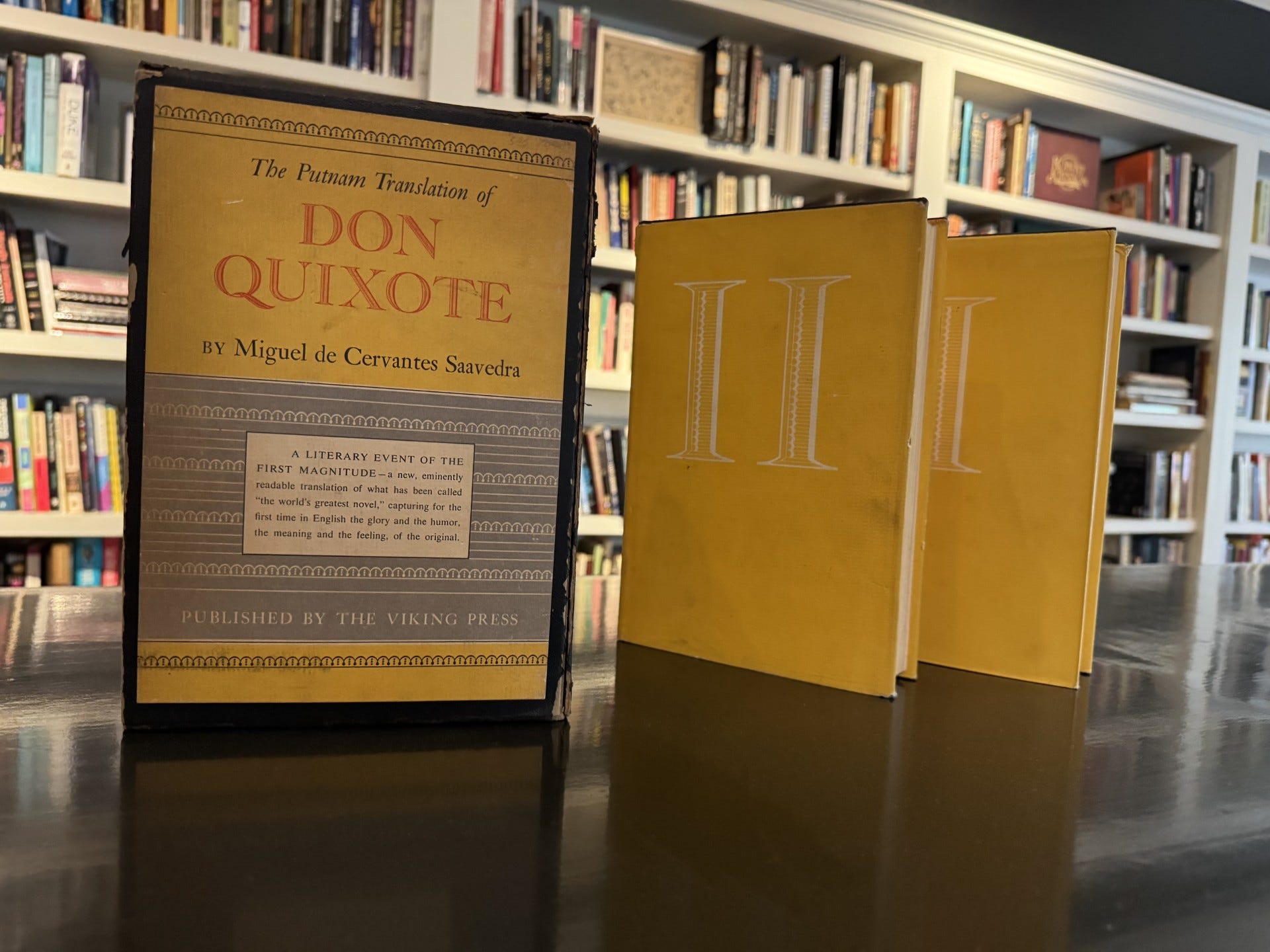
But years later, I had to research medieval literature on romance and chivalry while writing my book on Love Songs for Oxford University Press. I now saw that Cervantes was a towering figure, who changed the course of storytelling—deconstructing the popular myths of knights and jousts and lovely ladies (those were like the Star Wars of his day, tired franchises with too many reboots). He replaced these idealized myths with a new approach, which we now call the novel.
With the benefit of hindsight, I now see a double-edged approach in his great work. On the one hand, he mocks his protagonist Don Quixote, a deluded old man who still believes in the medieval myths. Cervantes even punishes Don Quixote, subjecting him to all sorts of indignities during the course of the book. But despite all this, the reader still loves Don Quixote.
We admire his loyalty to his ideals. The fact that Quixote’s worldview has now disappeared from society only makes us sympathize all the more. Even tilting at windmills is heroic, when viewed in this light.
By the way, this is a good metaphor for the entire project of studying the great books. We can find beauty in things that have disappeared from the world. We can still learn from them. I can embrace Don Quixote as a role model even if I know he was pursuing an impossible dream.
This kind of hermeneutic exercise is invaluable. We actually put ourselves in the proverbial shoes of another person, from another world. An education in the great books is our best way of cultivating this expansive mindset.
Why did you include the Mwindo Epic in your reading list?
The Mwindo Epic—a story from the Nyanga people of the Congo—may be the least well-known book on my list. Many people assume that Africa’s traditional literary sources have disappeared, because they were part of an oral culture that was never preserved in writing.
That’s not true. Some of these stories have been documented, written down, and published in books. Reading the book may not give you the full experience—the Mwindo Epic, for example, is traditionally performed by a bard accompanied by three percussionists. But confronting works of this sort, even on the page, is an essential part of a serious education.
For the same reason, I also included Sundiata, an epic from Mali. Both of these works are short and can be read in a single sitting.
Of course, there are other options. I might instead have assigned the Anansi tales from West Africa. The spider Anansi is the quintessential trickster, and thus is a counterpart to other characters from our reading list—for example, Homer’s Odysseus or Shakespeare’s Puck.
That’s the advantage of this kind of cross-border approach to culture. You see the power of the idea in the connections it makes across time and space.
In one of your rules for reading, you mention getting good advice on which books to read. Who are those sources for you? It seems like everyone wants to tell you what you should be reading, but everyone is not very smart, or wise. I ask this as I’m preparing a couple of deep-dive projects for myself.
I’m fortunate that my older brother is one of the most well-read and thoughtful people on the planet. He is seven years older than me, and from my childhood onward guided me to great books, music, visual arts, and films.
This provided not just an education, but an ongoing source of inspiration. People who have met Dana will know exactly what I’m saying.
Of course, I also had other great teachers, and took seriously what they told me. I recently dedicated my book Music to Raise the Dead to my teachers and mentors—and listed more than twenty of them on the opening page. I take these debts seriously.
What’s your current deep dive, if any?
I like to pick topics of interest, and then devote several months to intense study. Maybe I’ll read a dozen or so books on the subject. In recent years , I have done these deep dives into the origins of Romanticism, Shakespeare’s life and times, and the decline of the Roman empire. My next immersive reading project will probably focus on mysticism as a force in intellectual history.
I’m also pursuing a fun side project—reading works of fiction about chess. I just finished Stefan Zweig’s novel on the subject, and absolutely loved it. Next up is Nabokov’s novel The Luzhin Defense.
You can learn more about the 52-week humanities project at this link.
Amen for the 52 films
"Maybe the best solution would be to add one movie per week to the assignments—that would give us 52 films over the course of the year."
PLEASE, we want the 52 films!