


The first work of classical literature that thrilled me to the depths of my soul was the Odyssey. It made such a big impact that, decades later, I insisted on reading it aloud to my own children, hoping they would feel that same magic.
I was little more than a child back when I discovered Homer—12 or 13 years old, I’d guess. Back then I knew more about comic books than serious literature. But I was outgrowing Spiderman and Superman, and decided to take a chance on Odysseus.
I approached this book with fear and trembling—worried it might be too difficult. But I soon discovered that Homer was the Stan Lee of antiquity. He told adventure stories not much different from the ones peddled by Marvel or DC.
Please support The Honest Broker by taking out a premium subscription (just $6 per month).
I’d somehow gotten my hands on a tattered used paperback copy of the Odyssey, in a 1937 prose translation by W.H.D. Rouse—published by Mentor Classics (cover price when new = 60 cents). This is not a respected translation—they will never assign Rouse’s version of Homer at any Ivy League college.
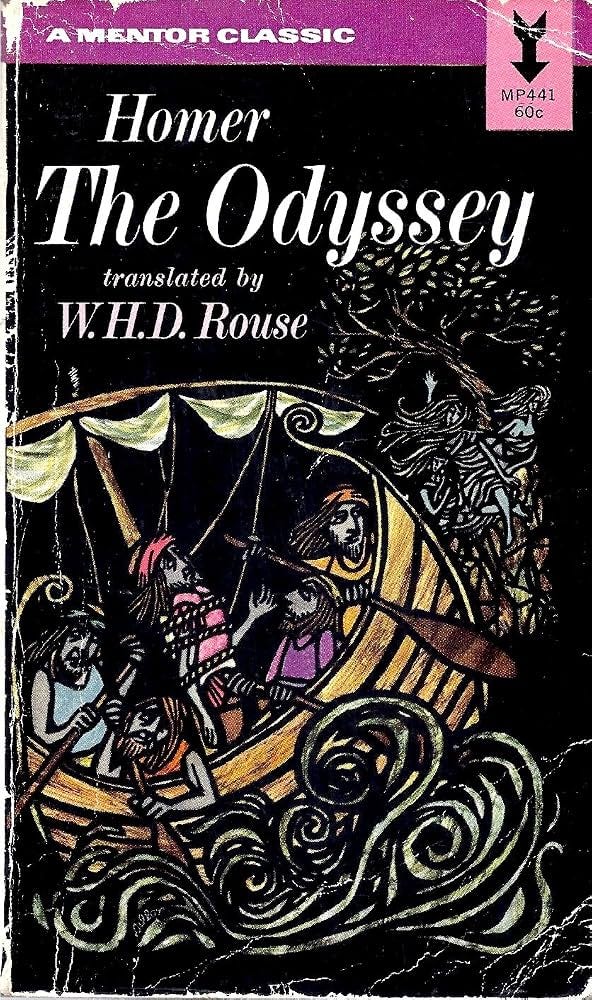
That’s because the legit translators try to convey this epic as poetry. Rouse made no attempt at that. He just turned Homer into everyday language, just like it was a pulp fiction story for the mass market.
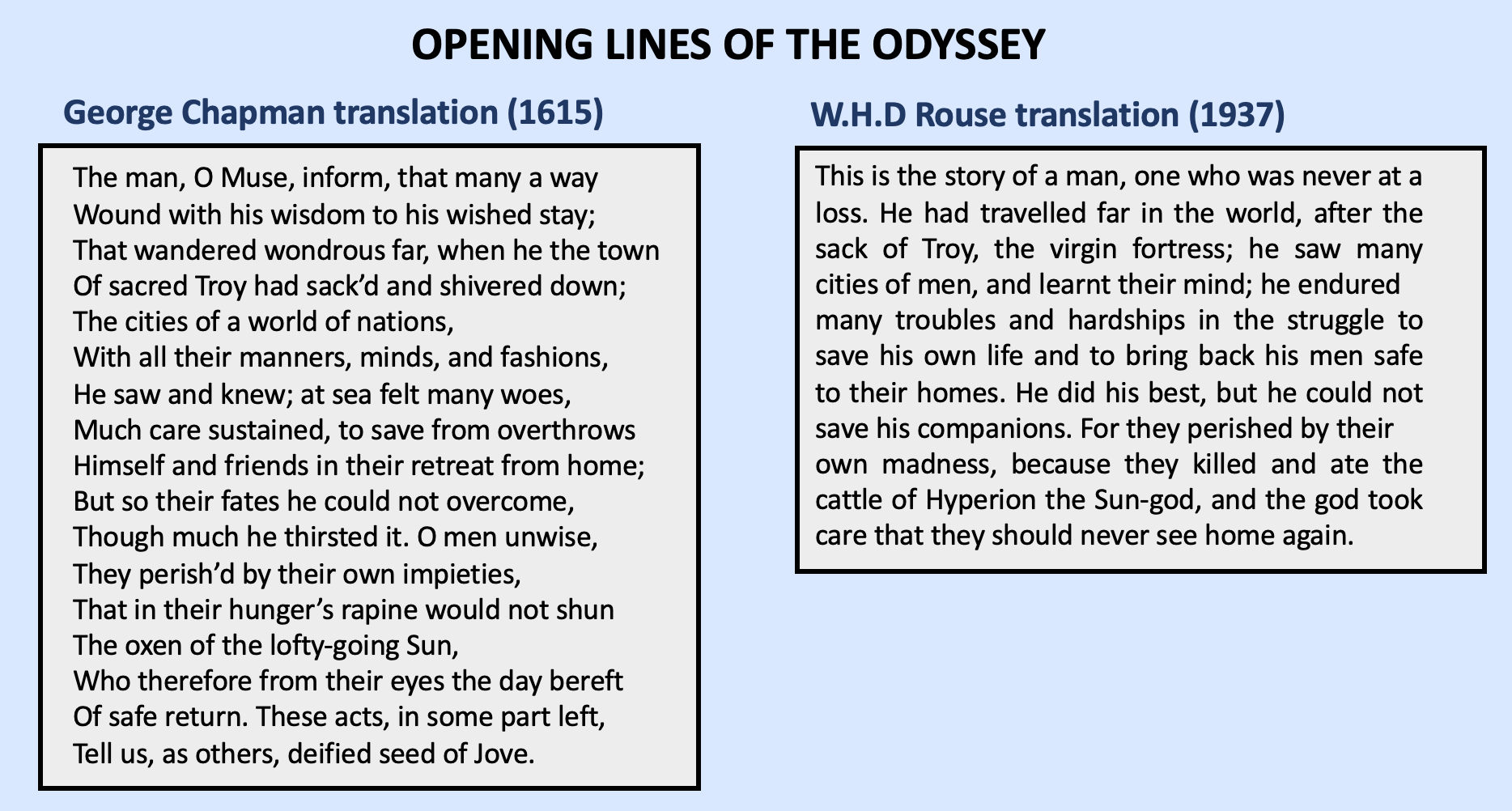
That was the right choice, he believed, because (as he wrote in his introduction): “The Odyssey is “the best story ever written….It has been a favorite for three thousand years.” Other translations of this book are, he claimed, “filled with affectations and attempts at a poetic language Homer himself is free from. Homer speaks naturally and we must do the same.”
You can see the difference by comparing Rouse’s rendering of the opening lines with the esteemed Chapman translation from Shakespeare’s era.
Is this the best version of Homer? I won’t go that far—years later I became very fond of Robert Fitzgerald’s translation. But I will insist that Rouse is the superior version for a youngster. And, in many ways, youngsters were Homer’s target audience—you can feel that at every turn in his story.
So this is the first thing about the Odyssey you won’t learn at Harvard—namely that this tale was not intended for Harvard elites. It’s a story for everybody. So it’s an obvious choice for a big-budget Hollywood movie. There was no pretension or elitism in Homer’s approach. In today’s parlance, you would say that he was appealing to a mass audience.
Director Christopher Nolan—whose screen version of the Odyssey makes its debut in London today—relied on the more recent Emily Wilson translation of the Odyssey into iambic pentameter. In her version, our hero is described, like Shaft, as a complicated man who won’t cop out (when there’s danger all about). Okay, she doesn’t use those exact words, but comes close….
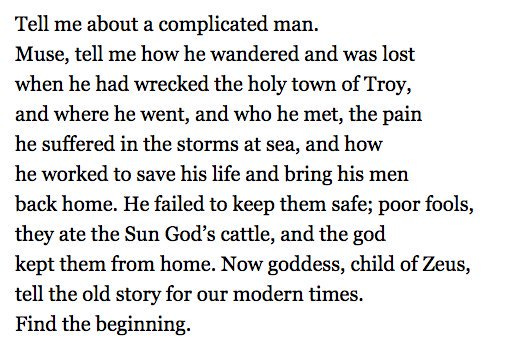
I like this rendering, and can almost hear that Isaac Hayes synth vamp in the background. Wilson is just as straightforward as Rouse—living up to her aspiration to “tell the old story for modern times.”
Yes, I’d love to hear Homer delivered with this music in the background.
And that brings me to my most important point….
If Nolan really wanted to be bold, he would take a far more radical step and reclaim the Odyssey’s original status as a song. In ancient Greece, this work was not a text—for the simple reason that few members of its audience could read. It was performed.
That’s a truth rarely mentioned—and the single most important fact about Homer that is hidden from view nowadays. His work ought to be taught in the Department of Music. But even music scholars have bought into the big lie that Homer is literature, not song.

So, if you track down the most influential books on Homer, you will find that they are all written by classicists or humanists, not experts on music. Even an astute scholar like Walter Ong, who focuses on the aural tradition in his influential book Orality and Literacy, scrupulously avoids discussing music—even though song is the origin of the entire aural tradition he celebrates.
I tried to rectify this in my books Music: A Subversive History and Music to Raise the Dead, where I reclaim Homer as part of our musical heritage. And it’s not just Homer’s epics that originated as music. The same is true of lyric poetry, philosophy, even the legal code—they were all originally sung.
And here’s where I (finally) give some credit to Harvard. We have a good idea of how these epics were sung because, almost a hundred years ago, two Harvard scholars tried to track down the last living epic bards.
These scholars were Milman Parry and Albert Lord. Parry did most of the initial work but, because he died young, much of the credit went to Lord—whose book The Singer of Tales is still the best starting point for learning about the real Homeric tradition. Those two academics deserve the same esteem accorded to Ong, McLuhan, Frye, Derrida, Searle, and other celebrated theorists of narrative and communication.
I first encountered The Singer of Tales as a college student, and was shocked to learn from Lord how much these epic singers resembled jazz musicians. That’s the third important fact about the Odyssey you won’t learn from Hollywood or your college Intro to Humanities course.
In both instances—the epic poet and jazz musician—the performer learns numerous stock phrases of specific metrical length, and often uses these repeatedly in live renditions. For Homer, these are the descriptors that recur in the Odyssey, such as “rosy-fingered Dawn” or “swift-footed Achilles.” Jazz musicians do the same thing, but their building blocks are known as “licks.”
This video—well known in jazz circles—provides fascinating examples of one such lick.
In 1935, Milman and Parry discovered a remarkable singer named Avdo Međedović—who was born in the Ottoman Empire circa 1875, before the days of commercial recordings. He was a true singer of tales, and accompanied himself on a one-string instrument called the gusle.
They captured performances by this amazing individual on film and in recordings and these provide a glimpse of what the Odyssey might have sounded like to its first listeners. I’d ask anyone who wants to grasp the reality of Homer to watch this short video.
This is the actual origin of the epic tradition—not those fancy books on the library shelves.
I wrote about this bard in my online book Music to Raise the Dead:
The gusle is played not for melodic embellishment or even what nowadays we call a bassline, but generates a pulsating rhythmic drone. Međedović’s singing, for its part, sounds like an incantation, and he appears to have fallen into a kind of trance. You can easily imagine listeners falling into a similar trance given the hypnotic and ritualistic nature of the proceedings.
The gusle also served another role for these singers, namely as a mnemonic support. Međedović displayed extraordinary memory skills, far beyond what the Harvard researchers believed was possible—at one point he performed a song for his visitors that went on for seven days. When it was later transcribed, this one song filled up more than 12,000 lines (by coincidence, the same length as Homer’s Odyssey).
A song that lasts for seven days? If that happened now, it would be some kind of stunt or avant-garde demonstration. Yet even in that context, you couldn’t imagine a singer performing 12,000 lines of lyrics from memory.
But precisely this happened in ancient Greece at the dawn of Western culture.
No Hollywood movie can adequately convey this kind of tradition, no matter how many superstars are in the cast or how much money is spent on special effects. What we learn from Avdo Međedović is that works like the Odyssey are ritualistic and trance-inducing. They are propelled by music and driven by rhythm. They cross a border beyond literature, and enter something more transcendent and metaphysical.
You won’t find any of that in a book, because it can’t fit inside a book. It’s too large for books. And if Hollywood could ever figure out how to transfer this type of creative ritual on to a screen, they would change the entire course of cinema. But is there a single director today capable of that degree of boldness?
This birth of literature out of a magical mystery song is our inheritance from the past—and one of incalculable value. We do ourselves a disservice if we don’t find ways of tapping into its primordial energy in the current day.
Where does that happen? That’s a subject for a different day and a different article. But I’ll say for a start that you won’t find it in a library or classroom.
It’s most likely to occur at live music events, especially those that possess ritualistic intensity.
Let’s both go on a quest to discover it—and keep each other posted.
Interesting that you make no reference to The Iliad. Without The Iliad the Odyssey is just a travel adventure. Planes, trains, and automobiles (see the John Candy movie) by other means. The Iliad is what gives The Odyssey its heft. The Iliad gives the Odyssey its moral and emotional weight. It's about a man suffering the staggering loss of his friends and comrades in basically a stupid war fought for no benefit to him. He gains nothing out of it. His kingdom wasn't in danger and he had no reason to fight. But he gave his word, his promise, to another ruler. He kept his word and his self respect. Now he has to keep his word to his wife. He loses basically everything, his friends, his compatriots in battle. After the fall of Troy the Greeks killed every male above the age of 12, raped all the woman and took them back to Greece as slaves. Odysseus sails home with none of that. Just his crew. No gold, no spoils of war, just his crew. And on the journey home he loses them, more because of their own selfishness and petulance than anything else Still they were his crew and a captain is responsible for his crew. He loses everything except his faith in his wife and family. He keeps his word to her and she keeps her word to him. The Odyssey is a story about a man keeping his word even to others who don't deserve it but most importantly to those who do.
I love everything about this essay, especially listening to Shaft for the first time in decades. It IS a great song and it WOULD be a great background for the Odyssey. How enchanting to learn about Međedović - how happy it makes me to think that maybe just maybe something like this pulsating background was how Homer himself may have sung it. (Also, thanks for the Rouse recommendation - yes I got it on Kindle just now and no I am not a kid and yes I anticipate this will finally get me all the way through the Odyssey.)