
The Hottest Musician in 2026 Is 'Problematic' Michael Jackson
And that's exactly what the music business wants

A few days ago, a major newspaper published an unusual piece of film criticism. The author wants fewer films released—has a journalist ever asked for that before?
The writer’s hate is targeted on one specific genre: Musician biopics. “Aren’t we tired?” asked journalist Rebecca Shaw. “Wouldn’t it be a good time after four individual Beatles movies to have a break from this genre?”
She won’t get her wish. The exact opposite will happen.
We are still in the early days of pop and rock biopics. There are more coming—a lot more. A few days ago, Paramount signed a multiyear deal with Warner Music, which gives it a “first look” movie option on the label’s roster of music stars.
There aren’t any projects in development, though WMG’s roster includes legends like David Bowie, Cher, Phil Collins, the Eagles, Fleetwood Mac, Aretha Franklin, Led Zeppelin, Madonna, Joni Mitchell, and Frank Sinatra, as well as contemporary stars such as Charli xcx, Coldplay, Dua Lipa, Bruno Mars and Cardi B.
As if that’s not enough, Warner Music has a totally separate deal with Netflix, focused on making music documentaries. And the next step is obviously AI-generated music videos or full-length films with those same artists.
They will milk that roster like it’s a prize Jersey cow. The more moos, the more moolah.
And you can bet your bottom stablecoin that every other big label is looking to sign similar deals. After all, the entire music industry wants to make bank on dead musicians—not living ones (they’re too cranky and hard to manage).
Nothing can stop them. That great bandstand in the sky is filled with talent. And in a music culture where most of the biggest names are septuagenarians or octogenarians or some-other-even-older-genarian, the ranks of the glorious departed are poised for rapid growth.
Yes, if you’re a musician, there’s never been a better time than now to be dead. Hollywood and the music industry are in total alignment on this.
And they now how have Michael to point at.
Please support The Honest Broker by taking out a premium subscription (just $6 per month).
Maybe you thought Michael Jackson was canceled. After all, he faced repeated abuse allegations, and even made a big settlement to avoid trial—with more accusations coming to light after his death.
Maybe you thought Hollywood is driven by cancel culture. I keep hearing that nowadays.
But I now know better.
I’ve always been skeptical and conflicted about cancel culture. (See my views here.) But even I’m surprised by how fast it has disappeared as an economic force (and not just social media noise—which, like death and taxes, is now eternal).
In fact, there are plenty of recent examples of artists getting a boost from cancellation.
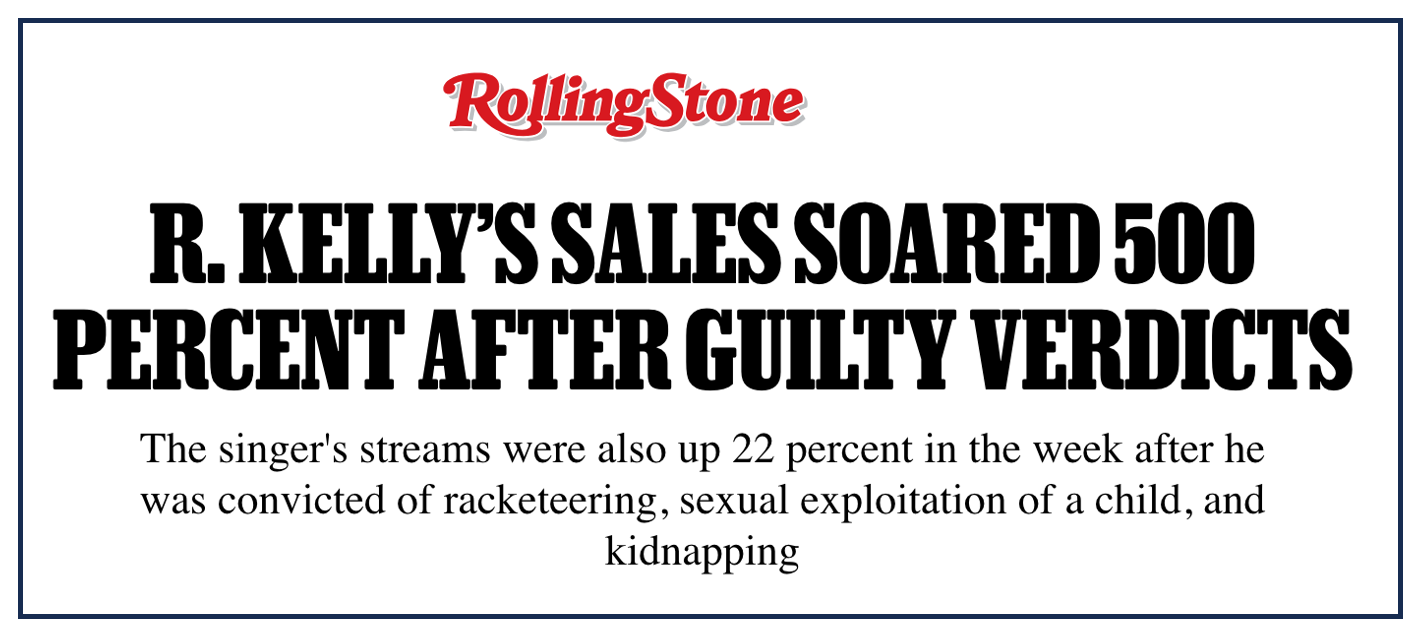
Here’s the unspoken truth: Everything in Hollywood is driven by money—and if the audience wants Michael Jackson, despite all the scandals, the entertainment industry will deliver him on a silver platter.
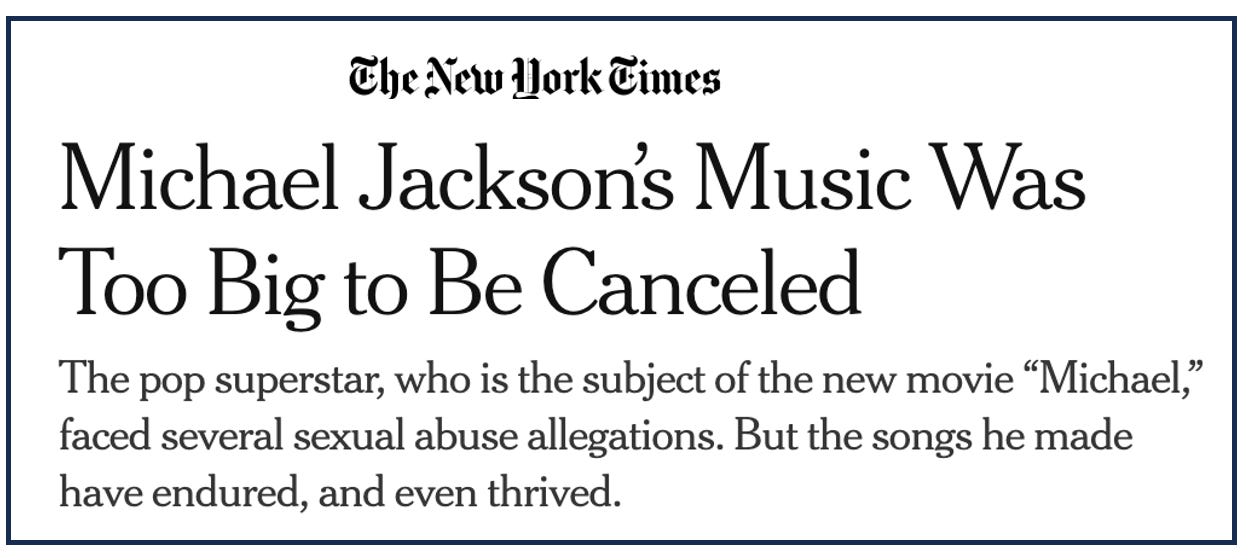
Even so, many were still skeptical about a Michael Jackson biopic. Hollywood wagered $200 million on this film—but what about that audience? Would mainstream America actually buy off on this? Can you really ignore this artist’s problematic private life in our sensitized post-Epstein environment?
We now know the answer is a resounding yes.
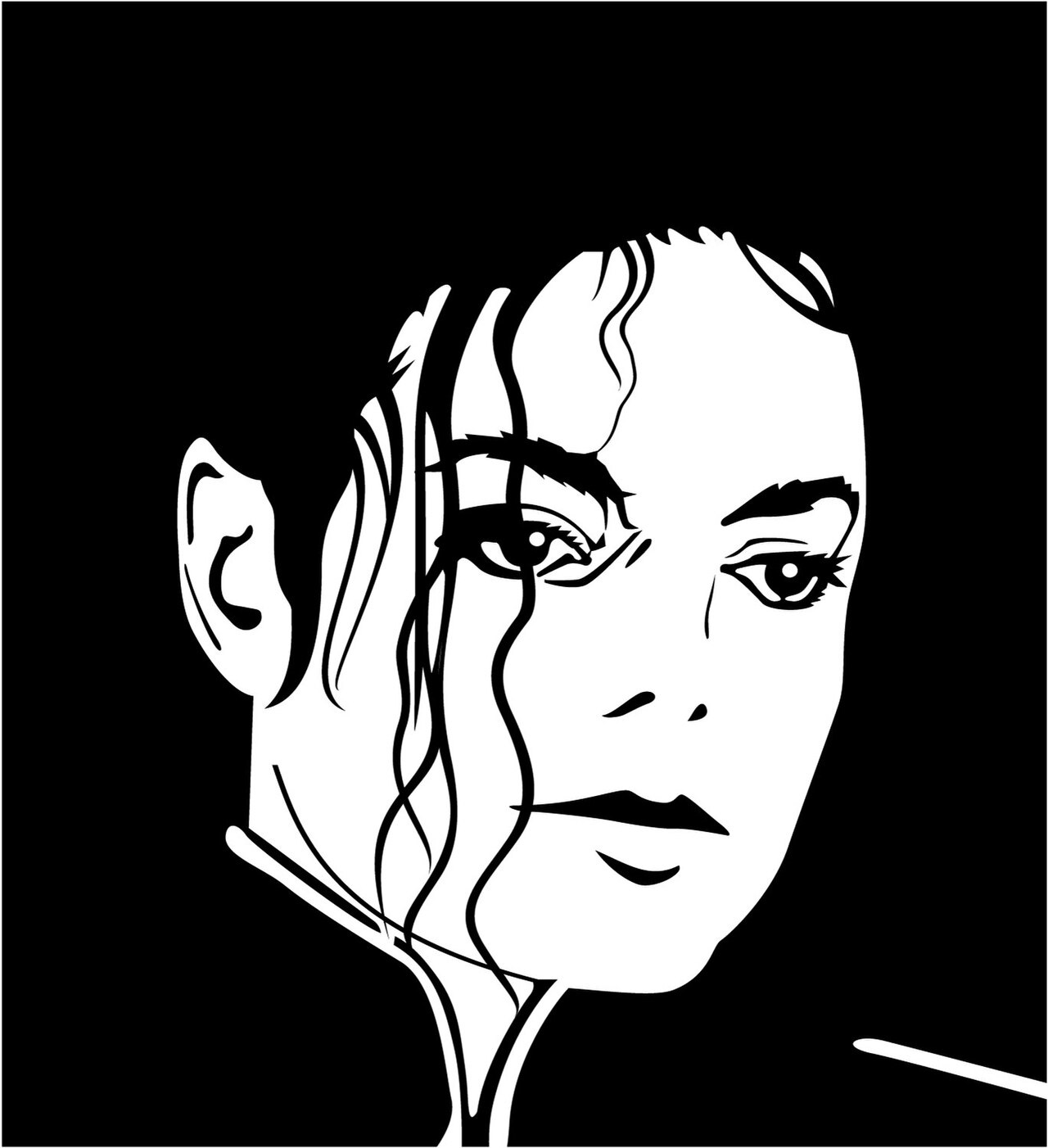
The Michael biopic is drawing huge crowds, and is the hottest movie in the US right now. The film has generated a stunning $700 million in ticket sales since its debut four weeks ago—that already makes it the second biggest music biopic in history, beating out Elvis (2022) and poised to surpass Bohemian Rhapsody (2018).
In a spillover effect, Michael Jackson songs have returned to the charts after the release of the film. This is a dream come true for the major record labels—their highest priority in 2026 is to shift the focus of the music industry from new songs to old songs. A few years ago, that might have seemed an impossible task, but it’s actually happening.
Check out the biggest hit songs right now. It’s not just Thriller thrilling again—the whole list is yesterday’s news.
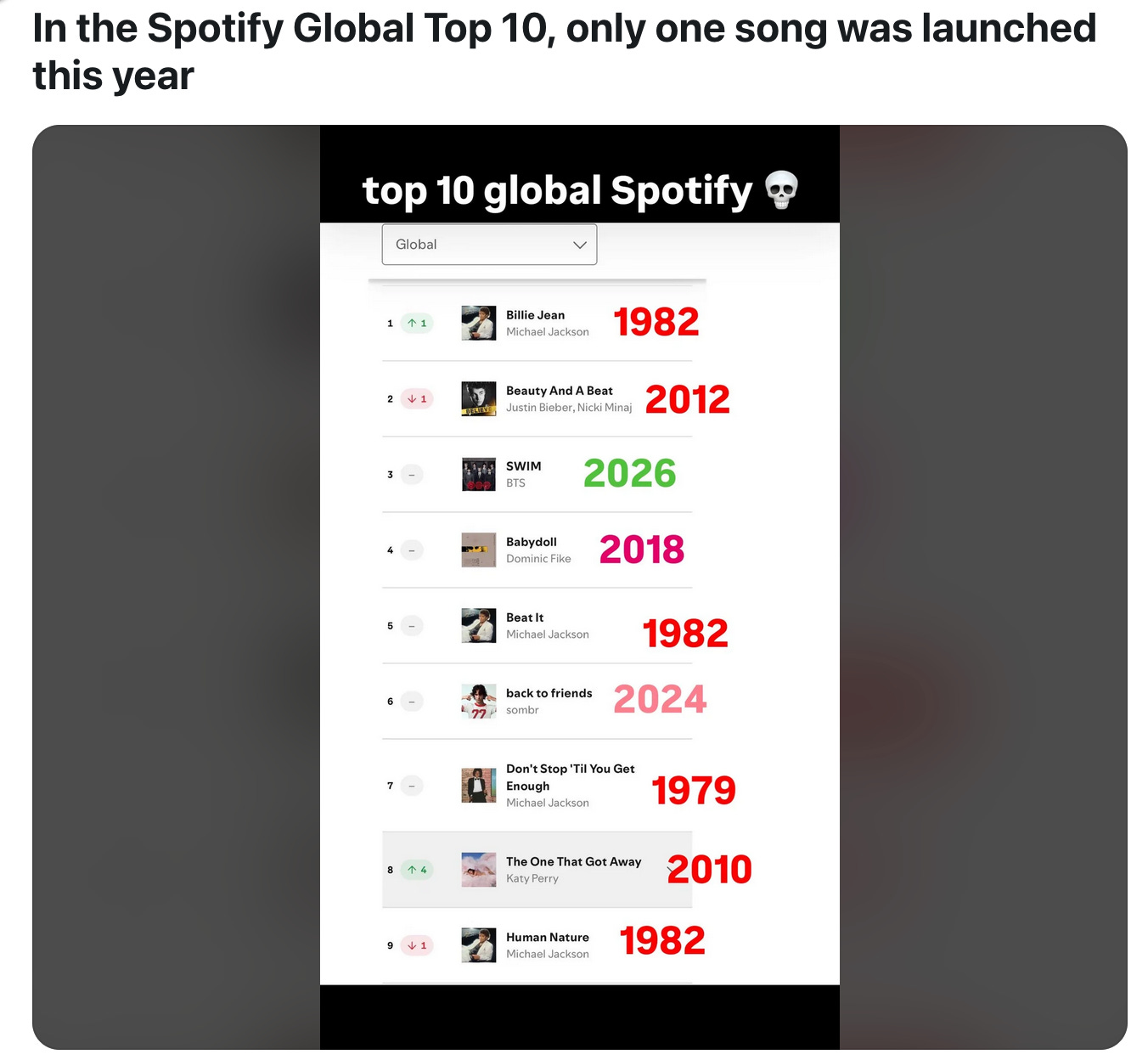

The last time old songs were this popular happened before the Renaissance, during the so-called Dark Ages. Back then, the Church imposed this reverence for antiquated music. Nowadays the same thing is happening, but the proponents are the lawyers, accountants, and wannabe private equity bros who run the music business.
Get ready for more of this—in both the music industry and the film business.
Hollywood may still be in a state of crisis, but movies about musicians are hot—seven out of the top ten all-time singer biopics were released within the last decade. Even as superhero and sci-fi movie franchises falter, these celebrations of hit songs of yore gain in popularity.
You might say that music movies are the new franchises—and will get the same sequel/prequel/spinoff treatment
It’s already happening. For example, the first Elvis movie from 2022 was followed by a second one, directed by Sofia Coppola (told through the perspective of Priscilla Presley) in 2023. The King also shows up in Elvis and Nixon (2016), the Sun Records TV series (2017), and the HBO two-part documentary Elvis Presley: The Searcher (2018).
Yes, Elvis is alive—at least as a box office phenom. Or consider the four Beatles movies slated for release in 2028. Meanwhile those other franchises (Star Wars, Indiana Jones, etc.) are in the doldrums.
Michael Jackson is also destined for franchise status. The Michael biopic ended in the late 1980s, and left viewers with a teaser quote: “His story continues.”
“We absolutely have more story to tell,” brags studio exec Adam Fogelson. And if they can turn a tiny Hobbit into three films running 532 minutes, just imagine what they can do with the King of Pop—with his 35 gold records and all that Jackson 5 prequel material. If people keep buying tickets, the story could go on forever.
All this might not be so bad if musician biopics weren’t so fake. The whitewashing of Michael Jackson is just another example of the phoniness. I’m now old enough to watch films of this sort where I knew personally some of the people portrayed onscreen, and the gap between the film and reality is wider than Snake River Canyon—and way too wide to jump if you care at all about the real artists and real history behind these films.
Don’t get me wrong. I still enjoy these movies—but almost solely for the songs. The wise director puts them at the forefront of the film.
Bohemian Rhapsody is a perfect example of this. Most of the last half hour of the movie is just the reenactment of a single concert. That left us all feeling good when we walked out of the movie theater.
Yes, this is how you make a musician biopic.
So now you know that I’m no Grinch. I like familiar hit records as much as any other Who in Whoville. But I also like new music.
That’s always where vitality and excitement reside in our culture. That’s where surprises are still possible. That’s where the future is born.
Not long ago, Hollywood made millions of dollars from movies that featured all new songs. Can you believe it? Those films were called musicals, and in many years they were the biggest box office successes in the land.
Families would go see The Wizard of Oz or The Lion King or Mary Poppins, and fall in love with music they had never heard before. Disney exists as a film powerhouse today almost solely because its founder built his blockbuster movies around new songs. His successors have forgotten how to do that—or maybe they are just too lazy or risk-averse to try.
I’d like to see that happen again. And I don’t see why it’s not possible.
In those days, there were also movie musicals featuring rising pop and rock stars. The Beatles made movies with all new music. Elvis did the same. These happened at the outset of their careers, when they breaking down barriers and creating new sounds. Now those very same artists, most of them dead, are coming out with movies again—but they’re filled with songs old enough to get a 15% discount at Denny’s.
Sure there’s also a place for these jukebox movies filled with melodies from the last century—just like there’s a place for karaoke and cover bands and all those other tributes to the past. But none of these tributes would exist if some innovative musicians (and their record labels) hadn’t been willing to take a chance on these songs when they were new and untested.
So go ahead and see Michael. Feel free to stream all his old hits, and get up and do a moonwalk dance, too, if you want. But let’s also leave some space in the culture for new musicians, new songs, and new stories. Otherwise we’re just living in the past—and that’s a terrible disservice to the future.
"But let’s also leave some space in the culture for new musicians, new songs, and new stories. Otherwise, we’re just living in the past—and that’s a terrible disservice to the future." Hear, hear!
For the target group for these offerings, the past is a fantasy they seek to escape into from an intolerable, confusing, and mostly hopeless present. Those of us for whom that past is history are an annoyance – and easy to consider irrelevant.