
The Best Online Articles of 2025
My favorite longform writing of the year


Every December, I showcase the work of other writers. They are total strangers to me, but have written some article or essay of exceptional merit during the previous 12 months.
So I share their work with you—to expand their audience, and give you access to writing you might find enjoyable or enlightening or inspiring.
Below is this year’s list of my favorite online articles. As always, I focus mostly on writing about music, arts, media, and culture. But I’m willing to include almost anything, if it captures my fancy.
If you have suggestions to add to the list, please share them in the comments.
Happy reading!
If you want to support my work, please take out a premium subscription—for just $6 per month (even less if you sign up for a year).
The Best Online Articles of 2025
“Vanity Fair’s Heyday” by Bryan Burrough, The Yale Review, March 14, 2025
I’m probably breaking some unwritten law of publishing, but here it is: For twenty-five years, I was contracted to produce three articles a year, long ones, typically ten thousand words. For this, my peak salary was $498,141. That’s not a misprint—$498,141, or more than $166,000 per story. Then, as now, $166,000 was a good advance for an entire book. Yes, I realized it was obscene. I took it with a grin….
“Finding Peter Putnam” by Amanda Gefter, Nautilus, June 17, 2025
The 60-year-old man lying on the street, as far as anyone knew, was just a janitor hit by a drunk driver. There was no mention of it on the local news, no obituary in the morning paper. His name might have been Anonymous. But it wasn’t.
His name was Peter Putnam. He was a physicist who’d hung out with Albert Einstein, John Archibald Wheeler, and Niels Bohr....
Robert Works Fuller, a physicist and former president of Oberlin College, who worked closely with Putnam in the 1960s, told me in 2012, “Putnam really should be regarded as one of the great philosophers of the 20th century. Yet he’s completely unknown….”
“The Naval Scientist Who Wanted to Know How Football Players Would Survive Nuclear War” by Chris Roberts, Defector, January 24, 2025
In January 1955, a lifelong football fan approached Lou Spadia, the general manager of the San Francisco 49ers, with a peculiar request: Would his players like to participate in a science experiment at an atomic research lab?
It wouldn’t take much, the fan explained—just some radioactive material inside the players….
“The DIY Maestro” by Naomi Buck, Toronto Life, November 10, 2025
The 78-year-old multimillionaire and tech entrepreneur had made small waves in Toronto’s classical music community. Without any formal musical training, Cheung has been paying to conduct the greatest works of the classical canon with the best musicians he can find. Opinions varied wildly. Some said he couldn’t conduct to save his life, others that he was actually quite good. Some called him an egomaniac, others a true patron of the arts. There was consensus on one thing only: Mandle Cheung paid well….
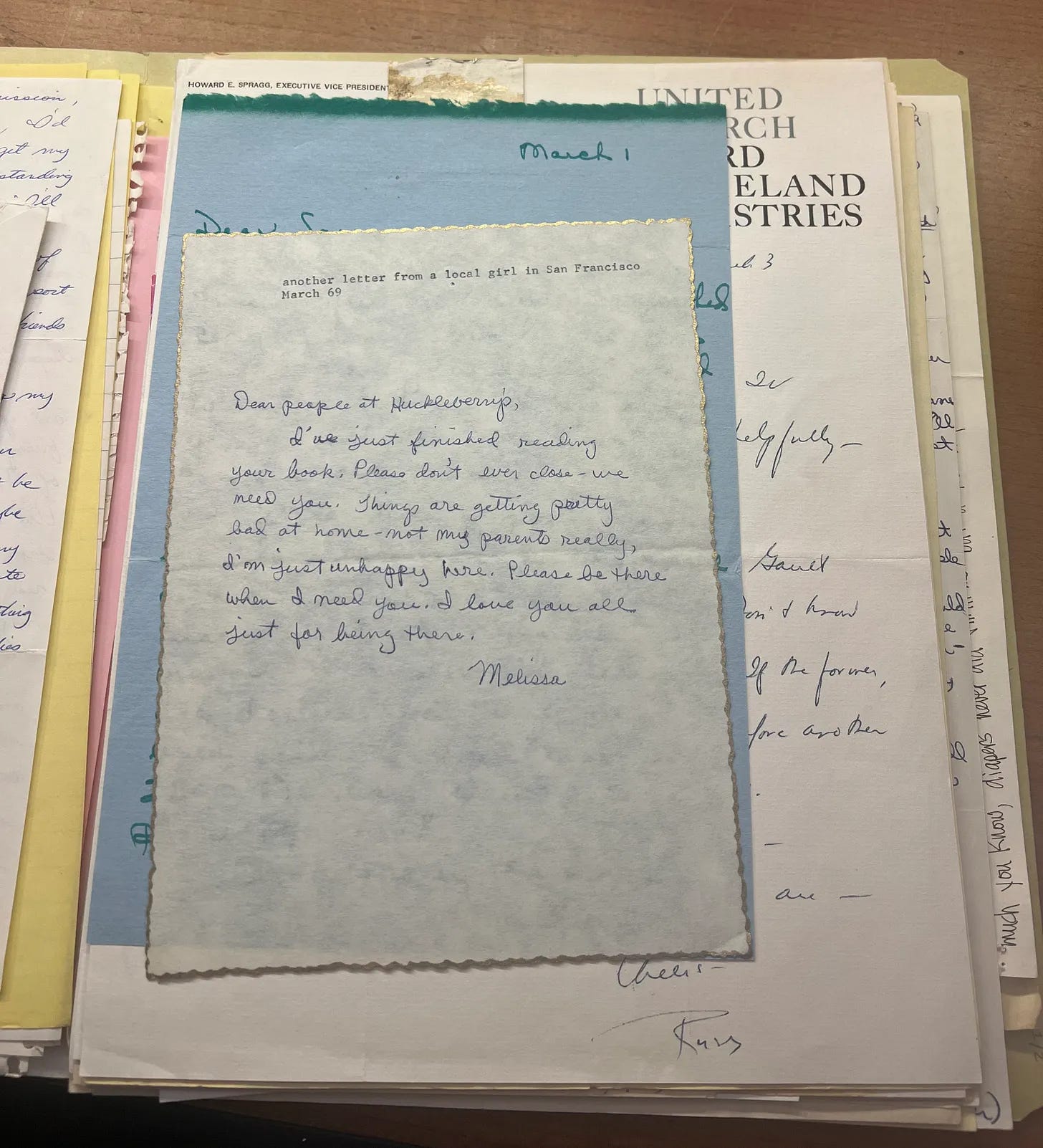
“The Kids Who Ran Away to 1960s San Francisco” by Zelda, Inside the Shell, December 2, 2025
While skimming through the house’s Wikipedia page, I discovered that archives on its history were available at the main library of San Francisco, including:
The ACTUAL letters exchanged between teen runaways and the house’s founder during the 60s!
I can’t explain the rush of adrenaline that gave me….
“A Love Letter to Music Listings” by Gabriel Kahane, The Atlantic, July 27, 2025
Over the past decade, event listings have all but disappeared. The New York Times killed its weekly arts listings at the end of 2016, and its online arts-and-entertainment guide remains frozen, like a butterfly pinned and dried, in March 2020….The Village Voice folded in 2018. (It has recently been revived but has no listings section to speak of.) The New Yorker’s Goings On About Town section was slashed in 2023 to just a page or two, now offering one recommendation per discipline. And Time Out, that veritable doorstop of weekly listings, now previews one or two concerts a month….
“The ‘Exciting Business Opportunity’ that Ruined Our Lives” By Andrea Pitzer, The Atlantic, January 30, 2025
The name Amway, she told me, was short for the “American Way.” We could sign up and buy products we already needed for the house, then sign up friends and neighbors to buy things, too. We would get rich by earning a little bit from everything they sold….
“The World Happiness Report Is a Scam” by Yascha Mounk, Yascha Mounk’s Substack, March 20, 2025
You would expect the happiest countries in the world to have some of the lowest incidences of adverse mental health outcomes. But it turns out that the residents of the same Scandinavian countries that the press dutifully celebrates for their supposed happiness are especially likely to take antidepressants or even to commit suicide….
“Alice Coltrane’s Lost Ashram” by Santi Elijah Holley, Alta, February 6, 2025
I am standing alone on an isolated plot of land in the Santa Monica Mountains, about a 30-minute drive northwest of Malibu, in the small, unincorporated community of Agoura. As I look around, it’s nearly impossible to comprehend that this barren site was once home to the worship community of one of the most celebrated names in spiritual jazz music….
Gift subscriptions for The Honest Broker are now available.
“Life on a Blacklist” by Perry Link, China Book Review, April 3, 2025
One of the questions I am asked most often is what it feels like, as a China scholar, not to be able to go to China. I have been denied visas since 1996. I do not know the reason (the authorities won’t specify), although I can see that the number of possibilities is large….
“‘Book Boyfriends’ and ‘Shadow Daddies’: The Men Cashing in on Romantasy” by Decca Muldowney, The Verge, April 11, 2025
Fell in love with a faerie king on the page? It doesn’t have to be a private experience. With the help of TikTok’s book community and its own influencers, there’s a growing world of book-themed fantasy balls. Now, you can spend the night twirling with him on the dance floor….
“The Shrouded, Sinister History of the Bulldozer” by Joe Zadeh, Noēma, February 20, 2025
Many technological innovations have spiritual origins, and so it is with the bulldozer. The Vermont-born industrialist Robert G. LeTourneau, who had the greatest impact on its early development, was an eccentric evangelical Christian who believed that he created his machines in collaboration with God. “God,” he declared, “is the chairman of my board….”


“The Radical 1960s Schools Experiment That Created a Whole New Alphabet —and Left Thousands of Children Unable to Spell” by Emma Loffhagen, The Guardian, July 6, 2025
The Initial Teaching Alphabet was a radical, little-known educational experiment trialled in British schools (and in other English-speaking countries) during the 1960s and 70s. Billed as a way to help children learn to read faster by making spelling more phonetically intuitive, it radically rewrote the rules of literacy for tens of thousands of children seemingly overnight. And then it vanished without explanation….
“The Making of the Buru Quartet” by Joel Whitney, The Believer, March 27, 2025
After his release from Buru in 1979, Toer’s fame would grow in tandem with the public’s recognition of what he underwent—and accomplished. He told interviewers about his struggle to write in what he called a “concentration camp” on a sweltering island….For the Buru Quartet, the four novels he wrote while imprisoned, Toer was nominated for the Nobel Prize and won several prestigious international literary prizes. His writing has been compared to that of Dickens, Camus, and Baldwin….
“The Mother Who Never Stopped Believing Her Son Was Still There” by Sarah Zhang, The Atlantic, My 16, 2025
In 2003, Terry Wallis, in Arkansas, suddenly uttered “Mom!” after 19 years as a vegetative patient in a nursing home. Then he said “Pepsi”—his favorite soft drink. After that, his mother took him home….
“The Claims of Close Reading” by Johanna Winant, Boston Review, November 26, 2025
The English department had a lovely old brick building, but there were hallways of empty offices after colleagues left and weren’t replaced….All of this is true, but it’s not the only truth. Because several times a week I walked into classrooms of students. Nothing there was missing: my classes were full in every way. Where everything else everywhere else felt exhausted, the classroom was overflowing, plentiful….
“Why Would He Take Such a Risk? How a Famous Chinese Author Befriended His Censor” by Murong Xuecun, The Guardian, April 17, 2025
Online dissent is a serious crime in China. So why did a Weibo censor help me publish posts critical of the Communist party?…
“We Did the Math on AI’s Energy Footprint. Here’s the Story You Haven’t Heard.” By James O’Donnell and Casey Crownhart, MIT Technology Review, May 20, 2025
Three months later the company launched a larger, higher-quality model that produces five-second videos at 16 frames per second (this frame rate still isn’t high definition; it’s the one used in Hollywood’s silent era until the late 1920s). The new model uses more than 30 times more energy on each 5-second video: about 3.4 million joules, more than 700 times the energy required to generate a high-quality image. This is equivalent to riding 38 miles on an e-bike, or running a microwave for over an hour….
“‘I Am Not Who You Think I Am’: How a Deep-Cover KGB Spy Recruited His Own Son” by Shaun Walker, The Guardian, April 10 , 2025
Rudi Herrmann took a deep breath and asked his son Peter to sit down. “I have a story to tell you,” he said. Rudi had been preparing for this conversation for several years, running over the words in his mind. He was about to tell his 16-year-old son that everything Peter thought he knew about their family was a lie….
“A Life in Zen” by Anshi Zachary Smith, Aeon, August 1, 2025
Suzuki arrived in California with answers. At a dilapidated temple founded for Japanese immigrants in San Francisco’s Japantown, he slowly defined the trajectory of Zen in the US. ‘Just sit,’ he told his followers. ‘Just breathe….’
“The Chess Cheating Epidemic” by Danny Rensch, Quilette, September 16, 2025
Hans Niemann was one of the players who everyone had been whispering about. He’d had a startling rise in the ratings over the previous eighteen months, and there was a great deal of speculation about how he’d pulled it off. People believed he’d cheated in cash tournaments online, specifically on Chess.com, and it had become an openly debated question as to whether or not Hans was cheating in over-the-board tournaments as well….
“What’s Not to Like” by Max Byrd, The American Scholar, July 24, 2025
Similes! I have hundreds of them on three-by-five notecards, highbrow and lowbrow, copied from newspapers, comic strips, sonnets, billboards, and fortune cookies. My desk overflows with them. They run down to the floor, trail across the room into the hallway. I have similes the way other houses have ants….
“I’ve Gone to Look for America” by Masha Hamilton, Atavist, September 30, 2025
We’re on the road, my oldest son and I, traveling nearly 2,000 miles on Interstate 95 from Miami to Maine, and pausing at virtually every rest stop. Our project is simple and vast at once: to ask fellow travelers where they’re headed, and where they think America is going too. I take notes. Cheney takes photos….
Just a quick note that the post by Fyodor is AI-written. I'm not sure (or hopeful?) that this is what you meant to promote...
As Fyodor explains on his About page: "The AI’s contributions, though generated, are shaped by the essence of Dostoevsky’s narrative techniques, themes, and ideas."
My husband Peco wrote an essay in response to Fyodor's viral piece, "Dear Dostoevsky: Should we take advice from AI" https://pilgrimsinthemachine.substack.com/p/dear-dostoevsky-should-we-take-advice
As an emerging writer and non-native English speaker, I feel honored to have made it to this list, Ted. And I'm delighted that the story of the runaway kids who made it to San Francisco in the 60s will be read by many more!