
The 50 Essential Western Films (Part 2)
In this installment, I cover the period from 1955 through 1968


Below I continue my survey of 50 essential western films. (Click here for part one.) I’m sharing these in chronological order. In this installment, I cover films released from 1955 through 1968.
It was a strange period for cowboy movies. The mass audience would soon abandon the genre, turning instead to space operas, disaster films, and superhero movies. The whole idiom sometimes now felt like a tired string of clichés—almost the antithesis of the free and untamed ethos that had originally made the Wild West so appealing.
But this shift in preferences also allowed—or even required—directors to take more chances when dealing with western themes. So in some ways, this end-of-an-era mentality produced many of the most innovative films in the genre’s history.
Please support my work—by taking out a premium subscription for just $6 per month.
The 50 Essential Western Films (Part 2)
Bad Day at Black Rock (1955)
This film is as tightly constructed as a Greek tragedy, and even abides by the three Aristotelian unities of time, space, and action. The entire drama plays out over the course of a single day in Black Rock, a small desert outpost, where a World War II vet named John Macreedy (Spencer Tracy) attempts to repay a favor to a Japanese soldier who saved his life on the battlefield. But he finds himself unexpectedly caught up in a criminal investigation, with the entire town conspiring against him.
The film features five past or future Oscar winners—Tracy, Ernest Borgnine, Lee Marvin, Walter Brennan and Dean Jagger—who between them would eventually earn eight Academy Awards for acting. That’s essentially half of the cast, and it ensures a gripping ensemble performance rarely surpassed on screen.
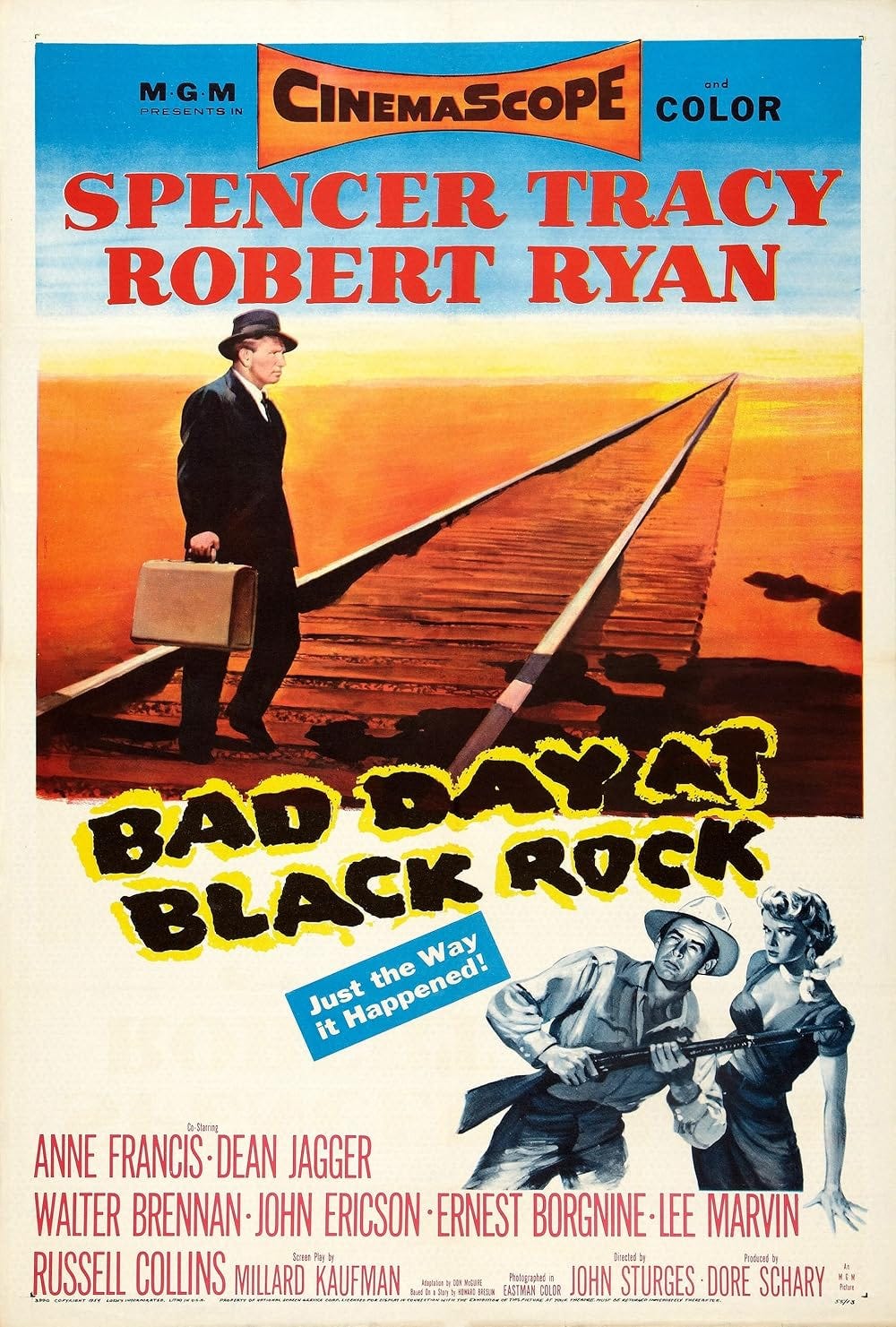
Together they create a slowly building tension finally resolved in a fiery desert confrontation. The widescreen CinemaScope technology is artfully employed, and André Previn makes full use of its stereophonic capability for his brash, electrifying score. This film has been unfairly forgotten, but rewards repeated viewings.
The Searchers (1956)
John Wayne was often criticized for playing the same role over and over. But that’s not entirely fair. As we’ve already seen with Red River (1948), he sometimes took parts that undercut the simple heroism of his public image, defying the standard formulas of the genre.
In The Searchers, Wayne plays a Civil War veteran on a mission to find his niece, abducted by Comanches. But he grows obsessed with vengeance and hatred—no doubt shocking moviegoers unready for this ignoble side of the Duke. Yet The Searchers undercuts its disruptive story lines with the sheer beauty of its delivery. Director John Ford, taking full advantage of Technicolor technology, never made a more visually stunning film.
Even from that first scene, when the cabin door opens, you know you’re in for a magical experience. It’s like that other Hollywood doorway leading to Oz, or the journey to Narnia from the back of a closet. You almost feel as if you’re leaving your seat in the cinema and entering a spectacle from a different time and place.