
My Gripe with LeBron James
Am I the only person who feels this way?


Every now and again, I write about sports. But I only end up showing how out-of-touch I am.
Ah, I’ve put my foot into it again, with my response to LeBron James’s announcement that he is moving on—one more time—to a new team. This was my initial take on today’s “last decision” (as he describes it) to join the Philadelphia 76ers.
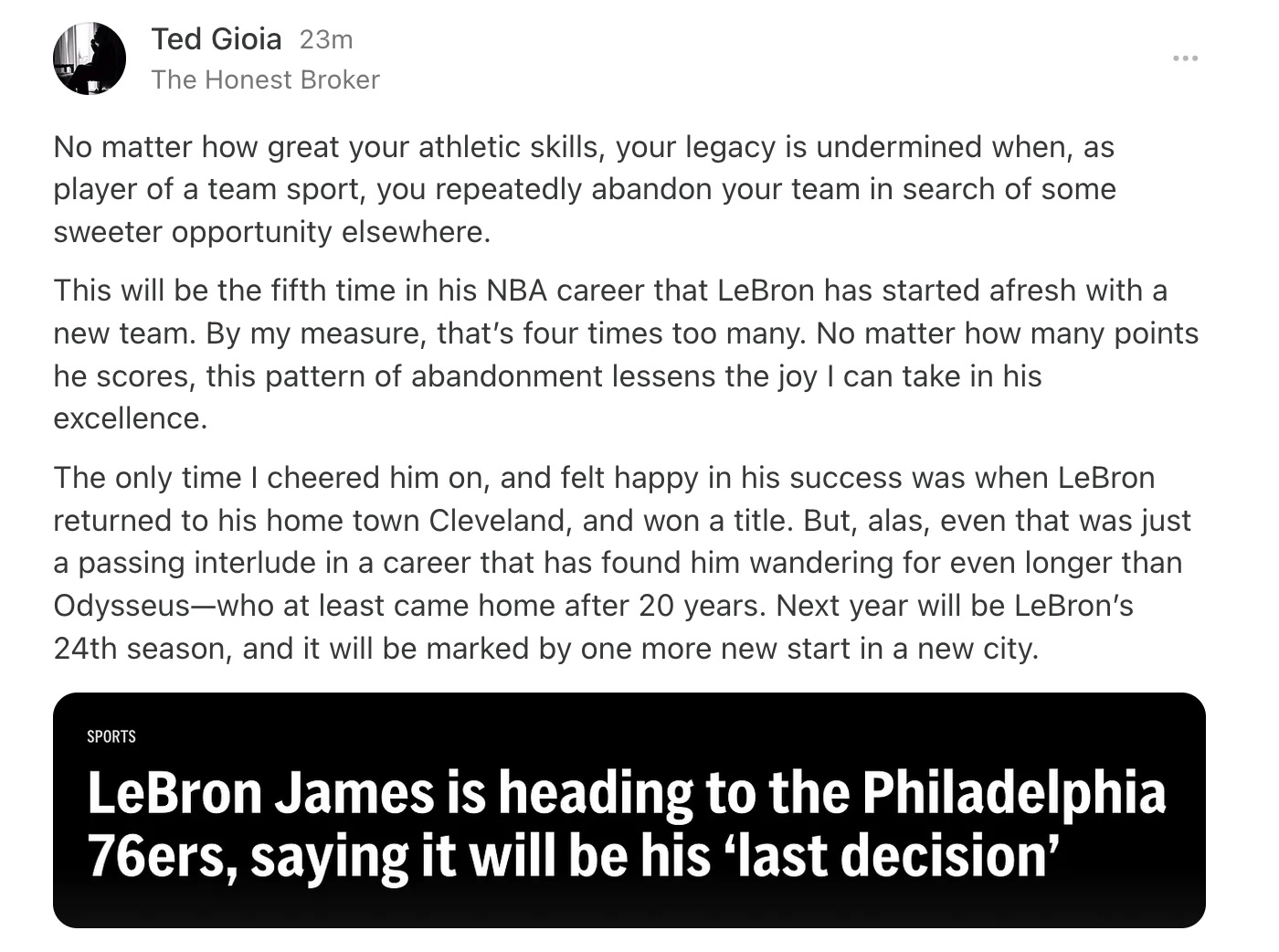
This man jumps around more often than a knight on a chessboard. So much so, that these repeated relocations now define who he is, and how he will be remembered. After more than two decades in the NBA, LeBron has four championships, but will have started afresh five times with a new team. For someone chasing titles with his generation-defining talent, that ratio is out of whack.
Please support The Honest Broker by taking out a premium subscription (just $6 per month).
But even if he had more rings to show, LeBron would still force us to ask if chasing titles is a legit reason to abandon your team. Wouldn’t most fans say that greatness is defined by the opposite—namely when an athlete triumphs without first running away?
So if I could give him a nickname, it would be LeBron “The Decision” James. The irony is that, despite taking pride in his decisions, he is a man who can never make up his mind. Shakespeare’s Hamlet looks like a paragon of decisiveness by comparison.
Of course, this is just one more example of how poorly aligned I am with current sports culture. I’ve gone on record as praising six things about sports—and I never hear any of them mentioned on ESPN.
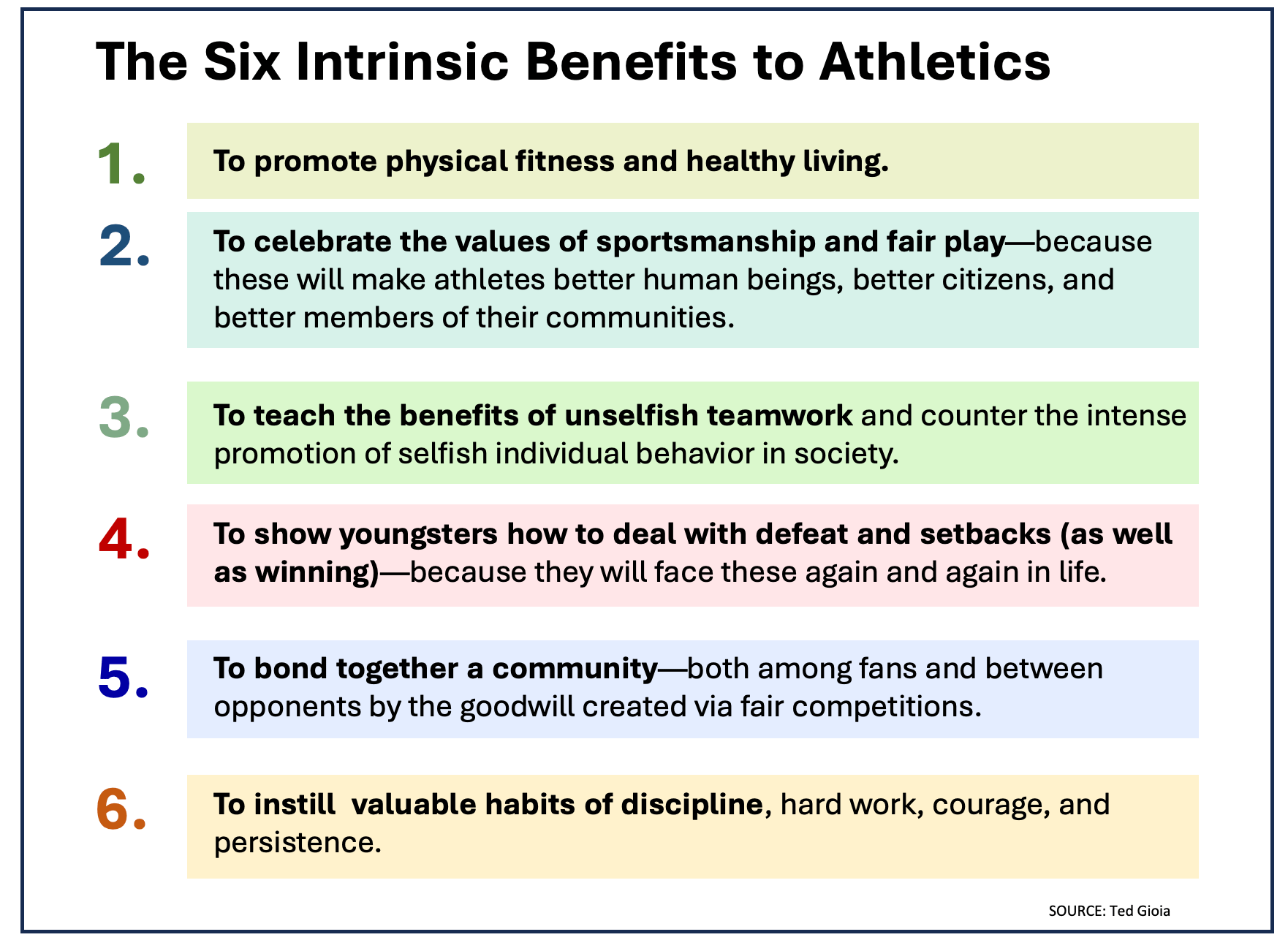
It’s actually far worse than that—the prevailing ethos in sports now runs totally in opposition to all six of these core values. Just consider that the hottest trend in professional sports today is gambling. That tells you how far we’ve fallen.
Not long ago, Pete Rose got thrown out of baseball for gambling. Nowadays he would earn a huge endorsement deal and launch his own betting site.
Yes, I wasn’t made for these times. But can I really be the only person who feels this way?
No, I’m certain I’m not alone. It’s just that the voices of those who believe in sports for character building are drowned out by a culture that puts money and winning above everything else.
Each fan also gets to make a “decision”—although it’s not covered in the news. And their cumulative decisions will determine the actual fate of the league
There’s a price to pay for this. A society that trains its youngsters with these degraded values on the sports field will soon find the same vices everywhere else. Long ago, Duke Wellington allegedly boasted that the battle of Waterloo was won on the playing fields of Eton. Nowadays we could make a less enviable claim, namely that the corruption of our institutions starts in the youth sports leagues.
I’ve criticized LeBron for lacking loyalty. Sports insiders mock this view—but with tremendous hypocrisy. That’s because the whole profession of sports depends on the loyalty of fans. Without loyalty, every pro sports league in the world would soon collapse. So not only is loyalty an important value in team competitions, it’s actually a foundational principle that holds teams together and pays everybody’s salary along the way.

Yes, I’m an outlier. But I also think I’m speaking in the interests of the sports insiders too when I advocate for more loyalty, not less. If I could, I’d make it harder—much harder—for teams to abandon their cities. I would make it easier for teams to sign home town talent (brining back a variant of the territory draft that once increased the likelihood that an NBA squad would actually include players from its home city. I’d take other steps to maximize the emotional ties between fans and teams, and vice versa.
It’s obvious that these moves would increase the popularity of teams. Even players would benefit—despite what you might hear to the contrary. It’s well known that players who stay with one team for their entire career are beloved by the fans, even long after they have retired. They have a happy home for life—along with lots of free drinks and dinners along the way—that the itinerant player will never enjoy.
But what about winning, you ask? I’d reply that the most successful NBA teams have tended to hold on to key players for their entire career—starting with their initial draft and continuing until retirement. Magic and Kobe and West and Baylor were always Lakers. Russell and Bird and and McHale and Havlicek were always Celtics. Duncan and Robinson and Ginóbili were always Spurs. When these same teams lost this sense of continuity and put too much emphasis into short term deals and luring free agents, their dynasties fell apart.
I mention those elite teams only in passing, because sports for most competitors does not result in a dynasty. The value of sports can’t be based by winning, because losing is just as common. And it’s even less dependent on a championship season—which few ever experience. For most competitors, the real value lies is those principles listed above—being there for your team, learning self-discipline, bonding with your community, handling setbacks and losses, and the like.
LeBron, of course, is free to pursue other values. But he will need to do it without me cheering him on. And at lease some insiders are aligned with me on this. For example, here’s a smart take that calls it straight.
There’s an old proverb that says “Be careful what you wish for, because you just might get it.” That’s exactly what’s happening in the NBA right now. They wanted a profit-maximizing world in which loyalty meant nothing—with ultimate freedom and mobility. Now they have it. But wait until they see the price to pay when fans ditch their loyalty in response.
Yes, each fan also gets to make a “decision”—although it isn’t covered in the news or hyped in press conferences. And make no mistake, their cumulative decisions will determine the actual fate of the league, not anything LeBron does in Philly.
If the honchos running the NBA were really smart, they would be worrying about those decisions, and not the last gasp destination of a soon-to-retire baller.
That you can pivot (see what I did there) from music to business to sports so seamlessly and on target is just one reason your audience continues to grow. Right on, Ted. Right on.
I just think this view is misguided. If the owners - who make and are worth many times what any single player earns - can easily trade players, players should absolutely have the right to move to whatever situation is best for them. At bottom, players are employees. (Even if we like to pretend different.) And blaming employees for trying to put themselves in a better position - whether that means making more money, or playing with people they want to play with, or having a better chance of winning - demonizes the wrong group of people, I think.