
I Blame Jan Garbarek
This saxophonist turned the tables on me—but what can I do but listen?


When I was a student overseas, I performed regularly as a jazz pianist. And I got lots of respect—like a Mafia don showing up at the Copa. I’d like to think this was due to my musicianship, but there was something else going on.
In jazz circles, I was an obvious American. And everybody knew that great jazz came from the US—just like fancy watches come from Switzerland and stinky cheese comes from France. I was bona fide by my place of origin, and obvious Yankee accent. And this gave me some distinction on the jazz scene overseas.
I dug every minute of it.
So I got hired and hired again. Everybody smiled at me. When they introduced the band, the announcer always made sure to say: “Please welcome on piano—all the way from Los Angeles, California—Ted Gioia!”
They clapped a little harder at that. Everybody loved LA back then, not just Randy Newman. Okay, maybe I wasn’t a Hollywood star, but I got a tiny taste of what La La Land glamor was all about.
But when I returned a few years later, it had all stopped.
I didn’t get that tender loving care anymore. Nobody even bother to mention my LA origin—they didn’t care a whit about it. It was like discovering that stinky cheese really is stinky.
Something had changed in European jazz. Musicians there didn’t give a wise owl’s hoot about what was happening in LA or NY. Not anymore. Instead they just talked about their own exciting jazz scene and homegrown musicians.
And they had lots to talk about.
Euro jazz had come of age, and they didn’t envy us Americans anymore. Poor Ted was shut out in the cold.
And I knew who to blame. It was that damned Norwegian Jan Garbarek.
Please support my work—by taking out a premium subscription (just $6 per month).
Sure there were others to blame—he didn’t do it alone. But Garbarek was the ringleader and role model. He showed what proud and confident European jazz looked like—unapologetic and independent of US-driven trends and expectations. And after Garbarek, there was no going back. I would never enjoy that taste of Yankee glamor again.
But I probably shouldn’t blame Garbarek and (in his wake) these other strutting Euros. He was great—and, even more than great, he had created a formidable sound all his own, liberated from US influences. The upshot was that he had unleashed a whole new pro-Europe vibe that soon spread all over the continent.
Even I loved listening to this stuff, despite the personal cost I paid. What else could I do?
Of course Garbarek hadn’t always been so independent and aloof from US currents.
I once heard a bootleg tape of Jan Garbarek jamming as a teenager. I couldn’t believe what I heard. He was playing hot hard bop like he had been born in Philly or New York.
I always associated him with European chamber jazz, and totally disconnected from the gravitational pull of US postbop stylings. But it’s now clear that his original inspirations weren’t much different from my own. Not only did he respect American role models, but had started out by mastering their most idiomatic ways of playing.
That’s evident on his earliest album, a rarely heard recording called Til Vigdis. It captures two live performances and reveals Garbarek deeply immersed in late Coltrane phraseology. The opening track is a Coltrane composition, and for eighteen minutes Garbarek turns his horn into a perpetual motion machine, accompanied only by bass and drums.
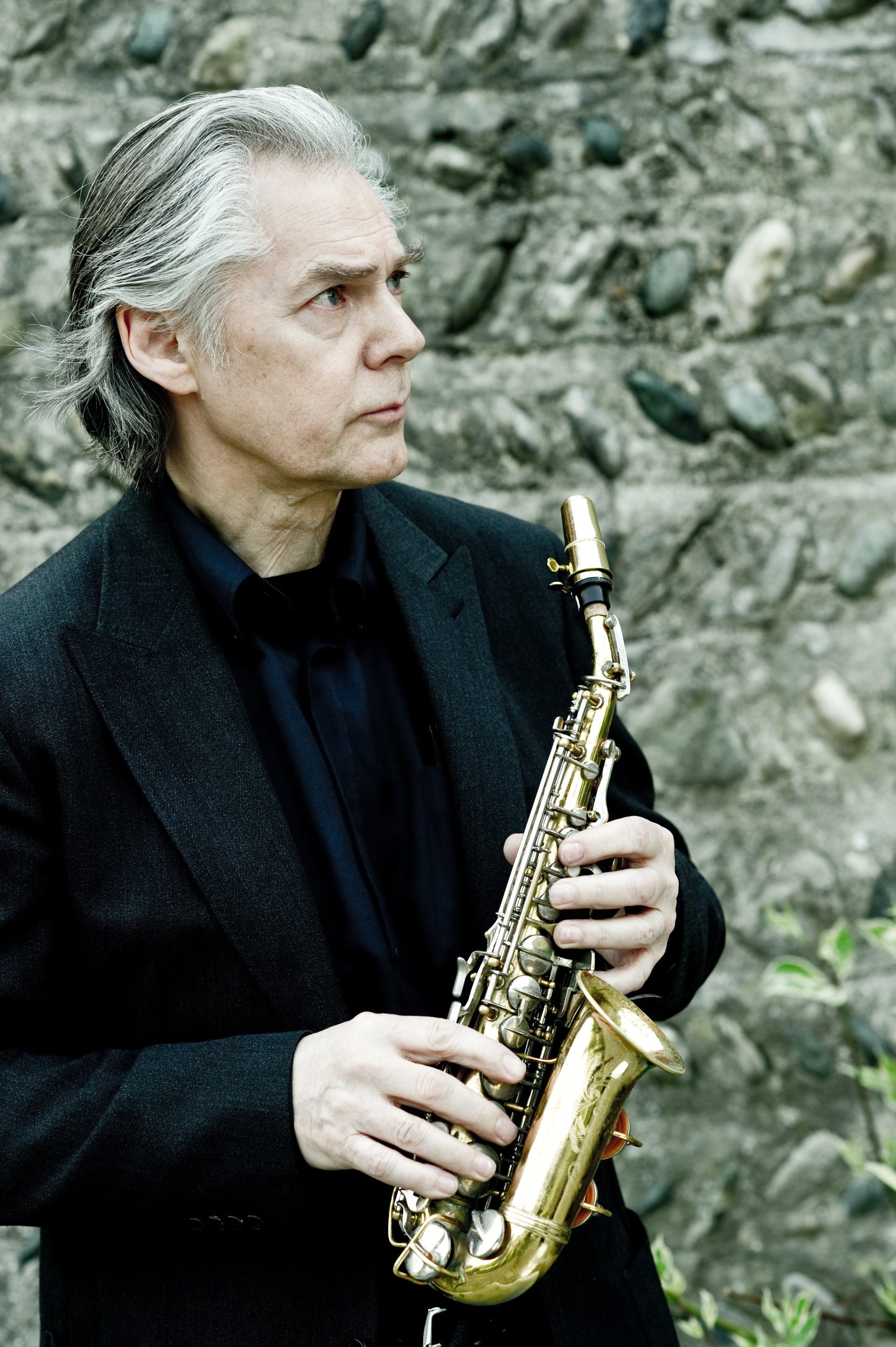
If you’re looking for the future leader of chilly Nordic chamber jazz, he is nowhere evident here. It’s only in the final track, “Til Vigdis,” that Garbarek allows some air and space into his improvisations, but even here you feel his allegiance to US free jazz role models.
Two years later, Garbarek made another album, Esoteric Circle, and here his ruminative moods would occasionally temper his riotous tendencies. But this is still intense music where tonality is always getting beat up and pushed around in unseemly ways.
Here Garbarek is joined by guitarist Terje Rypdal, bassist Arild Andersen, and drummer Jon Christensen—all of them would soon migrate to the ECM label, and two would get enlisted in Keith Jarrett’s crowd-pleasing quartet. But you would never guess any of this in a blindfold test based on this early album.
Less than a year later that same group made a record for producer Manfred Eicher at ECM, and something magical happened. The album is called Afric Pepperbird—don’t ask why—and Garbarek still shows his allegiance to the avant-garde, but his tone is now different. The haunting plaintive sound that would be his trademark in the decades ahead is now on display in all its lonesome beauty.
This young hornplayer, just 23 years old, is still enamored with John Coltrane and other US role models (especially iconoclast Albert Ayler). But this new sound is something different, something Nordic, something original. It wasn’t easy, back in 1970, for a European jazz musician to create a style that didn’t sound like an homage to American predecessors, but Garbarek was now on a pathway to doing just that.
In a wonderful conjunction, Garbarek’s new record producer Manfred Eicher was shaping a similar vision—of a European jazz record label that didn’t imitate its US competitors. Eicher is now a legend in the jazz world, but back in 1970 he wasn’t even an upstart—just a complete unknown, a bass player who had launched ECM a few months before.
In the coming years, Eicher would produce landmark albums by Keith Jarrett, Pat Metheny, Chick Corea, and other jazz stars. Even more to the point, he would help launch the careers of a hundred or so European jazz artists. But all that was all in the future when he went into the studio with Jan Garbarek. Afric Pepperbird was the seventh album for ECM, and none of its predecessors had sold especially well.
Eicher brought Garbarek back to the studio for a new album just seven months later. And the resulting work Triptykon not only reveals the saxophonist’s growing maturity, but also begins to define what would come to be known as the ECM sound.
Some people describe this as “chamber jazz.” And I can understand why. It’s more nuanced music, played at lower volume levels than American jazz. For that reason, it’s well suited for the same concert halls that host string quartets and piano recitals. It’s music for people who listen closely instead of brawling at the bar.
I note that this is a very appropriate choice for a German jazz label like ECM. The German-speaking world practically invented chamber music, and its proprieties and cultural expectations must have felt natural to someone like Eicher—in a way that they wouldn’t for someone who, for example, grew up playing blues in a Mississippi juke joint or tickled the ivories at a New Orleans brothel.
Europe really is different. So European jazz ought to reflect that.
But on another level, the “chamber music” descriptor for ECM, and especially Garbarek, is misleading. It suggests a kind of prissy daintiness that is the exact opposite of the saxophonist’s soul-searing declamations on his horn. That’s why Garbarek is so effective playing quasi-rock songs (especially when paired with guitarist Rypdal)—he always plays with intensity, although in his case that doesn’t always mean loud or flashy.
But ECM deserves credit for another innovation: the birth of a truly global cross-border attitude to jazz. It’s not unusual for Eicher to feature a band with every member from a different country—or even a different continent, as happened when Garbarek recorded with Brazilian Egberto Gismonti and American Charlie Haden. The same thing happened when the saxophonist recorded with John Abercrombie and Naná Vasconcelos.
This cross-border openness was a revelation to the jazz world of the 1970s. It set the stage for Garbarek to make ECM recordings with vocalist Ustad Fateh Ali Khan or Anouar Brahem or the Hilliard Ensemble. These forays challenged the very definition of what jazz is—and in the best way possible.
All these currents start to come together in Garbarek’s recordings from the mid-1970s—such as the underrated Red Lanta with pianist Art Lande (1973), Dansere with pianist Bobo Stenson (1976), and Dis with guitarist Ralph Towner (1976). Each of these is a major statement both for the hornplayer and for the ECM label. Garbarek has now found his groove, and can hold an audience mesmerized with the fewest of notes, no longer requiring all the Coltrane-esque demonstrations of his youth.
Just listen to the space and held notes and stark phrasing of “Lokk” from Dansere. This a declaration of independence from all those US-centric flavors (free, fusion, post-bop, etc.) of the era. This represented a whole new way of playing jazz, as even the folks back in the USA were now realizing.
One of those Americans was Keith Jarrett. And he would soon release the most successful solo piano album in history, The Köln Concert, for the ECM label. But a few months before that historic moment, Jarrett flew out to Oslo, Norway to make an album with Garbarek’s band.
Many were puzzled by this—and I was one of these skeptics back then. Keith Jarrett already had a quartet back in the US, and some jazz fans thought it was the best band in the world. Why would he abandon it for three unknown Scandinavians?
But the resulting album Belonging, recorded over the course of two days in April 1974, was destined to become a cult classic. Consider the fact that Branford Marsalis released a full album tribute to Belonging in 2025, performing every song on the record with his own band.
Even pop stars were paying attention to Belonging—so much so that Steely Dan got sued by Jarrett for copyright infringement because the title track to Gaucho sounds so much like “‘Long as You Know You’re Living Yours” from Belonging. Jarrett had a strong case and eventually got added as a co-composer to the Steely Dan song.
Garbarek truly belonged on Belonging because he could adapt to every turn and twist of Jarrett’s imaginative songwriting. He could play funky or folkish or free as the situation required. But, here again, his plangent Nordic tone is the main draw, almost like a lover’s call from a castle tower in some magical story, drawing the listener deeply into the music.
Jarrett was so enamored by his new collaborator, that he made another album, Luminessence (1975), featuring Garbarek as the only soloist, accompanied by strings. Jarrett himself doesn’t perform on the album—this is a total showcase for the saxophonist. Jarrett composed three works, and you can tell how much he is obsessed with Garbarek’s forthright but melancholy tone.
“He studied Jan’s music,” producer Manfred Eicher later explained, and the whole album was composed with “Jan in mind.” This would be a compliment to Garbarek under any circumstances, but especially coming from Keith Jarrett—who typically expected musicians to adapt to him, not the other way around.
Jarrett had first heard Garbarek when the saxophonist appeared on a George Russell album. “He was just a kid when I heard him,” Jarrett later recalled. But his first reaction, as he told biographer Ian Carr, was: “What—wait a minute. I don’t want to forget that.” Later Jarrett heard Garbarek in person, at a jam session in Oslo, and this further confirmed his interest. Garbarek, in turn, kept close tabs on Jarrett, and got a seat in the front row every night when the pianist showed up in Boston for a week-long gig with Miles Davis. So Eicher found it easy to convince these two artists to collaborate.
Jarrett followed up Luminessence with another orchestral album, Arbour Zena—his most impressive work to date as a quasi-classical composer. This time Keith played piano, but once again he featured Garbarek too. By this time, Jarrett was a legit music star with a huge mainstream audience on the basis of his crossover hit The Köln Concert, and he seemed determined to bring his Norwegian collaborator along with him for the ride.
Jarrett was now touring with his Nordic band, and performing to sold-out concert halls. Some live recordings were later released, but the quartet only made one more studio album—but it’s one the most celebrated jazz albums of the decade.
For many fans this recording, My Song, made clear why Jarrett switched to a European band. So I’m not overreaching when I say that this was, to some degree, a moment of legitimization for jazz beyond the sphere of American cultural colonization.
Things had changed. So I wasn’t really surprised that Garbarek continued to flourish—both creatively and commercially—after his partnership with Jarrett ended. That was, I believe, his destiny.
If American jazz still had a New York-fixation—demonstrated on thousands of albums featuring musicians who all live in the same city—Garbarek embodied a different possibility. He was the cosmopolitan man of the world who found musical partners everywhere, making records with Eleni Karaindrou, Ustad Bade Fateh Ali Khan, Naná Vasconcelos, Miroslav Vitouš, the Hilliard Ensemble, Anouar Brahem, Rainer Brüninghaus, L. Shankar, and many others from far and wide.
You just need to try to spell the names in his discography to get a sense of how far and wide.
But just as important, Garbarek’s sense of purpose and unique musical style also declared independence from the “Made in America” stamp of approval that had previously dominated all jazz proceedings. The previous generation found great European jazz stars—George Shearing, Marian McPartland, Toots Thielemans, etc.—moving to the US to reach the next level in their career. Their careers demanded transatlantic relocation. After Garbarek, that was no longer necessary.
He blazed the pathway that made possible the later eminence of so many others who stayed close to home, and still found legitimization and stardom—from EST to all those hot Nu Jazz names on today’s London scene. Every last one of them ought to thank Jan Garbarek.
Garbarek demonstrated this fertile independence in album after album following his departure from Jarrett’s quartet. He plays with such authority that the best tracks sound like prophetic statements from someone who has just returned from the mountaintop. Listen to him, for example, on “Soria Maria” with Abercrobmie and Vasconcelos.
Or hear him on “Going Places,” where drum dynamo Jack DeJohnette tries to give Jan a kick in his Nordic ass, but Garbarek doesn’t budge. He still spouts out his lonesome sound of the frozen north even as the US drummer triples the beat of the saxophone—until giving up around the three minute mark. Then even DeJohnette decides to float along at a fjord’s pace.
It’s like a metaphor for Garbarek’s entire career. His serenity on the sax flows on the surface, but he is as solid as a glacier below. And it’s the same no matter the context—there’s that Euro confidence again that took away all my perks.
But Garbarek, for all his glacier toughness, was still growing. His most daring work starts around the time he turned fifty. At this stage, he doesn’t even need jazz anymore—at least not in any convention sense. He is now a citizen of universal soundscapes with a passport that lets him travel anywhere and at any time.
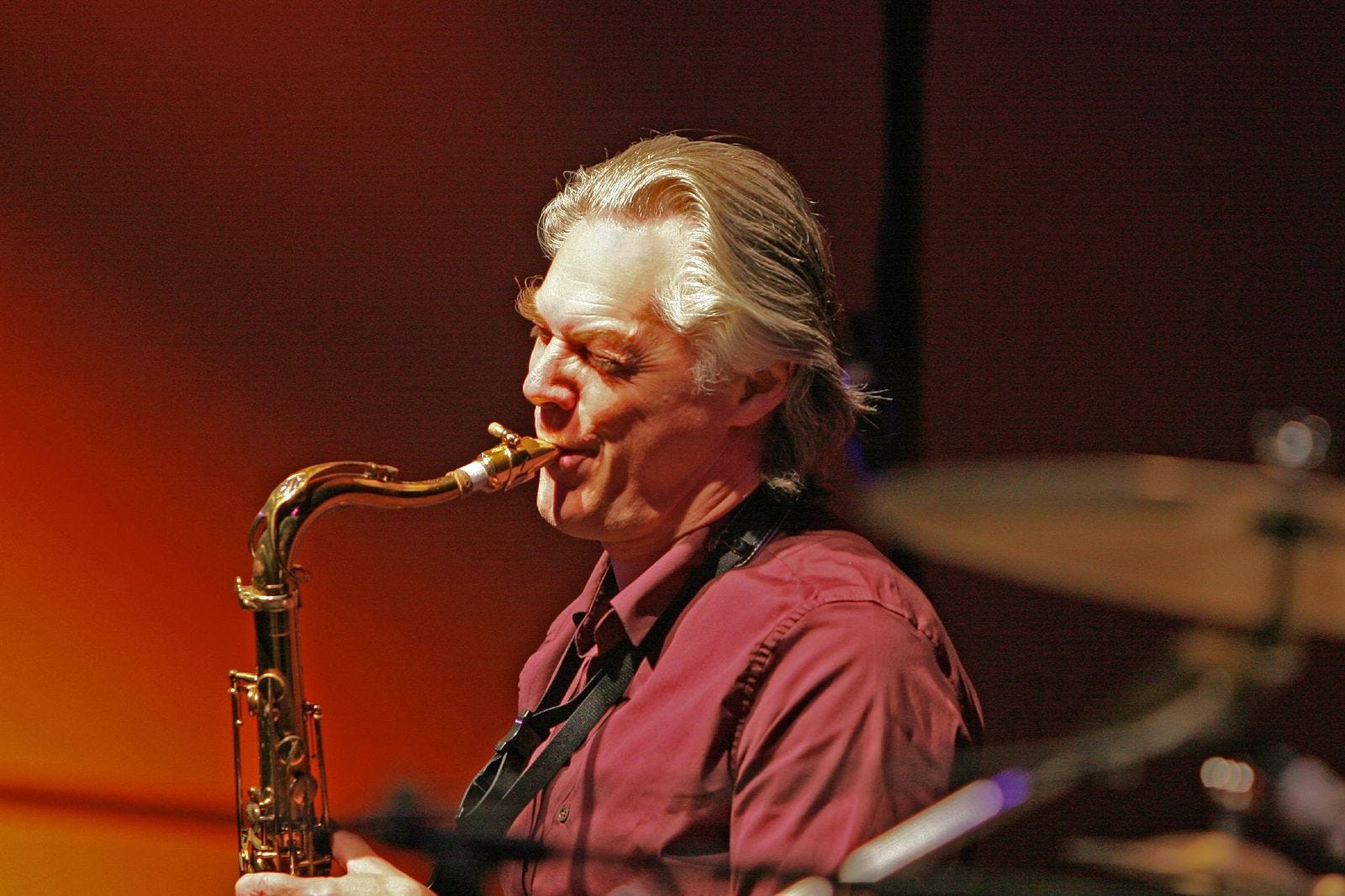

Consider Ragas and Sagas, released in 1992. Here’s the band’s line-up
Jan Garbarek plays tenor and soprano sax
Pakistani (born in Punjab) Ustad Fateh Ali Khan sings
Norwegian (of Punjabi/Pashtun descent) Deepika Thathaal sings
Pakistani Ustad Nazim Ali Khan plays sarangi
Pakistani (born in Punjab) Ustad Shaukat Hussain plays tabla
French Manu Katché—who has recorded with Sting and Peter Gabriel—plays drums
This is not a jazz band. Or maybe it is—but only in the expansive border-breaking mind of Jan Garbarek. He certainly fits in. Or even more, he sounds like he was destined to play music of this sort.
The rest of us didn’t realize this until we had a chance to hear it.
Two years later, Garbarek released a trio album featuring his sax work alongside Tunisian oud player Anouar Brahem and Pakistani Ustad Shaukat Hussai, who returns on tabla. Brahem wrote most of the music, and Garbarek performs it as commandingly as he did all those Keith Jarrett compositions twenty years before.
Around this same time, Garbarek embarked on the most ambitious collaboration of this late stage in his career—and the most unusual of them all. He now started making music with the Hilliard Ensemble, a celebrated British vocal ensemble best known for medieval and early Renaissance music.
I love this group, but its best work features liturgical music composed five hundred years ago. What possible use could they have for a jazz saxophonist? But they gathered together in an Austrian monastery, and took the plunge.
As Garbarek proved, they both operated on some uncanny wavelength where the adjectives modern and medieval are no longer relevant. Everything is now timeless. The music on the resulting album Officium is mind-blowing, but also totally unsuitable for any radio station’s format.
One listener, struggling to find some way of describing this work settled on this: Officium is “what Coltrane hears in heaven.”
Garbarek’s pace of recording slowed down considerably after 2000. New albums from him were now rarities. But he continued to collaborate with the Hilliard Ensemble until it disbanded in 2014. I don’t think it’s going too far to say that this is the most personal music of his late career—and also the most mystical.
Maybe all jazz musician seek transcendence, but Garbarek sounds likes he has found it—and, even better, wants to share it with the rest of us dullards. We just need to be willing to listen. And also to put aside all our preconceptions about the saxophone and jazz and genre definitions and historical chronology.
So I will continue to lament the loss of America’s unchallenged dominance of the jazz idiom. I enjoyed getting that special treatment, like a Mafia wiseguy out for the evening—but (sigh!) that’s gone forever. Even so, Garbarek has paid me back in full by showing what a truly expansive vision of jazz sounds like.
No, he didn’t take anything away from us American jazz musicians. He actually gave us a gift—showing us possibilities in our own traditions we didn’t know even existed.
Who knows? Maybe that’s exactly what jazz is supposed to do.
In 1999 I was visiting family in Norway, and was lucky enough to be taken (via 3 ferries) deep into fjord country to a mountain cave where Garbarek performed with the Hilliard Ensemble soon after the release of Mnemosyne. The musicians slowly circled the small audience in near-darkness, creating a swirling sonic landscape. It was the most surreal concert experience of my life.
When I read a line like “what Coltrane hears in heaven” I am reminded that AI will never be able to replace the human observer of art. Who was the listener who said that?