
How to Tell If You're Living in a Binary Crisis
And how to get out of it

I’m releasing this article from behind the paywall. If you find it worthwhile, consider taking out a premium subscription to The Honest Broker.
That will give you access to future deep dives into our turbulent culture, as well as hundreds of archived articles on music, movies, books, etc.—including my annual guide to the best recordings for each year going back more than a decade (in The Vault).
Enjoy!
If you want to support my work, please take out a premium subscription (just $6 per month).
How to Tell If You’re Living in a Binary Crisis
By Ted Gioia
I want to start with a story about Texas. It’s also a good description of what I call a binary conflict.
I recently wrote a letter of recommendation for an engineering student at Texas A&M. He’s an impressive, hardworking young man—with solid character and very trustworthy.
To help cover college costs, he does part time work helping people move. It’s grueling physical labor. But he never complains.
Someday soon he may be an engineer. But when he does a moving job, he has no attitude—and he puts 100% effort into the physical labor.
This young man recently showed up at a Texas house, where he was scheduled to help a family move But as soon as they opened the door, he could see they were shocked, even horrified, by his presence on their doorstep.
“I’m here to help with the move,” he explained.
“No you aren’t,” the woman at the door said, ready to slam it in his face.
“You don’t understand,” he replied. “I’m helping with your move today.”
“No, you are NOT,” she repeated, and pointed at his shirt.
His shirt had just one thing written on it: Texas A&M.
She scowled—and after a moment, explained: “This has always been a Longhorn house. We never let Aggies in here.”
And so he didn’t have a job that day. That’s how they roll in the Lone Star State.
And if, by some terrible destiny, a Texas A&M supporter marries a University of Texas fan, they put this “House Divided” banner outside their home.
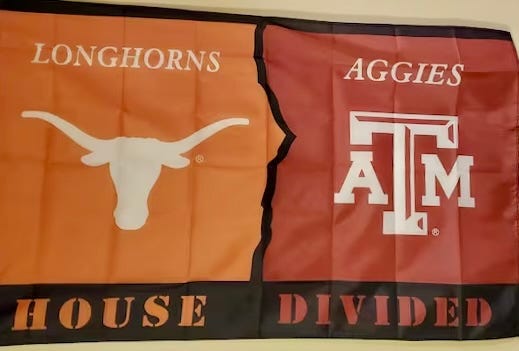
That’s how a binary conflict works in society. Life may be complex—but it gets simpler if you can reduce things to two opposing forces.
But sometimes the binary conflict escalates into a binary crisis. When that happens, events spiral out of control.
Did you ever wonder why the biggest sports battles always involve two teams?
You could easily design a basketball court with three hoops—and play the game with three teams. Or four or five or any number you want.
But that never happens.
Despite all the talk of threesomes, you’re not gonna find one on ESPN. Well, not on screen—who knows what those athletes (or sportscasters) do after the game?
But every team competition I’ve seen in my entire life has featured a binary opposition—whether we’re talking football, baseball, hockey, volleyball, or even quidditch in a Harry Potter film.
It’s always two opposed forces.
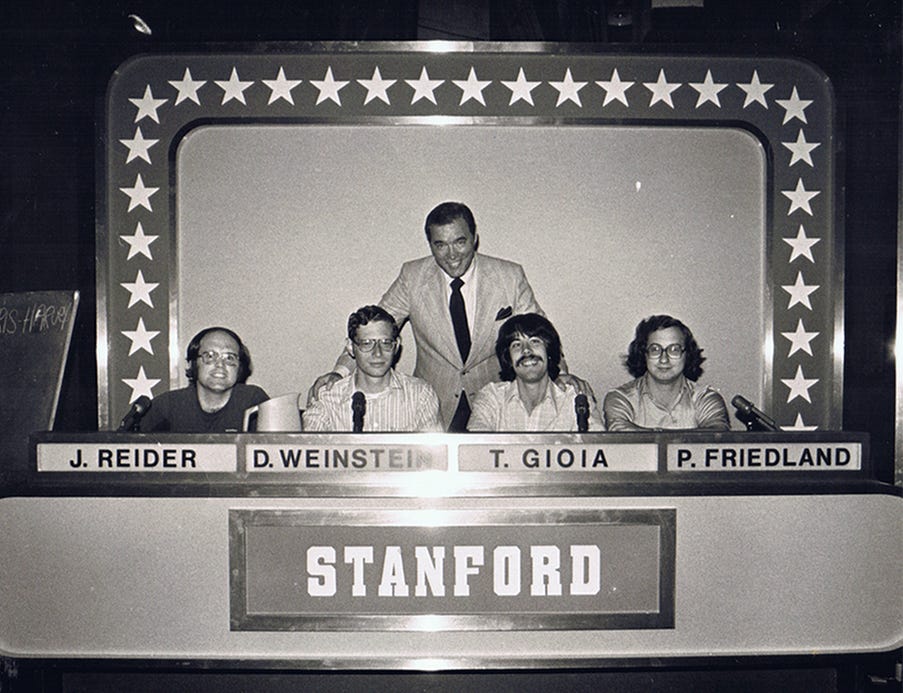
That was even true when I competed in an academic contest during my student days—the national quiz bowl competition known as College Bowl. My team had to defeat dozens of other schools to win the national title—but every competition was a head-to-head matchup. We beat Yale in the televised finals, and the binary opposition was what drew the ratings.
The producers even told us so. “We like this Stanford versus Yale matchup—the ratings will be good.”
Only a few individual sports allow for multiple participants competing all at once. Can you spell B-O-R-I-N-G? That’s why track events and swim meets don’t get much TV coverage—audiences demand the binary opposition.
In my youth, I was a fan of TV wrestling, and I recall with fondness the famous Battle Royale, which took place once each year at the Olympic Auditorium in downtown LA. But these free-for-alls never lived up to expectations—because so many competitors made it hard to identify the enemy.
And it wasn’t just the audience that got confused Even the participants and referees looked lost up in that ring. Without the binary opposition, the sport felt meaningless.
Just look at a video and see for yourself. A bunch of dudes in a brawl should be a lot more exciting than this.
There’s a rule here, but an ugly rule. The key to effective teamwork is having a single enemy.
Now here’s something even uglier. The same team-building hostility is heating up over in the enemy’s camp. That evil team is getting bigger and stronger because it hates you—and precisely because you’re bonding with your own team.
Some of this stuff is so toxic nobody wants to talk about it. But I’ve actually seen management teams bond together more effectively because they all hate the CEO. That’s what finally brings them together, and gets them to cooperate.
But don’t expect to hear human resources explain this at your next office seminar on teamwork. The reality is that, at some companies today, workers bond together to battle HR.
Somebody should write a global history of binary conflicts—because no force has exerted more influence over human affairs.
Rome collapsed while its citizens fought over the colors blue and green. That sounds crazy, but it’s absolutely true.
I believe this is the single most significant fact about Roman history.
The conflict between Blues and Greens lasted for a thousand years.
During that period, each color enjoyed periods of dominance, and could have used its power to make tangible improvements and fix a broken system.
But they rarely did this—because were obsessed with punishing the other color team.
They won’t teach that in history class. But they should. It ought to be the first lesson.
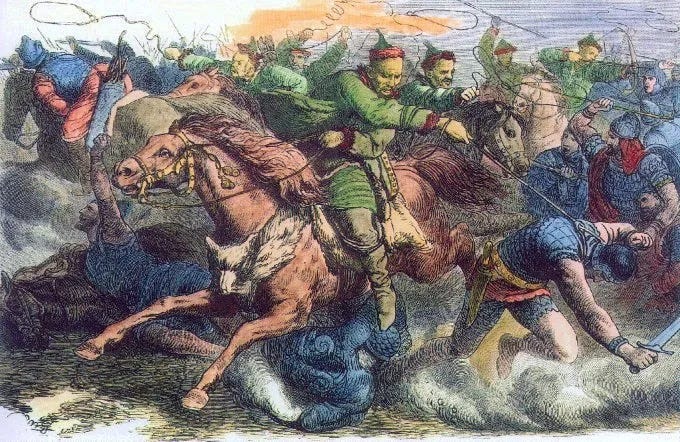
It’s hard to explain this Roman mania, but here’s what I’ve written elsewhere:
The conflict may have started as a sporting rivalry, but in time the battling colors impacted every aspect of society. Your chosen color could influence your political loyalties, your pastimes, your religious views, and almost every other affiliation in day-to-day life….
The more you study the phenomenon, the clearer it becomes that the main motivating force of each group was hatred of the other group. Making the opponent suffer was far more satisfying than any mere policy outcome.
As a result, the most trifling incident at the chariot races or theaters could set off the factions, and as Rome declined the violence got worse. By the time we get into the fifth century AD, the conflicts sometimes took the form of pitched battles in the streets.
That’s what a full-blown binary crisis looks like.
It happened in Rome. It happened during the medieval witch hunts. It happened during the French Revolution. It may be happening in some parts of the world today.
How can you tell when you’re living in a binary collapse? Here are seven warning signs:
All conflicts are channeled into a single binary opposition between two teams. There is never a third team—if someone tries to create it, one or both of the two teams will work fervently to destroy the third option.
Each team is obsessed with punishing the other—and this becomes more important than taking steps that might help their own supporters.
The common good turns into an empty concept, and is only mentioned as a rhetorical device in attacking the other team (which is always opposed to the common good). Policies that might help everybody are ignored (as in the Roman example), because they can’t be used to energize team supporters—which is where all power and resources reside.
Even institutions and vocations that have no direct connection with the two teams get drawn into the battle. Everything becomes part of the conflict—science, entertainment, math, medicine, architecture, etc.
The fault of the other team is never a simple matter, but always involves a long list of extreme accusations. As Rene Girard shows in his book The Scapegoat, the same charges are invariably lodged against the other team—violence, sexual transgressions, greed, ethical abuses, moral corruption, violation of taboos, and a litany of other abuses. Even if the conflict begins with a single difference (class, religion, race, etc.), it soon expands to encompass every one of society’s most feared transgressions. It sounds absurd but, in periods of binary collapse, the opposing team is always accused, sooner or later, of incest, rape, murder, devil worship, profanations of all sorts.
Despite their espoused hatred, the two teams repeatedly imitate each other—in fact the hated enemy is also the main role model. Like warring Mafia gangs, they engage in tit-for-tat behavior. Hence, the exact same accusations are made, back and forth. Threats, excuses, reprisals are always identical; even promises for the future (after the victory) are eerily similar. These mirror-like reflections merely increase the polarization and escalate the conflict.
People who try to operate outside this binary conflict have no impact. They are literally individuals without a team—which in a binary crisis is always the worst possible situation. They are the weakest of all parties. To have any influence, they must join one of the two teams…and so the cycle continues.
As Girard points out, the other team may actually deserve punishment. But he avoids trying to “determine precisely where injustice begins and ends.” The more salient fact is that, in a binary collapse, things always push to extremes, beyond any reasonable limits. In this totalizing ideology, degrees of justice or injustice hardly matter, and merely serve as rhetorical fuel for escalating the conflict.
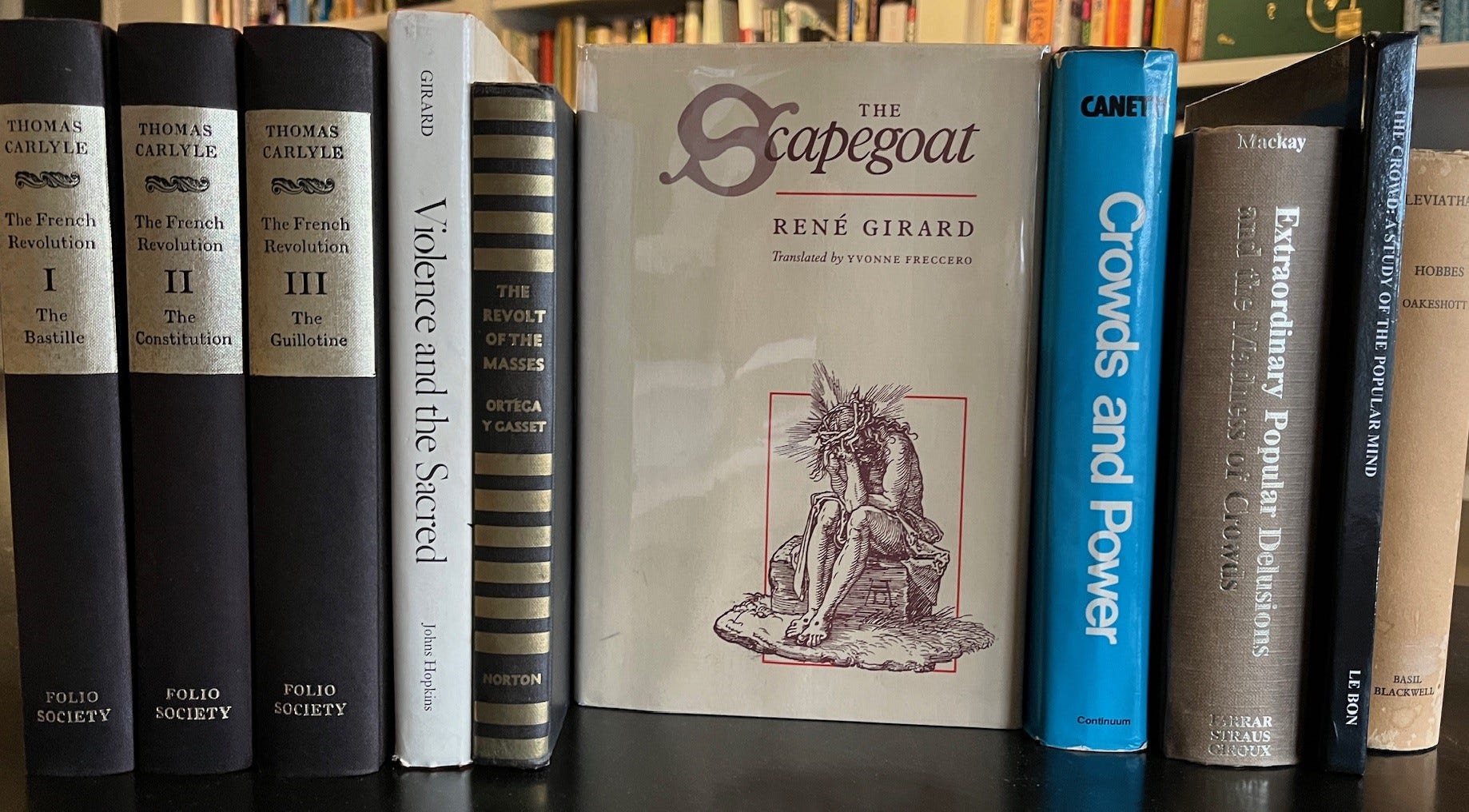
He gives as example the trial of Marie Antoinette. Girard readily admits that the French monarchy bears a large degree of responsibility for the revolution and its violence. But when the Queen went on trial, the accusations became all encompassing.
Her foreign birth was frequently mentioned, and all her vices. (No, she never said “Let them eat cake!”—but facts like that don’t matter in a binary crisis.) And, eventually, Marie Antoinette was even accused of committing incest with her son. That was just slander, but (as noted above) these situations invariably escalate into demoniac obsessions—because there are no reasonable limits in a binary crisis.
Girard argues that this is a repeating pattern in human society. He focuses on the scapegoating, while I emphasize the collapse of all social problems into a battle of two teams—which can be an even more powerful, totalizing force.
So I will point out that after the King and Queen were finally executed, the coalition that killed them quickly broke into a new binary opposition—and the former team members started killing each other.
Tens of thousands of people died in the aftermath. In other words, the binary crisis was so strong it outlasted the murder of the scapegoat.
Does any of this sound familiar to you?
Of course it does. That’s because this happens again and again in history—and it’s happening again today, especially in an election year. After all, politics is the main sphere where binary conflict plays out today. (Five hundred years ago, it was religion.)
But what if the binary opposition escalates into a total conflict—a binary crisis—and spreads into every aspect of daily life?
At that stage, the battlefield is everywhere. Everybody becomes a soldier—the gym teacher, the nurse, the fire fighter, the sports journalist, the film critic, the librarian, the checkout clerk at the drugstore, you name it. I’m not necessarily describing a military civil war—but that can happen too, and precisely in situations like this.
Many will seek a way out. But guess what? Anybody who dares suggest a remedy outside the binary conflict will be attacked by the now massive forces of the two teams.
And they will get lectured endlessly about the “lesser of two evils” theory. (When you start hearing that argument constantly, pay close attention—because it identifies the source of a potential structural shift in the situation.)
This oft-stated theory declares that you must always limit yourself to the best of two bad options—because anything else is EVIL.
Maybe that’s true. But there’s another theory, perhaps even more persuasive. This other theory states that a system which only offers lesser-of-two-evil choices is already broken, and people deserve more and better options.
Is there any escape from destructive binary conflict?
In the opening sentence to The Scapegoat, Rene Girard tells readers to pay close attention to a forgotten text from the fourteenth century. This work is Judgment of the King of Navarre by Guillaume de Machaut.
My learned musician friends will recognize that name. Machaut was the most innovative composer of his day—they even called his music ars nova (which translates as new art).
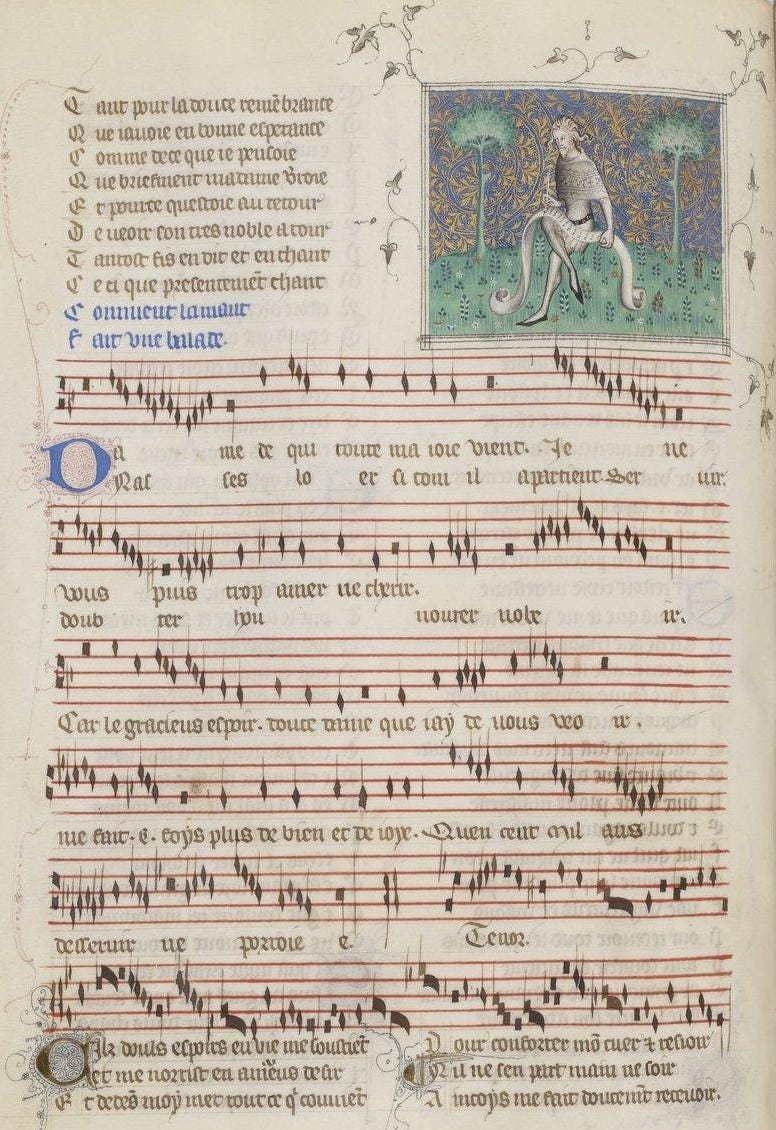
But the story Girard relates is more brutal than musical. He writes:
Guillaume claims that he participated in a confusing series of catastrophic events before he finally closeted himself in his house in terror to await death or the end of the indescribable ordeal….
There are signs in the sky. People are knocked down by a rain of stones. Entire cities are destroyed by lightning. Men die in great numbers in the city where Guillaume lives (he doesn’t tell us its name)…..
People continued to die in ever greater numbers, however, until one day in spring when Guillaume heard music in the street and men and women laughing. All was over, and courtly poetry could begin again….
In the case of Machaut’s story, the main source of the crisis is binary opposition between Christian and Jews. The latter are persecuted as scapegoats, and are even accused of responsibility for the Black Death. Soon lightning is striking, and stones are falling out of the sky.
I hardly need to point out that this was all ignorance and hate, not science. Jews didn’t cause the plague, or falling stones, or whatever.
But in a binary crisis, as Girard explains (although he doesn’t use that term, referring instead to crowds and mobs), natural causes are of no interest to anybody. The mob must always have human enemies.
That’s why the science in Machaut’s story is bogus.
But the music that marks the resolution of this conflict is the most accurate thing in the whole narrative. The scapegoating was a fantasy, but the music represented a real moment when a rupture healed, and the killing stopped.
Can we draw any comfort from this?
I note that music is the opposite of the sporting events mentioned at the start of my story. When athletes play, they turn against a common enemy—the opposing team. But when musicians play, they operate in a purer realm—and the audience still packs into the arena or stadium (the same venues!) for this peaceful way of forming into teams.
It’s easy to point out where music falls short. Historians of Nazi Germany, for example, like to point out that the same people who committed atrocities during the day, came home and listened to Mozart or Beethoven at night. Yet the very fact that we are shocked by this testifies to our expectation that music should pacify and soften, even in these extreme situations.
And consider those miraculous moments when songs prevail on actual battlefields. During the famous Christmas truce of 1914, opposing soldiers put down their weapons, and joined together in singing “Adeste Fidelis” (“Oh Come All Ye Faithful”). That happened on Christmas Eve, and the next day some soldiers actually crossed battle lines to exchange gifts.
The military leaders and politicians feared this. They hated it. One English general declared that this singing represented “the greatest danger” to troop morale.
He was probably right.
This countering of the binary crisis with music happens more often than people realize. Consider an example from pop culture.
Many were upset when country star Luke Combs recorded Tracy Chapman’s song “Fast Car,” and enjoyed a hit with his cover version. But what could they say after the two musicians joined together at the Grammy Awards?
If this keeps up, who knows where it might lead? The next thing you know, they’ll be exchanging gifts, like those WWI soldiers.
By the way, the power of music to defuse violent impulses is amplified if the performance takes on symbolic and ritualized elements of conflict. I don’t have space here to provide full details—this subject really deserves an entire book. Nobody has adequately told the story of ritualistic conflict in music, which shows up everywhere from marching bands to punk rock to American Idol.
But you can see it even in the video above, where Luke Combs clearly offers a symbolic victory to Tracy Chapman during the performance.
Anybody who knew what to look for could see this—just read the account in the NY Times, which spells it out, almost as if it were a heavyweight boxing match:
Combs never overshadowed Chapman. He knew that in that moment, no one could. Something about the way he looked at her said it all: His eyes shone with irrepressible respect. Here was a grown man, an assured performer who sells out stadiums, visibly trembling before the sight and the sound of the folk singer Tracy Chapman.
Real conflict is defused. But only because a ritualized resolution has occurred.
Music can’t turn the world into a 24/7 love-in.
But a song can create a 3-minute love-in. And if art short-circuits the binary conflict for even just that brief spell, it deserves our reverence.
Nothing in human culture has done more to bring people together than music. I discussed team-bonding through hate above, but you can form an even more beautiful bond through song. Many of us would not be here today if our parents hadn’t heard the right romantic song at just the right moment.
That’s real magic for you.
There’s scientific reasons for this. When we join together in singing or music-making, our bodies release the hormone oxytocin—which makes us more trusting and less suspicious of others.
And trance-inducing rhythms have a similar impact—although now its our brainwaves that are impacted, as well as our body chemistry. This is why dance is so liberating—it reduces our defenses, and actually lets us enjoy the moment when we become most vulnerable.
This is the role the arts should play in a divisive culture. Songs bring us together—and diminish the deadly energy of the binary crisis. The dance, by the same logic, is the opposite of the military march—it is the rhythm that frees us, instead of dominating us.
The same can be true of poetry, and painting, and movies, and games, and the rest of it. Even if they can’t defuse a crisis on their own, they are still the best place to start the process.
One of your best in recent memory. Wish it were an op-ed in the NYT.
Makes sense, especially in light of how many comment sections devolve into political shouting matches even when the original post/news story wasn't political. Everything is either for or against my team.