
How to Destroy a Literary Reputation in One Move
Media companies invent a new kind of stupid

This would typically be behind a paywall. But I’m making it available to everybody. So enjoy!
If you value this kind of coverage of culture and media, consider taking out a premium subscription.
Please support my work—by taking out a premium subscription for just $6 per month (and less if you sign up for a full year).
Media Companies Invent a New Kind of Stupid
by Ted Gioia
Imagine if sports journalism were like an actual sporting competition—and the best team wins.
In that kind of contest, could any periodical in history surpass this lineup:
William Faulkner reports on a hockey game.
Robert Frost covers baseball.
Carl Sandburg offers golfing tips.
John Steinbeck contributes a story about fishing.
Ernest Hemingway writes on bullfighting.
This sounds like an editor’s fantasy. But these are actual stories and bylines from Sports Illustrated.
For a period of fifty years, this magazine set the gold standard for sports journalism. Nobel and Pulitzer winners wrote for them. Sports Illustrated even convinced John F. Kennedy to write a freelance article. In fact, that was one of the first things JFK did after getting elected president.
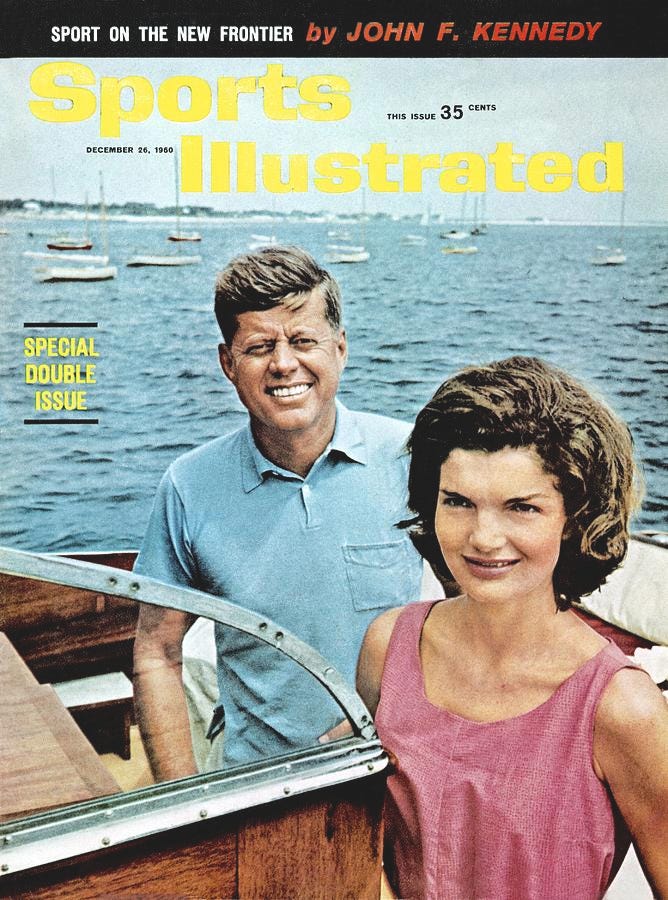
How do you kill a brand as powerful as Sports Illustrated?
It’s easy, you can do it in one just one move. You just need to embrace the most exciting, futuristic technology of the 21st century.
That’s what Sports Illustrated did. The world’s most respected sports magazine gave up on Hemingway and Faulkner, and started publishing AI slop. The editors clearly wanted to hide this—they pretended that the articles were written by actual human beings. They even created fake bios with photos for the non-existent authors.
When a journalist from Futurism asked them about this, they quickly deleted everything.
Former SI journalist Jeff Pearlman now mocks the magazine as an “empty vessel for selling sh*t to idiots and for getting people to gamble away their money on sports.”
But the damage was already done. The magazine’s reputation was on the mat, like those bloodied boxers it had covered over the decades.
Just 55 days later, Sports Illustrated announced that it was laying off most of its workforce. The media reported that Sports Illustrated would stop operations completely.
A few months later, a new publisher stepped in as savior. But there wasn’t much to save—at least as a journalism business.
The latest move happened yesterday. The new owner laid off 12% of its workforce, including several of the remaining skilled journalists from the pre-AI era. Some of them are in desperate shape.
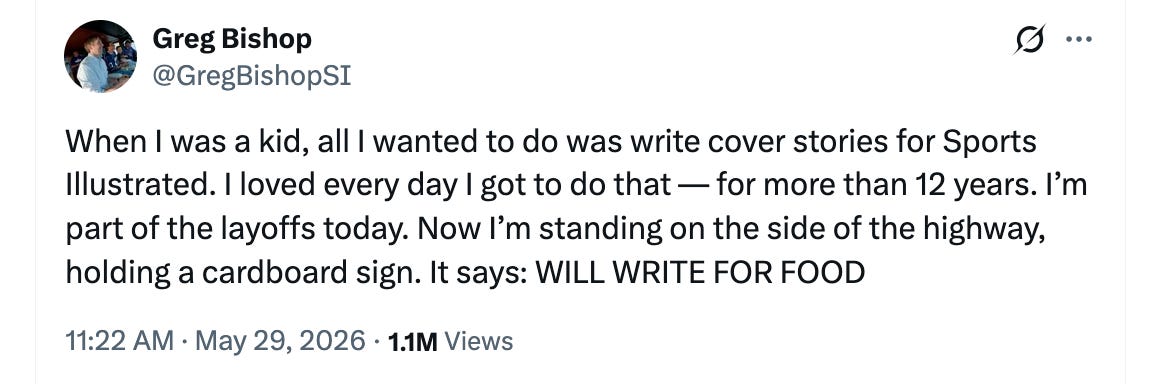
Former SI journalist Jeff Pearlman now mocks the magazine as an “empty vessel for selling sh*t to idiots and for getting people to gamble away their money on sports.”
It’s now a brand name, he insists, with nothing behind it.
That’s all Sports Illustrated is. It’s a name. It’s something to put on cruise ships. It’s something to put on clubs. It’s something to put on popcorn. Literally, there’s a Sports Illustrated popcorn.
This is what AI actually delivers in the media world right now.
The exact same thing happened to the people running National Novel Writing Month. They embraced AI—and then they soon went out of business.
You might think that others would learn from this example, but this month the folks at the Commonwealth Prize are in the process of self destructing over AI. The judges didn’t test for AI until after giving out the prize—an unwise move in the current environment.
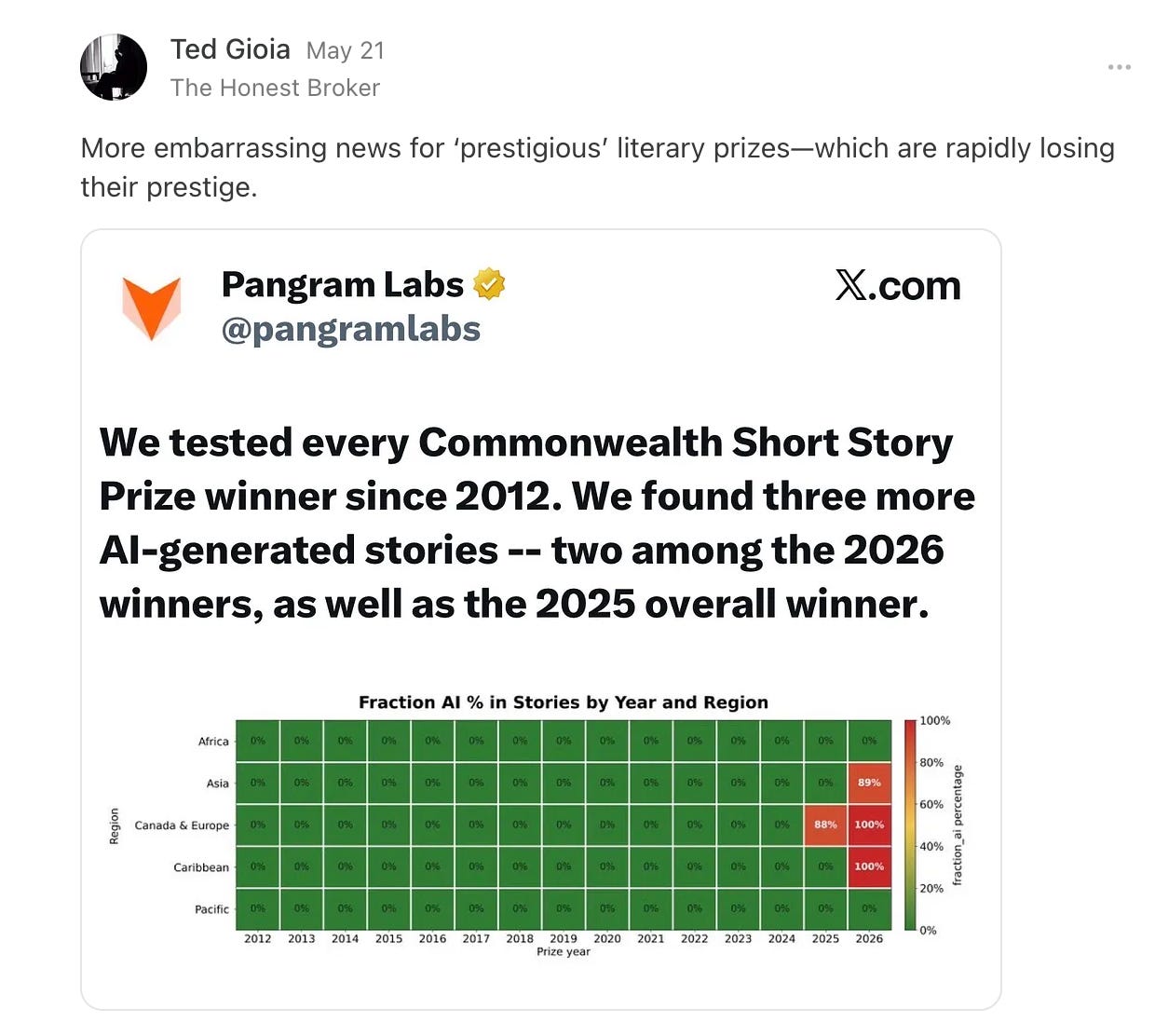
Is Business Insider now going to learn this same painful lesson?
Check out this timeline:
May 15, 2025: Nieman Lab reports that Business Insider is prodding its writers to use AI more. They have even launched an internal leaderboard—which celebrates the ten employees who use ChatGPT the most.
May 29, 2025: Business Insider announces that it is getting rid of 21% of its staff.
June 1, 2025: Semafor reports that Business Insider is asking its journalists to read books about AI—but the company recommends books that don’t exist. Yeah, AI does that kind of stuff.
August 21, 2025: Business Insider admits that it got scammed into publishing two freelance articles written by AI, and apparently filled with make-believe facts. The articles were taken down from the web.
September 5, 2025: The Daily Beast reports that Business Insider has now “quietly deleted at least 34 articles written under 13 different bylines.” It appears that the periodical had been scammed repeatedly into publishing fake first-person articles by fake people.
May 14, 2026: Business Insider announces more layoffs. This marks four years in a row with headcount reductions.
March 26, 2026: Subscription numbers obtained by Status, show that Business Insider is losing readers at a rapid pace. The number of paid subscribers has cratered from 185,000 to 135,000 in just three years.
May 20, 2026: The CEO of Business Insider resigns.
That whole ugly drama played out in just one year. Say what you will about AI, but it sure is fast.
What will happen next? Only time will tell, but if I worked at Business Insider, the first question I’d ask ChatGPT is about job openings elsewhere.
Which media outlet will be the next to discover the wonders of AI? If you’re a journalist, you better hope it’s not your employer.
We will continue to track this at The Honest Broker. That will be necessary because AI isn’t going away—although the companies that use it just might.
Henry Luce (the creator and original publisher of SI) is turning in his grave again, not having completely recovered from the butchery job that has been done to his other creations, "Time", "Life" and "Fortune".
It's a frustrating situation. But I believe the real revolution in the creative arts will be the reemergence of human voices.