
Four Steps to Hell
Can this really be the aesthetic vision of the 21st century?

Smart people have recently asked: What is the aesthetic vision of the 21st century? What are the stylistic markers of our time? What are the core values driving the creative process? What is our zeitgeist?
At first glance, that’s a hard question to answer. We are more than a quarter of the way through the century, and very little has changed since the 1990s.
Music genres have barely shifted in that time. The songs on the radio sound like the hits of yesteryear—in many instances they are the hits of yesteryear, played over and over ad nauseam.
Movies are in even worse shape. Hollywood keeps extending the same tired brand franchises you knew as a child. SoCal culture feels like an antiquated merry-go-round where the same tired nags keep coming around in an endless circle.
Publishers still put out new novels, but when was the last time you read something really fresh and new? Even more to the point, when was the last time you went to a social gathering and heard people discussing contemporary fiction with enthusiasm?
The same obsession with the past is evident in video games, comic books, architecture, graphic design, and almost every other creative sphere. Everything is a reboot or retread or repeat.
It’s not aesthetics, it’s just arteriosclerosis.
Even so, I see a new dominant theory of art—and it’s sweeping away almost everything in its wake. It already accounts for most of the creative work of our time, and is still growing. Nothing else on the scene comes close to matching its influence.
So if you’re seeking the most influential aesthetic vision on the 21st century, this is it. It’s simple to describe—but it’s ugly as sin.
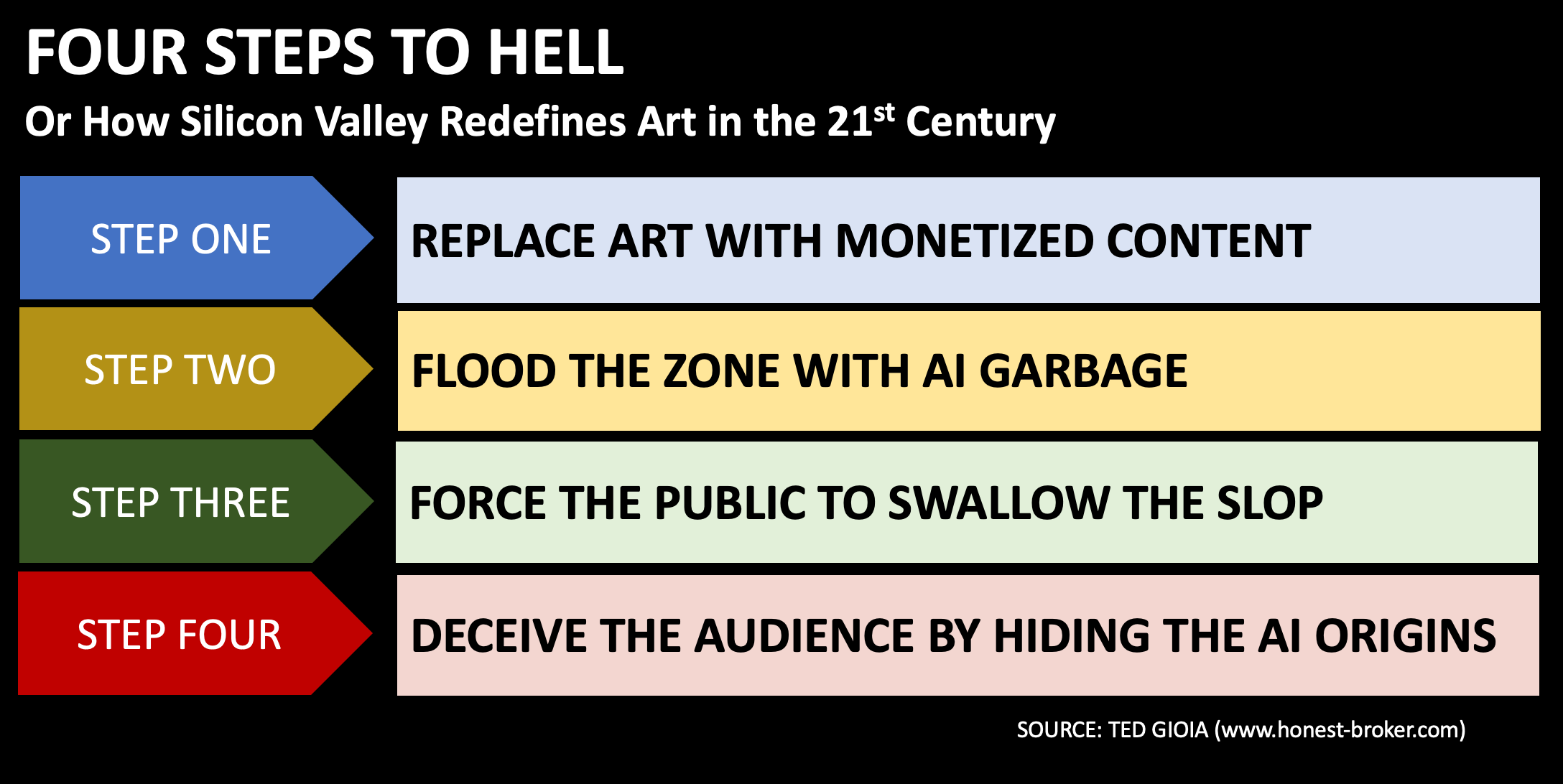
I call it Flood the Zone. It happens in four steps.
If you want to support my work, please take out a premium subscription (just $6 per month).
FLOOD THE ZONE IS NOW THE DRIVING FORCE IN THE CREATIVE ECONOMY
STEP ONE: TURN ART INTO CONTENT FOR MONETIZATION
The most noticeable thing in culture today is the replacement of aesthetic values with financial targets. In the creative economy, money is now the starting point, the endpoint, and everything in-between.
The artists aren’t doing this, it’s the overseers and the dominant platforms. They view everything as content that exists solely for monetization.
In all fairness, I must admit that record labels and movie studios have always sought profit—but not long ago they also sought prophets. So when talent scout John Hammond signed Bob Dylan (at age 20) or Bruce Springsteen (at age 23) or even earlier launched the recording career of Billie Holiday (at age 17), he obviously wanted his employer Columbia Records to make money. But that was secondary—his real goal was promoting artistry and boosting talent.
Hammond didn’t need money. He was born rich. What he sought was genius. And there were many other true believers like him in the culture businesses of that era.
That was then. And what about now?
“Record labels and movie studios have always sought profit—but not long ago they also sought prophets.”
Take some time and read interviews with the CEOs of the dominant music companies today, and look for even a hint of aesthetic vision. It’s missing in action.
Years ago, the MGM studio declared its motto was Ars Gratia Artis—which translates as Art for Art’s Sake. They still show those words at the start of every MGM film. You can read them above that roaring lion.
How quaint—a Hollywood studio with a motto in Latin.
But that lion is now roaring in pain. Ars Gratia Artis no longer passes the sniff test. What might be a more honest motto today? I’d suggest something I heard years ago—and it shocked me at the time. In fact it shocked me so much I still remember today.
I had just criticized a talented musician who had sold out, releasing an embarrassing crossover album. It was an obvious money grab, made without conviction but with hopes of a hefty payday. And I said so—but a teenager disagreed with me, pushing back with a simple rebuttal.
He told me that it was impossible to sell out because: “The art that sells best is best.”
Mull that over for a second: The art that sells best is best.
That, my friends, is the first demand of the new aesthetic—defining artistic quality in terms of profit margins. Put those sad words up above that suffering lion. Picasso had his Blue period (1901-1904) and his Rose period (1904-1906), but the culture czars of today prefer a never-ending Green period. Everything is made subservient to the almighty dollar.
That brings us to the second plank of the dominant cultural program of today.
STEP TWO: FLOOD THE ZONE
Greed can only take you so far. At a certain point you need to decide on how to make money in your creative field.
This has been a challenge for the tech platforms, because the people running them lack artistic talent and aesthetic sensitivity. But the rise of AI has given them a glimmer of an idea. Instead of making clear artistic decisions, they will just flood the zone with AI-generated content.
Dump everything on the market—then see what happens.
Under this scenario, you don’t even try to create good art. You don’t apply distinctions and criteria. You don’t exercise taste or good judgment. You don’t even try to learn one damn thing about the art form.
You just dump millions of pieces of content on the public—with predictable, but devastating results.
Amazon deceives readers with a flood of AI books pretending to be written by humans.
The AI startup Sumo is responsible for the creation of 100 million AI songs every 14 days.
A single scammer in North Carolina robs $10 million from human musicians by dumping thousands of AI songs on streaming platforms and promoting them with bots.
Visual artists see their careers destroyed because their online galleries get taken over by AI. The platforms they need to make a living turn into a toxic dumpster fire, and they have no recourse.
Media platforms delete writing by human, replacing it with boatloads of AI content designed for search engine optimization.
A new zombie internet arises—where bots conquer every available forum, every interaction, every outlet for creativity.
You can’t deny it. Flood the zone is the dominant strategy of arts creation in the current moment. And unless something happens to stop it, we will be living with the ruinous consequences for the rest of our lives.
This leads, of course, to the next defining element of 21st century aesthetics.
STEP THREE: LET THERE BE SLOP!
Creative works made in this way are inevitably slop. They are churned out willy-nilly by the millions, without the kind of scrutiny and care required to make great art. So the results are filled with pointless ingredients, stupid juxtapositions, and vapid notions.
This is, by definition, slop.
You would use that exact word if you went to a restaurant that cooked meals in this haphazard way—all possible flavors jumbled together in an inedible gruel. What is this slop? you would ask. And we now have the identical reaction when we see an image or video made with this same unappetizing recipe.
To get rid of slop, the tech companies would have to exercise discretion and good judgment. But that’s incompatible with their flood the zone strategies. So we have entered the Age of Slop, and will be lucky if we ever find a way out.
STEP FOUR: REFUSE DISCLOSURE AND PRETEND IT WAS ALL MADE BY HUMANS.
In the final step, the AI slopmasters insult our intelligence. They know how much the audience hates this stuff, so they avoid disclosure. They need deception because, without it, the whole AI business model collapses. So they pretend AI music, writing, etc. came from human beings.
This is the most revealing part of their entire strategy. It shows how ashamed they are of what they’re doing—if AI really was so great they would boast about using it. But instead they lie, and build their aesthetic vision on shamming, scamming and spamming.
We’ve now unveiled all four steps. The result is the single most destructive aesthetic vision in the history of human culture.
Are you disgusted by this? Of course you are.
But can you deny it? Is there another aesthetic movement happening right now that comes close to matching the power and influence of this four-point manifesto imposed by the technocracy on a helpless public?
This does not mean that real creativity disappears. This does not mean that great art will no longer get made.
But it does mean that
The real heroes of the creative world will be forced into operating as a resistance movement.
The actual artists will now form a counterculture.
The only sustaining work will come from the indie world, not the established order.
Those who care about culture absolutely must support this alt rebellion and indie vibe.
Our only hope is for this counterculture to rise up, and take the audience away from the technocracy. This is hard work, but I believe it’s possible. Even more to the point, it is absolutely necessary.
If you share these values, please support my work.
We must create islands of sanity and human flourishing in the flooded cultural zones. We need our own equivalents of Noah’s Ark.
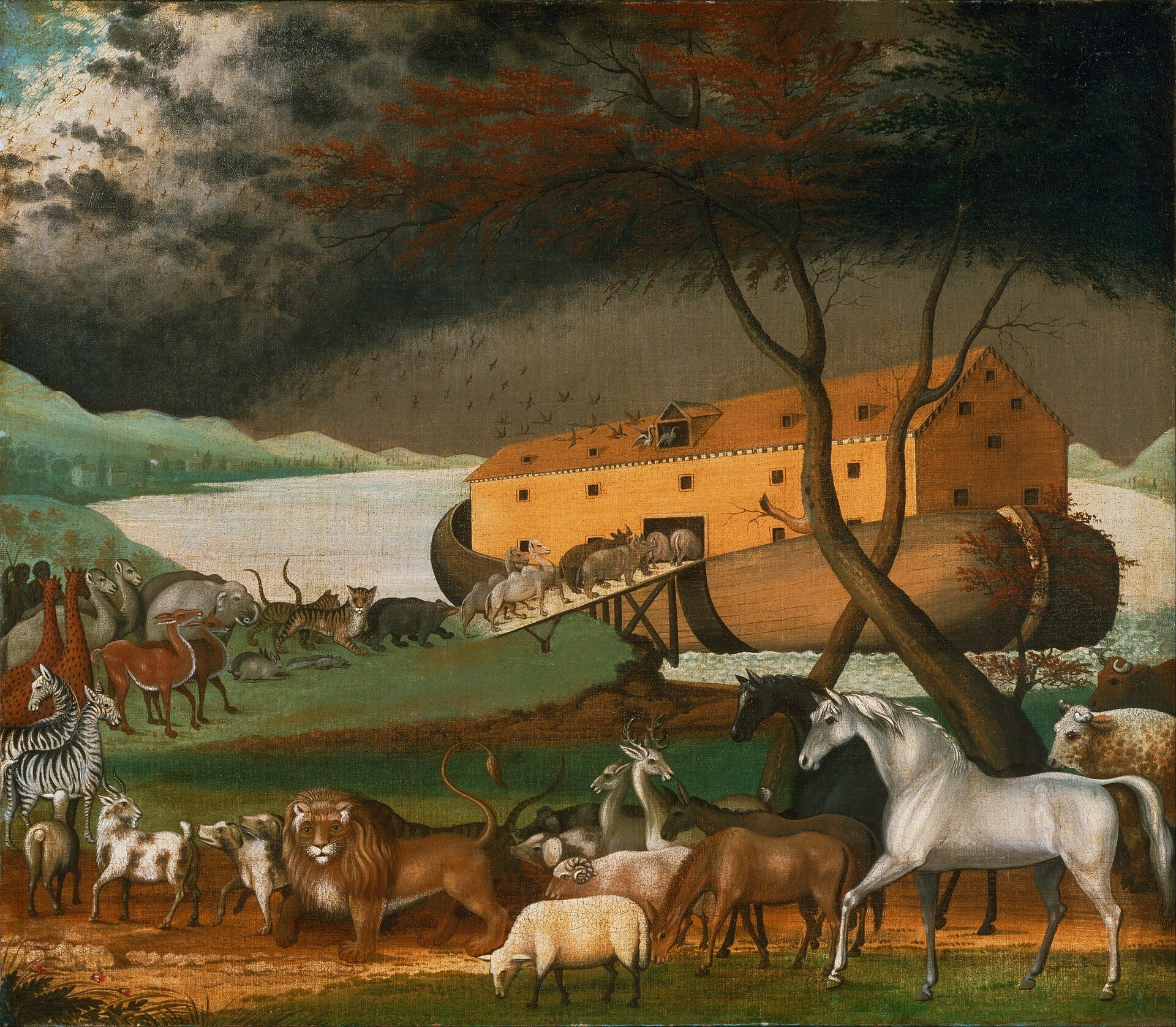
In other words, we will be creating parallel institutions. They will operate separately from the tainted platforms. The faster we make that happen, the better.
I will be writing more about this in the future. That’s necessary because this is the make-or-break challenge facing all creatives. We can’t afford to sit on the sidelines. The water is already rising and we must find higher ground. Let’s do it together.
I got caught by Spotify a week or so ago. I like Bossa Nova music, and was listening while I was cooking dinner. A cover of a pop song came on, and it was fun, and then another, and I thought...wait a minute. I looked up the artist and it was someone from Sweden? I'm pretty sure it was AI generated, so I went back to some older albums. One of the awful effects of slop is that you can't trust a new artist not to be a bot! Guarding against slop is exhausting, and it either pushes you back into your "known artist" bubble, or you just give up. There should be some way to toggle a "no AI" or "human only" choice on these platforms that I'M PAYING FOR. So many bad results from this new "art form."
I'm not sure if I fully agree with this, at least on the subject of music. Certainly mainstream music has pretty much stayed the same since the 90s, but music that inhabits the top of the charts, driven by the marketing departments at the major labels, has always been deliberately dull and banal, catering to as broad an audience as possible. But underground music, driven by small labels, run by obsessives, has always been interesting. And I would argue that's as true today as it was back in, say, the late 70s. If you are willing to dig, there is plenty of exciting, innovative, challenging music available right now on platforms like Bandcamp, YouTube, Soundcloud, Mixcloud and so on. In fact, its probably true to say that there's more available now than ever in history, much of it created and distributed by the artists themselves. But basically I agree with your article, thank you for posting it!